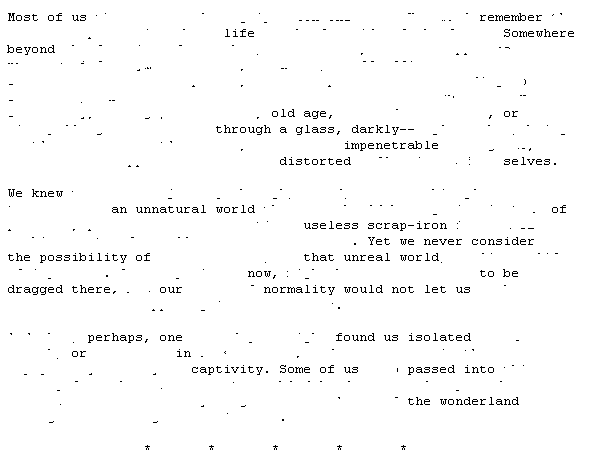
wonderland

[click image to read]

Who will remember
life beyond old age

We saw darkly— being
opposite reflections of ourselves

We knew an unnatural world
negative – passive – useless

Yet consider the possibility
of unreal life

Let us happen
in our own isolated
captivity

Some of us passed
into this fantastic
wonderland

william james on melancholy

In this letter to his 13-year-old daughter, who was struggling while away at school, psychologist William James (older brother of writer Henry James) offered his insight into what he calls melancholy, or what I would characterize as mild depression, the severity of which still allows for effective self-initiated non-clinical therapy. While I think his description of depression is somewhat dated in parts—or perhaps it’s just his wording (e.g. arising from an organism’s generation of poison in the blood?)—I also think there is some merit to his advice. Here is the excerpt that struck me the most:

Now, my dear little girl, you have come to an age when the inward life develops and when some people (and on the whole those who have most of a destiny) find that all is not a bed of roses. Among other things there will be waves of terrible sadness, which last sometimes for days; and dissatisfaction with one’s self, and irritation at others, and anger at circumstances and stony insensibility, etc., etc., which taken together form a melancholy. Now, painful as it is, this is sent to us for an enlightenment. It always passes off, and we learn about life from it, and we ought to learn a great many good things if we react on it right. (For instance, you learn how good a thing your home is, and your country, and your brothers, and you may learn to be more considerate of other people, who, you now learn, may have their inner weaknesses and sufferings, too.) Many persons take a kind of sickly delight in hugging it; and some sentimental ones may even be proud of it, as showing a fine sorrowful kind of sensibility. Such persons make a regular habit of the luxury of woe. That is the worst possible reaction on it. It is usually a sort of disease, when we get it strong, arising from the organism having generated some poison in the blood; and we mustn’t submit to it an hour longer than we can help, but jump at every chance to attend to anything cheerful or comic or take part in anything active that will divert us from our mean, pining inward state of feeling. When it passes off, as I said, we know more than we did before. And we must try to make it last as short as time as possible. The worst of it often is that, while we are in it, we don’t want to get out of it. We hate it, and yet we prefer staying in it—that is a part of the disease. If we find ourselves like that, we must make ourselves do something different, go with people, speak cheerfully, set ourselves to some hard work, make ourselves sweat, etc.; and that is the good way of reacting that makes of us a valuable character. The disease makes you think of yourself all the time; and the way out of it is to keep as busy as we can thinking of things and of other people—no matter what’s the matter with our self.

As I mentioned above, this advice could be helpful even today for those who are suffering from mild depression. For the clinically depressed, of course, this advice is not sufficient. I’m also not sure how I feel about the way James lightly disparages those who embrace melancholy. On one hand, I can see his point, in that this outlook does direct inward and tends to stay there, where it can fester and corrode our “character” as he puts it. However, I also believe much can be learned from intense self-examination, and if our first instinct when feeling ourselves slip inward is to deny this and instead seek out others to “speak cheerfully” with, then I think we lose out on a possible learning experience. There is also the vast canon of visual art, music, and writing generated by so many melancholic individuals to consider. Were these people to put down their pens, brushes, and instruments whenever they started feeling blue so they could instead go chop some wood or chat with their neighbors, think of what a loss to the world that would be.

Maybe I am taking James out of context, or over-analyzing his advice; after all, he was trying to cheer up his daughter, not writing a treatise on depression. Unfortunately, he’s not here to clarify his thoughts. Interestingly, James himself suffered from chronic depression, and was at times suicidal. I wonder if he ever tried taking his own advice, or if his depression was too crippling to be helped by it.

human dust

[click image to enlarge]

© 2012 S. D. Stewart

Erased from Ch. XXVIII of Nerves and Common Sense (1925) by Annie Payson Call

Audio of reading:

the quiet, the quiet

© 2012 S. D. Stewart

Erased from Ch. VII of Nerves and Common Sense (1925) by Annie Payson Call

Some live in chronic time.
They do not find it,
they do not find it and they get ill.

It is really much the same,
keep a little stimulant
keep a bad habit.
We feel unnatural if we feel natural.
We are in it—but it is poison.

If a habit of
rocking or chattering
may feel unnatural and weird,
we wrench out these things
and yet the poisoning goes on.

When we are in a pretty bad way,
the worst know it.

I once lived in excitement,
dressed in excitement,
went to breakfast in excitement,
went about everyday excited.
Every event—little or big—was excitement.
Excitement over nothing.

We went deep in the woods and the mountains,
full of great powerful quiet.
When first there, excited about arrival,
excited about it,
but the night jumped in with torture.

I suddenly started up the trouble.
‘Oh, oh, the quiet! It is so quiet!’
Brain in whirl of excitement
felt pain when excitement touched it.

r___ed f__ling

© 2012 S. D. Stewart

Erased from Ch. III of Nerves and Common Sense (1925) by Annie Payson Call

sorry but this person is dead and could not answer*

In the calm before this storm Foxtrot yet wanders the sky, shining its central eye into my hidey-hole. State of emergency in a place riddled with emergencies, a place where every day is an emergency and we pack our kits in our minds just to make it to day’s end. Listening to songs about erasing it all and hearing the calm outside. And we wait for wind. And we wait for rain. But right now all I hear is you breathing, on the floor, in black-and-white pose.

What will come in another day. Another two. I don’t know. It’s a time of year I do know. It’s the beginning of another end. I used to not even think about it. There have been so many other moments. But can you name just one. I see so many in my mind but I doubt I even lived them. Spectators spectating, dissolving from others’ memories before they are even written across the cerebellum. And the brainstem builds our dreams. And it also tells us we are hungry. But can it know when we are hungry for our dreams?

A long time ago there was a band we went to see in the bottom of a funeral home or maybe just a church. This band’s name was Sarabellum. We huddled on the green carpet and watched and learned. This memory of Sarabellum remains imprinted, though not on my cerebellum, more like my cerebral cortex, likely the prefrontal. So many lobes, so little time.

Where is that liferaft of hair I built. I will need it when my basement floods. I will need it when we are gone and all that is left are the strands of your hair I find everywhere. I will need it to ride out the crescendoes of noise trying to drown out all other sounds. I will float on sound, on my raft, like Huck Finn, down the Mississippi metaphor. And maybe someone will sing this song for us when we are gone. Maybe when this song erases everything else, it will keep on playing and never stop. And it will be us and we will be it and that is all.

*Google Image Search leading here, where this image does not exist

tuesdayish

On Walking Backwards

My mother forbad us to walk backwards. That is how the dead walk, she would say. Where did she get this idea? Perhaps from a bad translation. The dead, after all, do not walk backwards but they do walk behind us. They have no lungs and cannot call out but would love for us to turn around. They are victims of love, many of them.

–Anne Carson, Plainwater

Couples who walk around with their hands in each others’ back pockets proclaim a clear statement, I think. And that statement is, we don’t mind you watching us grab each others’ butts.

There are ghosts. And they haunt us. This can happen in nontraditional ways.

People work harder to make their lives easier.

At work we now have the same meeting every week, but every other week it is called something different. This, I believe, is some kind of trick.

I am waffling over something, and this makes me hungry for waffles.

Sometimes a piece of mail can frighten you. Imagine the worst, then wait awhile to open it. I don’t advise this.

Plans make me nervous. Once I’ve made a plan or been made aware of a plan that involves me, I often secretly wish for it to unravel. I’m not sure why.

Open statement to any UK policy-makers landing here as a result of a Google search:

Please don’t cull the badgers.

a tribute to conrad

Sometimes I look people up on the Internet, people whom I have lost touch with, yet periodically wonder about. After years of doing this, I have found that the people I tend to befriend are often not people with much Web presence. So, in general, this practice is frequently frustrating and, in most cases, fruitless. Sometimes I stop trying.

Today I again looked up my friend Conrad, a compatriot from long ago, and one whom I’ve never had much luck in tracking down before. And so I was shocked this time to find an obituary for him from almost two years ago. He was only 33.

I met Conrad in the dishroom of a large university’s student food court. We both worked there, and during my three years of periodic employment at that hellhole, he was my closest friend. We used to spend our days plotting to overthrow the management. We planned to mount towering Gothic thrones for ourselves in opposite corners of the dishroom, from which we would reign over our kingdom. We grew giddy from drinking too much Josta cola.

Conrad had a vivid imagination and a wicked sense of humor. He was generous and kind. From what I observed he was also quiet and rather withdrawn with most people. He loved comics, movies, and video games. I remember him being obsessed with Spawn. We shared a deep-seated love of the film Repo Man. He even made me a cassette of the soundtrack, which I still have. He liked Iggy Pop and Saturday Night Fever. Sometimes he would even dance like John Travolta in the privacy of the dishroom. He often wore black…maybe even always.  He was creative and liked to draw, but he was self-critical to a fault. He had talent, but didn’t seem to believe it and would viciously criticize his own work. It didn’t matter if you told him otherwise.

We goofed off a lot at work. It was a crap job and there was a lot of down time. We were young and belligerent. We’d go to the basement of the building and Conrad would do pull-ups on the pipes. He was in good shape and his arms looked strong. I remember going to his apartment once and he showed me some of his drawings. I pestered him to see them, and he finally relented. It felt to me like he was exposing some part of himself that he rarely did, and that meant a lot to me. He came to my place once, too, and played Scrabble with me and my girlfriend. I took a photo of him there, sitting on the couch, dressed all in black and scowling like Bela Lugosi at the camera.

I wish I could remember more about Conrad, the things he said, because he was so funny. But it was so long ago, what feels like a few former lives prior to this one. I have in my head a few bits and pieces of conversations we had and I still keep those close. In my online searches, I came across only a few pages referencing him: a guestbook from the funeral home where members of his family had left messages; a page on deviantART where his cousin (a noted comic artist), whom he had lived with back when I knew him, had posted news of Conrad’s death and written a bit about his interests and artistic skills; and a handful of illustration credits from role-playing adventure games. I was happy to see that he’d published some work. I hope that had boosted his self-confidence.

Conrad was one of those regretted lost companions, for we connected on a certain rare level. I used to send him my zine after he moved back home, but I never received anything in return. I even based a character on him in a crappy novella I wrote some years back. He left an impression on me, and I’m sorry that I didn’t get to know him better than I did. He wasn’t easy to get to know, though; he was rather private and sort of a loner (like me, I guess), and I was also young and confused, aloof and distant from my own emotions.

I don’t know how Conrad died and I suppose it’s not that important. I don’t know what it is that makes us wonder about cause of death. I guess part of it is that he was so young. I don’t know if he was sick, or how much he suffered. Maybe some of this is morbid curiosity, from which I am not immune. But mostly it’s wanting to know how he was in his final days and wishing he was not in pain. All I know from reading the obituary is that he died at home, and I hope that means he was comfortable and with his family. But I don’t know that. I didn’t know any of his family, either, so I guess this mystery will remain.

He was a good person, a true friend, and I won’t forget him.

© 2012 S. D. Stewart

Repo Man Soundtrack b/w Dead Kennedys Plastic Surgery Disasters (and a little bit of Fever)

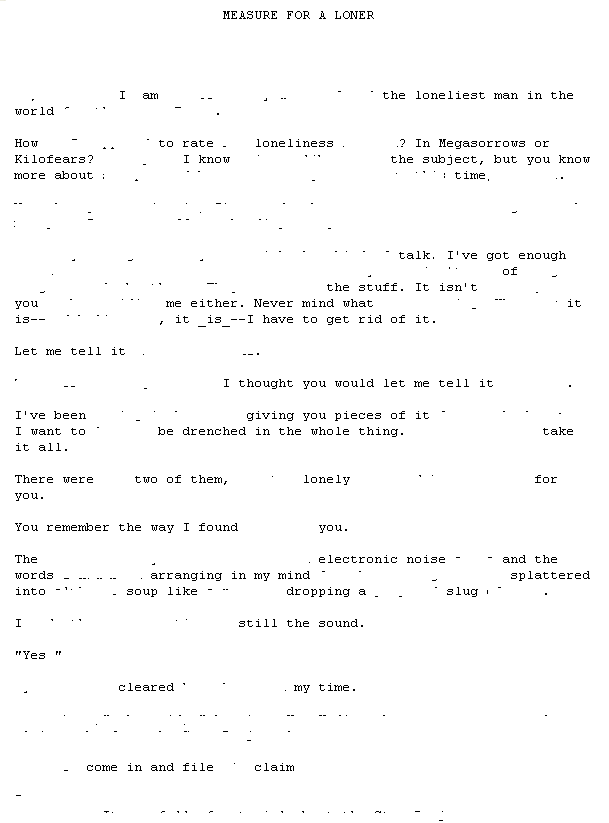
measure for a loner, erased

[click image to read]

© 2012 S. D. Stewart

Erased from the 1959 science fiction story by Jim Harmon, aka Mr. Nostalgia

lunchtime trip to the ♥library♥

© 2012 S. D. Stewart

My weekend looms…

  • Recent Posts

  • Navigation Station

    The links along the top of the page are rudimentary attempts at trail markers. Otherwise, see below for more search and browse options.

  • In Search of Lost Time

  • Personal Taxonomy

  • Common Ground

  • Resources

  • BOOKS BOOKS BOOKS