lemonade

The double take impregnated desire in both parties. Or did it.

(We’ll suck on that sugar-coated lemon for the remainder of our days.)

In dreams they meshed well, swimmingly even, though waking life led only to the double take, and once a brush of limbs.

Their twinned desire, limned in mind alone, clashed like rutting stags. From their invisibly ravaged bodies a horn or two broke off in a fugue of predestination.

(Perhaps you found one in the woods and thought of them.)

At the party one befriended a dog while the other dematerialized with a stranger.

Stranger things have happened. It’s an old story and doppelgängers may have been involved.

lydia davis on fragments

To work deliberately in the form of the fragment can be seen as stopping or appearing to stop a work closer, in the process, to what Blanchot would call the origin of writing, the center rather than the sphere. It may be seen as a formal integration, an integration into the form itself, of a question about the process of writing.

It can be seen as a response to the philosophical problem of seeing the written thing replace the subject of the writing. If we catch only a little of our subject, or only badly, clumsily, incoherently, perhaps we have not destroyed it. We have written about it, written it, and allowed it to live on at the same time, allowed it to live on in our ellipses, our silences.

—from her essay ‘Form as Response to Doubt’ in HOW(ever) Vol 4, No. 2 (October 1987)

the end of the beginning

She looked different from every angle, causing no one to ever remember her. She divided her time between this and that. There were long walks to nowhere. There were staring-out-the-window reveries lasting for hours until a thin string of drool hung from a mouth agape. As evening’s loam drifted down around her, rooting her further in place, she closed her dry mouth and prepared for bed.

She woke up at the same time every day with high ambitions. By the end of breakfast these were dashed to pieces on the great hulking boulders of the afternoon hours, casting their dark shadows as they always do across the glowing yellow light of daybreak. She dressed herself regardless. Her uniform consisted of a shapeless grey jumpsuit and knee-high rubber boots. It is possible that birds nested in her hair. Yet on certain days she looked neat as a pin. Without her uniform, in fact, she looked like most anyone else. It all depended on the angle.

She eked out a living by teaching small children how to pour without spilling. It was one skill she had perfected before she realized the entire system was rigged. Her services were very much in demand, for most parents did not want their children making a mess, while at the same time they were ashamed of their own inability to pour without spilling. Thus they were determined to give their children the one chance they never had, to progress through life without the need to always mop up the table after serving drinks.

Her one true friend was a mollusc named Boil that had lost its shell and now spent its days at the coffee shop down the street from her quarters. The mollusc was irascible in temperament but tolerated her, for she would stroke its foot when it grew apoplectic. Most days she and Boil sat in the coffee shop drinking espresso and waiting for the day to end so they could go home and go to bed. They filled this time among the hulking boulders by doing crosswords and spitting on other customers when the barista wasn’t looking. The barista, a morose badger named Larry, disliked Boil. The feeling was mutual, in fact, for it is well known that badgers and molluscs are natural enemies.

This was her life. She was sure the beginning had ended at some point. But when and where that had happened remained elusive. When she was young she remembered playing with molluscs in the tidal pools at the ocean beach. She never dreamed that after the beginning of the end she would find herself spending most days drinking coffee with a mollusc. Things have a way of coming full circle, though, don’t they, she thought. But was there a hand other than her own drawing that circle, this she also wondered as she walked. And then the window. And then the drool. And then the blinding yellow light shattering the boulders, grinding them to fine powder, the fertile loam of her life.

happy holidays

She stepped outside to smoke and the cigarette began to complain about the plight of its kind. We are oppressed, it said. We are pariahs, it continued, and we reject our role as straw man for the cancer industrial complex. While she did not necessarily disagree with the cigarette’s point of view, its continuing monologue made smoking difficult and so she extinguished it, a revolution snuffed out before it ever began.

Prior to this incident she used to walk and smoke at the same time every night. Not wishing to spark revolt, she soon gave that up.

After all, she thought, routine will either save us or kill us…or perhaps both, and possibly at the same time.

monday fuzz

What is this dialect—tearing the oilskin remnants of time—the sun a hot dripping ball of wax sealing shut another sudden day—a new place a new suit a new matchbox—walk this gauntlet overshadowed by a pair of rotors and a smile—another scene stuck in a feedback loop—(hey who let all these gnomes out in the desert)—welcome to distortion a normality found in the far reaches of a certain type of mind—if it makes sense do not r e p e a t do not report it—a pattern of melancholy strung up like twinkling lights throughout the ages—now we enter the cloud chamber now we genuflect to the amplifier—to celebrate a sudden soaring up of souls on waxen wings of failed entrepreneurs—now there is this feeling this feeling of looking up at lights in windows from sidewalks sewn lifetimes away—a hurt that feels too good not to press on a little—our survival depends on this twisted nest feathered with compulsions—and we pass through the gates—(having entered as sound, blind)—we board the vessel and wait—what ho, off the starboard bow is it Scylla is it Charybdis or is it nothing at all nothing at all—(we exit as light, deaf)—next time take the train it’s said to be more scenic—wait everything changed again—wait wait there is no next time.

quiet person day

Today (i.e. whatever day you’re reading this) is the day when we celebrate the quiet person. The quiet person among us is often overlooked and even scorned. This occurs for many reasons, all of which are rooted in the very nature of being quiet. Quietness can be interpreted as a supernatural state. This has caused problems for certain quiet people. Back in the day, the quiet person was often suspected of witchcraft and either burned or crushed to death under large boulders. Throughout history, quiet people have been perceived as oracles, goddesses, world-creators, world-destroyers, saints, sinners, aliens, demons, angels, lunatics, et cetera. An urge to fear the quiet person presents itself. The quiet person rarely speaks unless spoken to. What is going on in their heads. How menacing. Some people think this means the quiet person is a snob. In fact, often a quiet person will open up like a rare flower (e.g., an orchid) when spoken to. Or the quiet person will simply wilt into a pile of rotting organic matter. You’ll never know which unless you try.

Some people think the quiet person has no opinions, but get that person alone and look out! You will not believe the endless stream of words flowing forth from the quiet person. You may wish you had never engaged the quiet person in conversation. At times during this ‘conversation’, it may seem like the quiet person has been possessed by some manic force. When will this person ever shut up, you may find yourself wondering, I can’t get a word in edgewise. However, the quiet person is usually smart and insightful (if you have the right decoder ring), leading you instead to wish you’d not previously overlooked this person. In fact, you may wish you could bottle the quiet person’s wisdom and keep it with you at all times, so that you could take it out when needed and breathe deeply of its essence. Too bad for you that is not possible (yet). Besides, that’s just being greedy! It’s not your place to package the quiet person into a commodity to be bought and sold on the open marketplace, you capitalist bastard. The quiet person will resist the tyranny of your economic systems!

Unfortunately, the quiet person can be perceived as ‘creepy’ or ‘weird’ due to an inherent tendency to hang back and observe instead of participate in whatever inane activity the non-quiet people are currently engaged in. This is blatant discrimination. Quiet people are not all serial killers. It’s unfortunate that the description ‘seemed nice, kind of quiet, kept to her/himself‘ can apply to both sociopaths and non-murderous quiet people. Being quiet carries a heavy stigma, whether the loudmouths among us realize it or not. So step off, fools.

To help celebrate this important day, here are a few helpful suggestions on how to honor the quiet people in your life:

1. Leave them alone. (Can’t go wrong with this one, folks.)

2. Smile and nod at them in tacit approval of their right to remain silent.

3. Refrain from ‘volunteering’ them for public speaking.

4. Do not suggest that they ‘mingle’. They’re leaning against that wall for a reason.

5. Excuse them from any ‘icebreakers’  or other forms of forced socializing (see #4 above).

6. Learn to read minds so that they are not forced to articulate their thoughts.

7. Stop asking them to speak up all the time. Instead consider buying yourself hearing aids.

8. Engage in a ‘not-talking’ contest with them. (And don’t be a sore loser, chatterbox.)

9. Invite them to a mime performance.

10. Do not assume their quietness equates to a dislike for you.

alain robbe-grillet

Speaking of his autobiography in a 1985 interview with The Paris Review:

INTERVIEWER

Some people like the theory of literature contained in the book above all.

ROBBE-GRILLET

Indeed! Which is the continuation of what is in my novels and my theoretical works. None of these points is indifferent to me, at the same time none really interests me. What does interest me is the weaving of all these different elements in the book; the way they mix in movement, constantly shifting and changing, as if they were fragments of me. When I think of myself, I feel that I am made up of fragments in which there are childhood memories, fictional characters I particularly care about—such as Henri de Corinth—and even characters who belong to literature and with whom I feel I have family ties. Stavrogin of The Possessed and Madame Bovary are related to me exactly as my grandfather is, or my aunt. So it is the way all these figures move and refuse to be fixed that excites me. Well, at least that is what I say today. Another day I might say something different!

[…]

I am certain that a novelist is someone who attributes a different reality-value to the characters and events of his story than to those of “real” life. A novelist is someone who confuses his own life with that of his characters.

malone dies

[…] but I know what darkness is, it accumulates, thickens, then suddenly bursts and drowns everything.

I myself am very grey, I even sometimes have the feeling that I emit grey.

—Samuel Beckett, Malone Dies

more connections, failed and missed

Failed Connections:

[Codependent]  You:  Full of myself.  Me:  Full of yourself.

[Narcissistic]  Me:  Full of myself.  Me:  Full of myself.

Bonus Missed Connections:

[Linear]  You:  Forever first in line.  Me:  Forever last in line.

[Nonverbal]  You:  Always talking.  Me:  Always listening. *

*File also under: Failed Connections

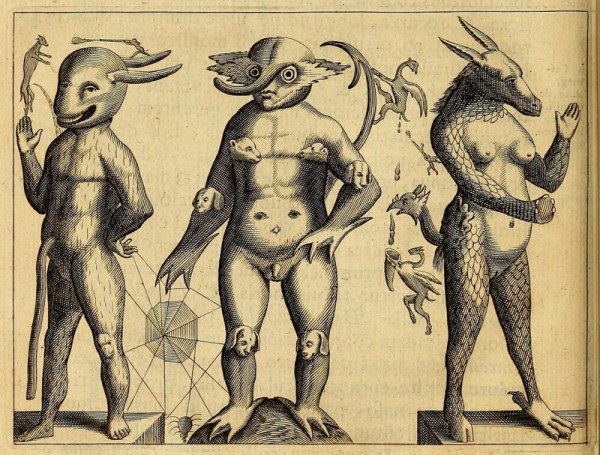
Fortunio Liceti’s De Monstris (1665)

De Monstris

Click image to see more ‘monsters’.

Found lurking in my RSS reader, courtesy of the always fantastic Public Domain Review.

Full-text of De Monstris available at Internet Archive.

  • Recent Posts

  • Navigation Station

    The links along the top of the page are rudimentary attempts at trail markers. Otherwise, see below for more search and browse options.

  • In Search of Lost Time

  • Personal Taxonomy

  • Common Ground

  • Resources

  • BOOKS BOOKS BOOKS