the blind owl by sadegh hedayat

It was always my opinion that the best course a man could take in life was to remain silent; that one could not do better than withdraw into solitude like the bittern which spreads its wings beside some lonely lake.

–Sadegh Hedayat, The Blind Owl (translation by D. P. Costello)

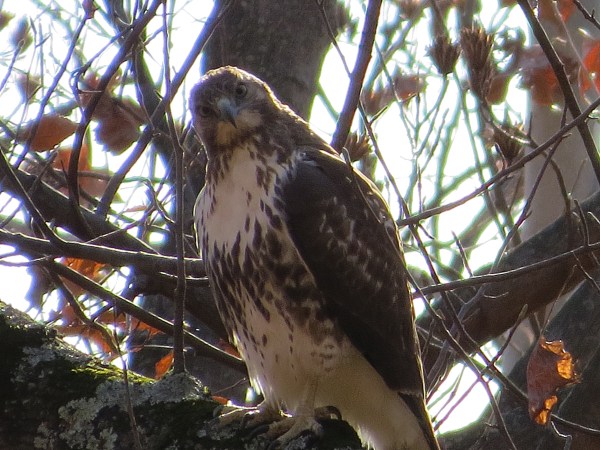
juvenile red-tailed hawk

Red-tailed Hawk, © 2015 S. D. Stewart

Red-tailed Hawk (immature)

morrissey

Debut Solo Gig (Farewell Smiths Concert) Wolverhampton Civic Hall

Debut solo gig / farewell Smiths concert – click to watch – the band comes on stage at about 12:00

crows on a fence

Crows on a fence, © 2015 S. D. Stewart

diminuendo*

One feels a certain compulsion to vanish into incomprehensibility. To pack up meaning into a suitcase and shove it under the bed. Nothing said or written can be understood. Therefore I understand nothing, and yet I am no longer concerned. The questioning strain withers on the vine. The inquiring train stops dead on the tracks. This concern of yours is no longer mine. Neither is mine yours. What concern is or ever was. Definition, please (irony!).

Concern (noun): (1) something that relates or belongs to one; (2) matter for consideration; (3) an uneasy state of blended interest, uncertainty, and apprehension (Source: Merriam-Webster [truncated from original]).

Imagine a life lived in this uneasy state: perpetual ‘concern’ over various undiminished ‘concerns’. Imagine this state existing inside a stopped train, or clinging to a dead vinedangling from said vine, about to fall but never indeed falling. Imagine inhabiting an indefinable state while trying to define it. For what purpose.

An enormous sense of loss yawns following a century of troubled sleep. I stick my finger in its cavernous mouth as a joke. It is not amused. Down my throat this finger crawls to oblivion, causing grave intestinal distress. The gut: canary in the coalmine for all imbalance in the bodya dark coiled mystery we prefer not to unravel (think about how long it is). When what happens in the gut stays in the gut we are in trouble. Serious trouble.

A portrait materializes of a mind in a state of atrophy. Stare upon it, cock one’s head to either side (it doesn’t matter which), place one’s chin upon one’s fist (your choice), and consider the mind’s half-life. When it fails to half warning signs erupt. At this point one must choose the route of optimist or pessimist. The half-life point. Mind semi-intact. From this point forward one can lead a life half-lived or not lived at all. Half-lived is better than not lived, right. Or what about living a life half-filled or empty. What is it like to live a half-filled life. Filled with what. Quality over quantity is preferred, is it not. Emptiness is not.

Welcome home to what’s no longer home (or welcome, for that matter). Adjust to institutionalized maladjustmentthese building blocks of lifeelements assembled from a dusty kit unknowingly on factory recall. Build a nest inside the trap. Line it with a soft layer of denial. Once comfortable forget what has never been remembered. Forgetting in advance lessens the pain, though it will still require tending. Pain always requires care and protection. Songs of the past frighten off intruders. Sing yourself to sleep. Ignore the ghosts wandering the halls. They want nothing from you.

*1987 LP recorded by Scottish band Lowlife

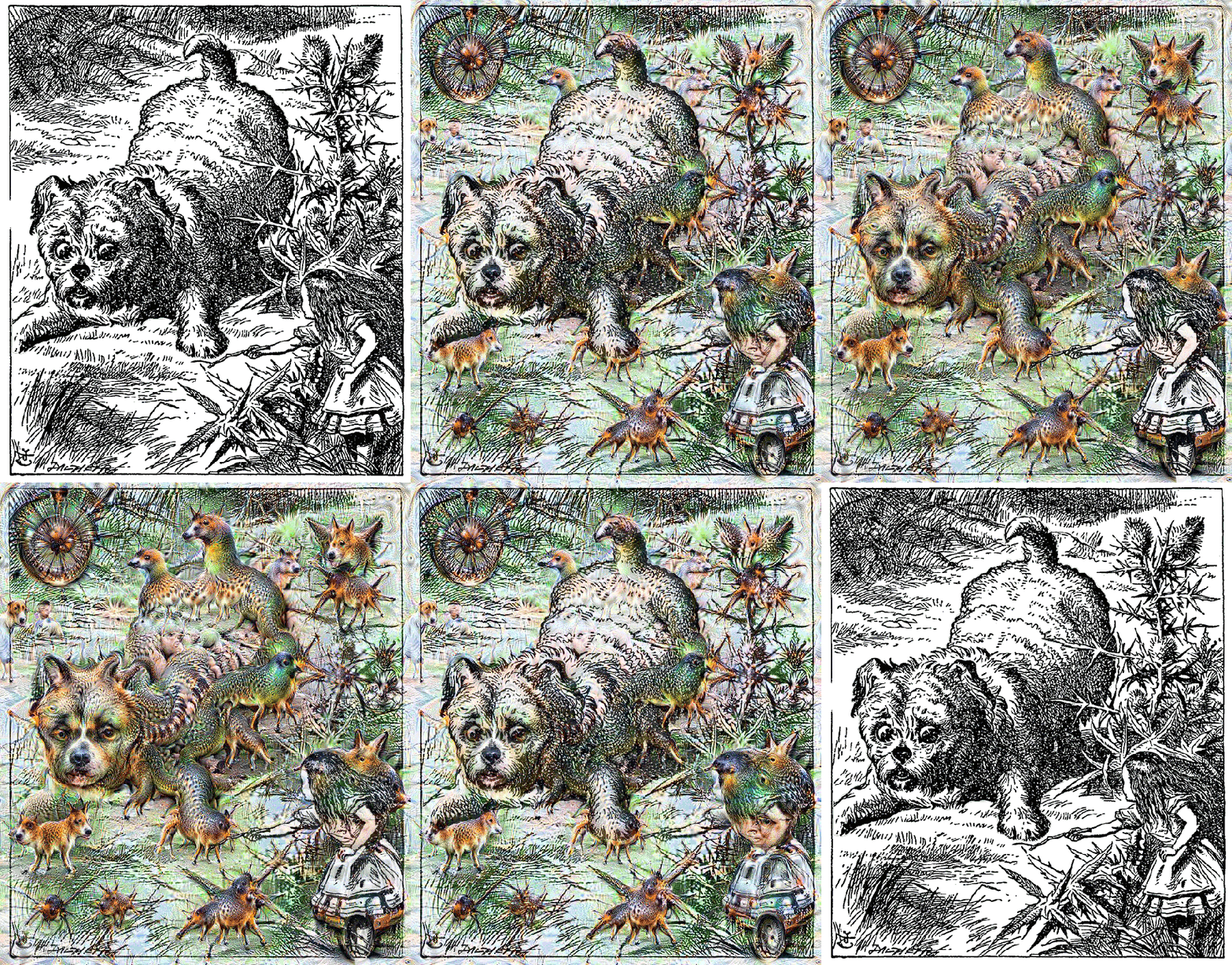
150 years of alice’s adventures

Illustration remix by Anna Vignet.

Illustration remix by Anna Vignet from Alice’s Adventures in Wonderland, an online annotated edition featuring twelve Lewis Carroll scholars taking one chapter each, plus new artwork and remixes from classic 1865 and 1905 illustrations. A joint project from The Public Domain Review and Medium, on the occasion of the story’s 150th anniversary.

spiral of silence — ‘across’

Belgian coldwave band Spiral of Silence.

self-medication with music

More evidence of the mysterious power of music…

Maybe most notably, patients listening to music used significantly less pain medication. Meads says, on average, music helped the patients drop two notches on the 10-point pain scale. That’s the same relief typically reported with a dose of pain-killing medicine.

personality and musical preferences

Do you love folk music? It may be due to your empathetic nature. A new study in PLOS One shows there is a relationship between musical preferences and personality, as well as how we think.

(That is clearly the most journalistic lead I’ve ever written on this blog. Absurd! Who do I think I am.)

Recent reports on the study have appeared in The Atlantic, the BBC, and on NPR.

Says The Atlantic:

[Study author] Greenberg found that people who scored high on empathy tended to prefer music that was mellow (like soft rock and R&B), unpretentious (country and folk), and contemporary (Euro pop and electronica.) What they didn’t like, meanwhile, was “intense” music, which he classified as things like punk and heavy metal. People who scored high on systemizing, meanwhile, had just the opposite preferences—they kick back to Slayer and could do without Courtney Barnett.

To get even more specific, the music empathizers liked tended to be softer, more depressing, and have more emotional depth. Systemizers, meanwhile, grooved to things that were high-energy, animated, and complex. Empathizers liked strings; systemizers liked distorted, loud, and “percussive.”

Loving both mellow and intense music apparently indicates my empathetic systemizing nature. I straddle the line, which I already knew. But what I’m curious to know is if at any given moment musical preference can indicate current capacity for empathy. For example, if I’m listening to Skinny Puppy would I be less inclined to listen to someone’s troubles than if I were listening to Nick Drake?

from ‘the air we breathe’ (gabriel josipovici)

Then she was quiet and they were walking together, crossing the Luxembourg Gardens the sun was disappearing behind a thin film of grey the air was cold she started to shiver but he didn’t seem to notice it was as if he had come out with the express purpose of finding her and now he was taking her back and perhaps it was like that he had always had that sort of taciturnity, as if speaking was painful and silence too she wanted to take his shoulders stop him turn him round look into his eyes and ask him what he was doing what they were doing where they were why he was so sure she would go with him that she had nothing else to do the day to give up to him no other friends to see or work to do that she too had just come out for the same express purpose of seeing him finding him returning with him she wanted to look into his eyes ask him to explain but what was there to explain that was always what happened always how it was there was the need to explain to understand and then nothing to explain nothing to understand but still the need persisted and it was as if this nothing was what had to be understood how it could be nothing and something both together and at the same time so that it was as if a hand had taken your heart and squeezed it and it slipped up and out of your hand like a fish you had to hold it you had to press it you caught it again and again it jumped you would never catch it and

–Gabriel Josipovici, The Air We Breathe

  • Recent Posts

  • Navigation Station

    The links along the top of the page are rudimentary attempts at trail markers. Otherwise, see below for more search and browse options.

  • In Search of Lost Time

  • Personal Taxonomy

  • Common Ground

  • Resources

  • BOOKS BOOKS BOOKS