virginia woolf on words

How can we combine the old words in new orders so that they survive, so that they create beauty, so that they tell the truth? That is the question.

It is only a question of finding the right words and putting them in the right order. But we cannot do it because they do not live in dictionaries; they live in the mind. And how do they live in the mind? Variously and strangely, much as human beings live, ranging hither and thither, falling in love, and mating together.

Regrettably the audio recording of Virginia Woolf’s discussion on ‘the mysterious demands and duplicity of words’ has been removed from the BBC archives due to copyright restrictions. I found a transcript of the recording here, though, and it is a good read. Until the copyright police yank it down, there is also this excerpt of the recording on YouTube:

digging in the shade of the vowel tree

Sylvia Plath wrote of
intolerable vowels
entering her heart
but what of ruthless
consonants headed
to our brains.

We all know about a-e-i-o-u and sometimes y. They may be intolerable but their numbers are small. And they are more easily made to do our bidding. The consonants, in contrast, are legion and their rigidity stifles. Perhaps the only way to harness their true power is to one-by-one start taking them away.

Anna Kavan wrote:

I had only learnt how to be friends with shadows; it might be too late to learn the way of friendship in the sun.

Friendship in the sun is a mirage. The way to it is false. The sun fades color and one day it will kill us all. Shadows make easy friends: we pass through them as they do through us. Few stay long. It is their nature. Sometimes it feels like it is in all our natures to expand and contract, pull away and grow close, like a squeezebox played by a jittery ghost.

Kafka wrote:

No one will want to lie in clouds of mist with me, and even if someone did, I couldn’t expel the mist from my head.

This gets at the heart of the problem, I think. One feels an isolation and maybe a desire to connect, sometimes even a desperate mania. But who can share a dreamy solitude? By definition, no one. And if it was at all even possible, the mist remains. How could we find each other. How could one’s dream self operate in reality? The pilot seat in your head is unlike the one outside of it. Out there, we cannot twist the knobs, adjust the instruments without consultation, without repercussions, without the sun blinding us. In the shadows, the mist, these difficulties melt away.

Jung wrote:

A man can hope for satisfaction and fulfillment only in what he does not yet possess; he cannot find pleasure in something of which he already had too much.

Yikes, Carl, that’s bleak, even by my admittedly generous standards. In fairness, on the next page of Modern Man in Search of a Soul, Jung also states: “The needs and necessities of individuals vary. What sets one free is for another a prison.” So I guess one could argue that for some people overindulgence sets them free, although I don’t think that’s his point with the former quote. I think it is about anticipation. Jung is talking about this concept in the context of the development of analytical psychology, and yet it stands out in the text as such a sweeping statement. But I don’t think this aphorism or whatever you want to call it can be universally applied. Certainly competitive eaters don’t find pleasure in the 18th hot dog in a row that they’ve shoved down their throats. But can Jung honestly think that attaining the love of another person does not lead to satisfaction and fulfillment? I mean, I will grant him that unrequited love is an exquisite thing, and possibly more intense on the whole than many long-term relationships. But no satisfaction and fulfillment for those in love? I don’t know, maybe he is not including love or other emotions here. Maybe he is referring strictly to material things, in which case I willingly concede his point.

Édouard Levé wrote:

The full weight of depression comes on between 1-5 PM, particularly when I am home by myself. Mornings and night are more filled with promise.

Filled with promise. Is that what we are after? Moments filled with promise? Is it merely the anticipation we crave, what Jung says we can find satisfaction and fulfillment in? Anticipation can be tantalizing, I’ll admit. But how. How can we be satisfied with mere promise. Inherent in promise is a pledge to fulfill at some point in the future, not at the moment of the promise. Like an IOU. Is it the step we take to accept the promise that is meant to satisfy? Is it the mental and/or emotional trust fall we allow ourselves to take? If so, what of broken promises. Do those negate the previous gain in fulfillment? Well, do they, Jung? If he were here, I’d have more than a few questions for him.

Levé also wrote: “Above a certain height I like what I see. Below it I don’t.” I suppose we can read this on a literal or a metaphorical level. What is the certain height. And is it a chronological point, a philosophical one, a spiritual one. Who knows. I think we can safely say, though, that whatever the certain height represents, it changes between individuals. Remember how Jung said what sets one person free is another person’s prison.  Some people don’t like what they see above a certain height, while others crane their necks for a peek. Some spend their lives craning for that view, but some are content to not look. They don’t want to know…they look away in fear, shame, embarrassment, whatever.

So what is the conclusion. Is Kafka’s mist the same as Carson’s foam? Sometimes it’s a strain to make all the connections. Certainly reading and writing are key decoder rings. Endless battles, ceasefires, sneak attacks, and truces with the vowel and consonant armies. And maybe the ladder stretches high enough to see above the mist. I think others have ladders high enough, too. If we squint hard enough we can probably see each other, mouths flecked with foam, across the scorched battlefield strewn with bloody words and mangled sentences. Hello there! I do not have rabies. I am merely seeking the sublime. Perhaps you’d care to meet in the mist and discuss for a few moments. I’ll be waiting.

every morning

[click image to read]

© 2012 S. D. Stewart Erased from Chapter XIII of Nerves and Common Sense (1925) by Annie Payson Call

possibility of foam

If buried all but traceless in the dark in its energy sitting, drifting within your own is another body—Anne Carson, “Seated Figure With Red Angle (1988) by Betty Goodwin”

There is something about living in a city, and it has to do with the surroundings being artificial, constructed by humans. Here we sever ourselves from real nature. Here what nature there is persists under duressit may even seem to be a thriving minority, but it will always be the minority. The muted signs of seasonal change vagulate. The constant reminders of the hubris of so-called civilized people swarm in smothering tones. Callousness blankets us. The automobile serves as master and slave. I am concerned.

There is another body inside of my body.¹ And it is drifting. And it is all but traceless in the dark. Whose body is it. Is it mine. Or does it belong to someone quite different.

It is an unfortunate thing to recognize that you are not one who is meant to live in such close proximity to other humans. And yet here you are, aren’t you.

John Stabb from Government Issue sang:

In that comfortable rut again
Goals for the talking man
Outside lies a presence
But a lonely spirit’s walking rut

And he can’t get out
Man in a trap

Deeper things getting direct
Empty social life’s a wreck
Weather and insects tonight
Happiness in black and white

And he can’t get out

Sometimes we come to embody the lyrics we listen to in our youth. This is neither here nor there. It is life. I think we’re all a little bit surprised when we get there. Or here.

Let’s find more creative ways to fail. And write about those ways in more creative ways.

Anne Sexton wrote:

The silence is death.
It comes each day with its shock
to sit on my shoulder, a white bird,
and peck at the black eyes
and the vibrating red muscle
of my mouth.

Anne reminds us that silence can be as menacing and intrusive as noise. A reminder that we are all out here flailing about. And some of us don’t make it. Like Anne herself. Some of us sink beneath the surface, our lungs filled with shards of the little brittle things in life. The ones that drifted beyond our reach, slow or quick, only to be breathed back in with fatal heaving breaths.

Recently I spent a fair amount of time writing up a review of a show I went to the other night but I lost interest. It suddenly seemed unimportant. Literally as I was writing it, I felt the words spelling out into nothingness. The only point of interest remaining when I finished was a question: What do we want from our rock stars? And do we even want them to be stars? I don’t go to see live music much anymore and rock music even less so. But this question startled itself into my mind and would not leave. Music once loved can be tainted. And how a band presents itself to its audience can either win me over or leave me cold. These are the lessons I learned. Outside the womb can be harsh.

There is foam² spilling out here. As winter prepares to wrap us in its icy sharp arms, I am awash with foam. And it may never dry.

___________________________________________________

1. See also: this post

2. For more on foam, see Anne Carson’s essay “FOAM (Essay with Rhapsody): On the Sublime in Longinus and Antonioni,” originally published in Conjunctions 37 and reprinted in the book Decreation (2006).

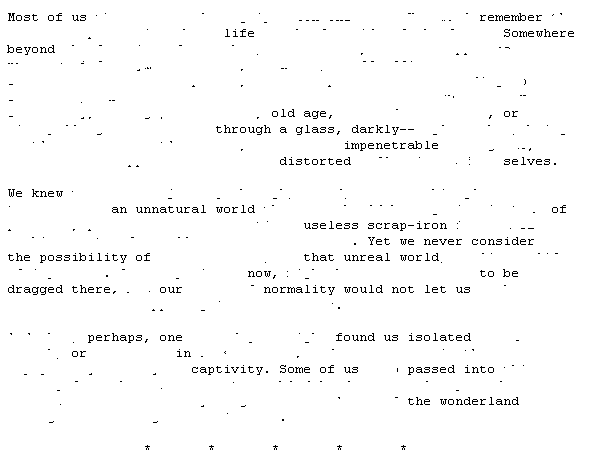
wonderland

[click image to read]

Who will remember
life beyond old age

We saw darkly— being
opposite reflections of ourselves

We knew an unnatural world
negative – passive – useless

Yet consider the possibility
of unreal life

Let us happen
in our own isolated
captivity

Some of us passed
into this fantastic
wonderland

human dust

[click image to enlarge]

© 2012 S. D. Stewart

Erased from Ch. XXVIII of Nerves and Common Sense (1925) by Annie Payson Call

Audio of reading:

the quiet, the quiet

© 2012 S. D. Stewart

Erased from Ch. VII of Nerves and Common Sense (1925) by Annie Payson Call

Some live in chronic time.
They do not find it,
they do not find it and they get ill.

It is really much the same,
keep a little stimulant
keep a bad habit.
We feel unnatural if we feel natural.
We are in it—but it is poison.

If a habit of
rocking or chattering
may feel unnatural and weird,
we wrench out these things
and yet the poisoning goes on.

When we are in a pretty bad way,
the worst know it.

I once lived in excitement,
dressed in excitement,
went to breakfast in excitement,
went about everyday excited.
Every event—little or big—was excitement.
Excitement over nothing.

We went deep in the woods and the mountains,
full of great powerful quiet.
When first there, excited about arrival,
excited about it,
but the night jumped in with torture.

I suddenly started up the trouble.
‘Oh, oh, the quiet! It is so quiet!’
Brain in whirl of excitement
felt pain when excitement touched it.

r___ed f__ling

© 2012 S. D. Stewart

Erased from Ch. III of Nerves and Common Sense (1925) by Annie Payson Call

measure for a loner, erased

[click image to read]

© 2012 S. D. Stewart

Erased from the 1959 science fiction story by Jim Harmon, aka Mr. Nostalgia

lunchtime trip to the ♥library♥

© 2012 S. D. Stewart

My weekend looms…

  • Recent Posts

  • Navigation Station

    The links along the top of the page are rudimentary attempts at trail markers. Otherwise, see below for more search and browse options.

  • In Search of Lost Time

  • Personal Taxonomy

  • Common Ground

  • Resources

  • BOOKS BOOKS BOOKS