reward for a cold trek

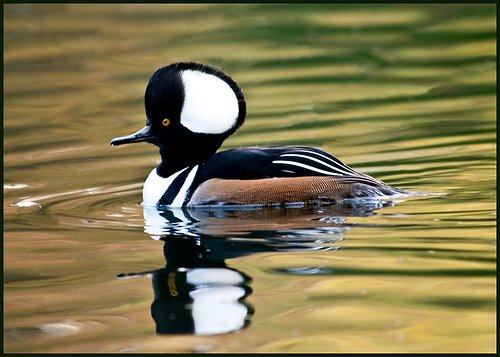
Yesterday morning I took a walk with ML up to the park. It was cold and blustery. I had my binocs with me to monitor any bird activity. The birds were quiet as we walked along the road into the park. As we approached the lake, though, I spotted a pair of ducks in the water, right above the dam. We got up closer and ID’d them as a male and female Hooded Merganser. Such striking birds! They swam steadily against the current, away from the dam, and then suddenly the female took wing, the male immediately following. Later as we walked back along the road, we looked down into the river and saw a solitary male merganser. Bonus duck! Below is a shot of a male Hooded Merganser from the Flickr page of TT_MAC, a Canadian couple who also have some other cool nature photos on their page.

digression

This week I battle to stave off stagnation. This day I sit in front of two screens, my ears sparking full of music to spontaneously combust to. I shake the familiar restlessness down my sleeves to the cuffs but it never falls out, just hangs there like weight bands around my wrists. This hour I question my motives, my motivations; I contemplate my dreams, both self-constructed and those scissored into my head as I sleep. This minute I cough up words, try to make sense of it all, just to still my quaking limbs. This second I blink and breathe, knowing that sometimes that’s all there is to do.

fiznit

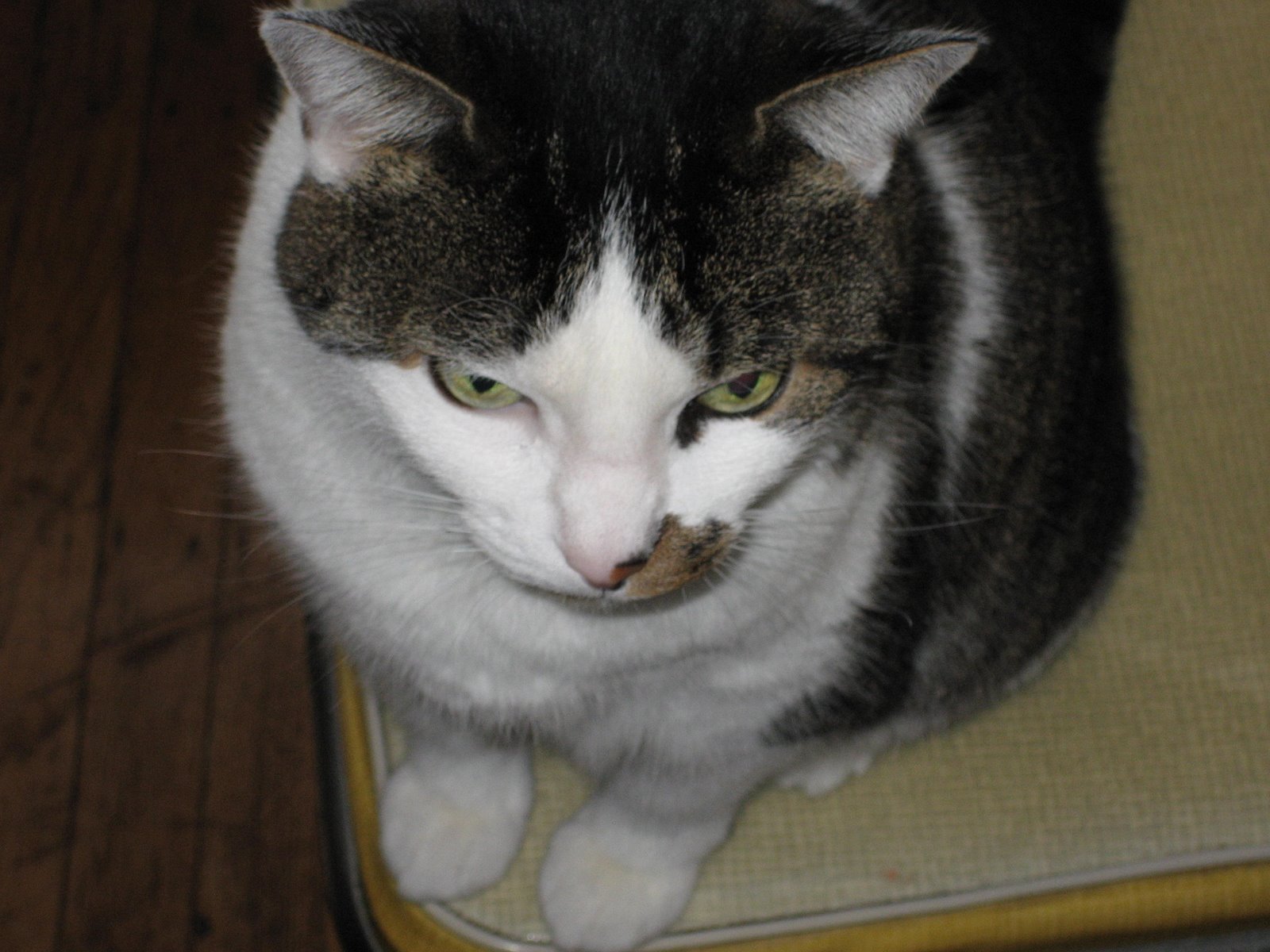
With her brother Scratchy, R.I.P.

zine life

I’ve been publishing my zine Thoughtworm for about 12 years now. The consistency of my publishing schedule has fluctuated over the years, but in the past few years I’ve settled into a routine of releasing issues about once-a-year. It usually happens near the end of the summer, although an unpleasant bout with writer’s block knocked me off schedule two years ago and I’ve yet to return to a regular timetable.

Back in the zine’s heyday, I had a mailing list of well over a hundred; I sent out postcards and email announcements when new issues appeared, and traded with a lot of other zinesters. Producing and distributing the zine was quite an operation. Between the cover design and printing, the collating and stapling, and the addressing and mailing, it was a lot of work. And that was all in addition to writing, editing, and proofreading the damn thing. Of course, I had someone helping me for a long time, and she was much more efficient than me. Without her, I probably wouldn’t have been nearly as prolific. Even though it was hard work, though, it was a labor of love. I made good friends whom I still feel a special bond with. I have five binders packed full of correspondence that continues to grow, and a sprawling collection of other people’s zines and artwork. I used to receive the most interesting mail; every week the mailbox yielded several wildly decorated envelopes stuffed with a wide range of goodies and some of the most thought-provoking writing I’ve ever read.

These days I’ve scaled back a lot; it’s a much more streamlined operation. I print less copies. I trade with far fewer people. In fact, a lot of people who I used to trade with don’t even publish anymore. Zines, by their very nature, are ephemeral. Many don’t last past issue one or two. Those of us who have been publishing consistently for over ten years are members of a rare breed. Since I’m working on a smaller scale, I receive far fewer personal orders. I probably sell more copies through stores. Of course, I’m also not as thorough about sending new issues out to review publications. I guess I’m just not as concerned with getting new readers as I used to be. It’s nice when it happens, but I’ve never felt wholly comfortable promoting my own writing and it’s much easier to share new issues within a smaller known circle of readership.

Still, there is always the thrill of finding a letter in my PO Box from a new reader, especially in this age of primarily electronic communication. It’s equally exciting to discover a new zine there from an old correspondent who I thought had stopped publishing altogether. I may not find something in my box every week these days, but there’s a comforting rhythm to the waves of correspondence that do come my way. It’s these old connections that remain, and the few new ones that are forged from time to time, that are the pleasant side effects of my creative endeavor. They help inspire me, and for that I’m very grateful.

Warning: Rant to follow

For some time now, and for various reasons not all of which I will mention here, my wrath toward Google has been festering. We have allowed Google to extend its insidious tentacles into our lives to the extent that I’m sure some people think they simply can’t live without it. Meanwhile, Google continues to make inroads with its efforts to ultimately manage all of the information entering and exiting our lives. Witness this, for example. Now don’t get me wrong; I use Google all the time. I have a Gmail account and I’m a fan of iGoogle for aggregating news and other RSS feeds. I just don’t want Google to rule the world, and I think it’s getting a little too cocky for its own good.

But this rant isn’t directed at Google as an entity; it’s directed at Google, the bossy search engine that acts as an enabler to the most ignorant of its users. By doing so, it in turn alienates its more intelligent users (you know, the ones who can actually spell and type, and who know what they’re looking for), and cripples its own value as an online finding aid. I’d like to illustrate my point with a pertinent example. For a long time, typing a compound word (e.g. sandpaper) without quotes into Google’s search box would produce only results with that exact word in them. Then Google started including results that included the two separate parts of the compound word (e.g. sand and paper, if they appeared next to each other). At that point, if you only wanted relevant hits with the compound word alone (not as two separate words), you had to enclose the word in double quotes. However, at some point last year (I think), Google decided to go one step further and always include hits that had the two separate parts of the compound word even if you enclosed the compound word in quotes when you searched it.

Now, this may not seem like a major issue at first glance. And with many compound words, it’s not, simply because the word itself is so common that it will dominate the relevancy ranking system, and the hits with the compound word split into two smaller words will appear few and far between, mostly in the deeper pages of the results list. However, in today’s world, idiomatic language aberrations constantly appear in everyday speech, despite the fact that they may not be “real” words. In addition, many company names, publication and book titles, and product names are nonstandard compound words. Take Paperchase, for example. It’s a UK stationery company. But The Paper Chase is also a movie. If you want to find results for the company Paperchase and not the movie, you can no longer just put quotes around it and search. If you do, you will also end up with references to the movie, in addition to other hits that have the words “paper” and “chase” next to each other (of which there are many, seeing as it’s a common idiom). You can try to work around this by eliminating words from your search using the minus sign, but then you risk losing relevant results. With this seemingly subtle change in its advanced search capabilities, Google is heavily influencing a person’s ability to find the limited list of relevant results they seek. This change may be useful for people who are sloppy typists and accidentally leave out a space in their query, but it destroys the relevancy ranking for queries that are meant to be just one compound word. [Note: it doesn’t matter if you type the quotes yourself, or if you type the word into the “this exact wording or phrase” box on the advanced search page. Either way, it ignores the quotes when executing the query. Interestingly, if you type the quotes around the word on the basic search screen and then switch to the Advanced Search page, it actually strips the quotes out! And if quotes are around the word on the basic search screen, it should show up in the “this exact wording or phrase” box when you switch to Advanced Search, but it doesn’t.]

I’m sure that Google’s motivation for this change is to help the user (while at the same time increasing ad revenue, since more search results equal more potential ad-clicks). But I find this change really annoying, and just another example of how Google enables people who are sloppy typists and/or don’t know how to spell or search to blissfully continue down that road. Where’s the motivation to be a better typist or to learn to spell correctly if Google automatically corrects all your errors? When I do a search with quotes, it’s because I want my results to be narrowed down in relevancy. By automatically assuming that I might have inadvertently left out a space between two words that also make a compound word, Google disallows me from narrowing down my results. So what if I had accidentally left out a space? I would’ve figured it out when I saw my search results, and then could’ve re-run my search. I would’ve lost a few seconds of time, but at least I would’ve had the opportunity to correct my mistake. By autocorrecting my compound word “mistake”, though, Google effectively shuts out the possibility of producing a truly relevant list of results, instead forcing me to weed them out on my own from the irrelevant ones. Why do you treat me like such a lazy idiot, Google? Don’t you think that if I was careful enough to put quotes around my search, I would’ve typed a space in my query if I wanted it there? Using Google’s search engine increasingly insults my intelligence. In my opinion, this dilution of advanced search capabilities in the interest of “convenience” only serves to decrease Google’s usefulness. It is also just another example of how obsessed the world is with “saving time” and making everything instantaneous and therefore more “efficient”, at the regrettable expense of quality craftsmanship, usefulness, long-term value, and countless other characteristics that have largely fallen by the wayside in our modern society. And as Google increases the ways in which it automatically anticipates and corrects our searches, it becomes that much easier for it to push us towards certain sites, thus shaping what information we consume without us even realizing it. If that’s not scary to you, then maybe you need to re-read 1984.

P.S. I also despise Google’s auto-suggestion feature for some of the same reasons (and others), but I’ll leave that rant for another time.

day and night

Blank mind in daytime hours. Night mind at rest stuffed with latent flotsam. To reconcile impossible. In sleep, what’s behind the wall stirs. To empty into linear thought, an uncertain task. In waking, the trivial seeds itself deep in dry barren soil. Buried even deeper dwells the core. I seek only to scrape down and gaze upon it for a moment.

reclaiming sunday from ambiguity

Readers of previous incarnations of this blog may recall past reflections on my ambiguous feelings toward Sundays. Many people I’ve talked to who report for work without fail on Monday mornings share these ambiguous feelings. Sunday is supposedly part of the weekend, but it often feels like a day of counting the hours down to the start of another work week. Today I decided, not quite consciously, to fill my Sunday with activities in order to distract myself from thinking about the inevitable surrender of my time tomorrow to the people who cut my paycheck. I rose early and joined my good friend betes for a brisk birding jaunt through Fort McHenry. We ended up with a total of 15 species, not bad for the first day of February and without even entering the woods. From there I hit the grocery store for the week’s shopping (not exactly fun, but necessary and capable of producing a feeling of accomplishment). An unseasonably warm afternoon inspired me to seize the bike by the horns (i.e. handlebars) and cruise the county roads for a couple of hours. This adventure confirmed my suspicion that I had indeed fallen badly out of shape. A winter without a gym membership was apparently a bad idea. Anyway, back home from my ride I dashed out a spate of cooking, then gobbled up dinner. Now I am in repose, imbued with the pleasant weariness that results from a fully active day. Sunday blues, I have vanquished you!

a prelude

Acrid winds from the past barely flutter past these days. It’s been longer than I can remember stillness such as this. Meditation in the moment comes more easily and more frequently, not always lacking in blackened tinges, but welcome nonetheless. And yet the rudderless voyage remains: the spinning in place, the lack of any one singular focus. I can’t ever tell if this is just my fate or my fatal flaw. The present state is not a bitter complacency such as I’ve tasted before, but still I feel tugs and yanks from deeper, richer corners of my psyche: roiling wells that have been tapped before and bubble over in anticipation of release again.

pedestrian non grata

At the bottom of the hill there is a traffic light. If I push the button on the pole, the light will turn red, the white “Walk” signal will light up, and I can safely cross the street in the crosswalk. This is all in theory, of course. In actual practice, I push the button on the pole, the traffic light turns red, the “Walk” signal lights up, I step into the crosswalk, and at least one, if not two, cars promptly run the red light and narrowly avoid hitting me. This is not an occasional occurrence. This happens every single time I cross this street. Every time without fail. Frequently I watch people with determined looks on their faces punch the gas as the light turns yellow then red before they have even reached the white line. I then pause in the middle of the crosswalk as the force of their passing vehicle’s speed practically knocks me over. Other times the drivers wear blissful unconcerned expressions as they sail through the red light, very nearly running over my foot or striking my knee with their front bumper. Often one hand clamps a cell phone to a fleshy cheek like some vulgar plastic appendage, as vacant eyes either fail to notice the 6 foot 2 man in the middle of the street or simply choose to ignore him. This morning once again as I reached the middle of the crosswalk, a middle-aged woman in an SUV paused uncertainly at the red light for a split second before racing forward, eyes locked ahead with a crooked half-smile hung on her porcine visage. I stood so close I could see her pores. This light basically exists to serve the pedestrians, as there is no direct cross street that the light also controls. Drivers know this and so they know that they can run this light without the possibility of striking another car, which would thus put themselves and their vehicle in danger. But when the element of personal danger to one’s own self is removed, every driver morphs into a scofflaw on the roads. And who cares about the person walking in the street? They are merely obstacles in the way. As a pedestrian in a major U.S. city, I see the worst of this behavior exhibited in humanity every day and it makes me both sick to my stomach and sick in my heart.

empty

I really don’t have much to say. I’ve been dealing with an extremely frustrating situation that has drained my energy and sapped all creativity out of me. I am like a piece of bleached driftwood, weathered and dull grey from the crashing waves. I’m weary of living in the too-close vicinity of hostile thoughtless human beings. I want my own castle, and I want to build a moat around it to keep out everyone except those who I choose to allow entrance. I am trapped and I don’t like being trapped. I feel exhausted and powerless. I just want peace and quiet. I too easily absorb the energy in my surroundings and this is a heavy burden.

In better news, the first new bird of the New Year was spotted at Patuxent River State Park on January 3rd. It was a Golden-crowned Kinglet. First spotted by my good friend AR, then ID’d by me. That takes care of the kinglets for me (there are only two). I spotted the Ruby-crowned Kinglet at Lake Roland one day back in the early fall. It landed about a foot away from me. I’m getting better at IDing birds based on their behavior. When we first spotted the bird, I immediately thought it might be a kinglet because of its size (they’re tiny) and how it was moving. They hover along branches to feed, rarely pausing at all.

  • Recent Posts

  • Navigation Station

    The links along the top of the page are rudimentary attempts at trail markers. Otherwise, see below for more search and browse options.

  • In Search of Lost Time

  • Personal Taxonomy

  • Common Ground

  • Resources

  • BOOKS BOOKS BOOKS