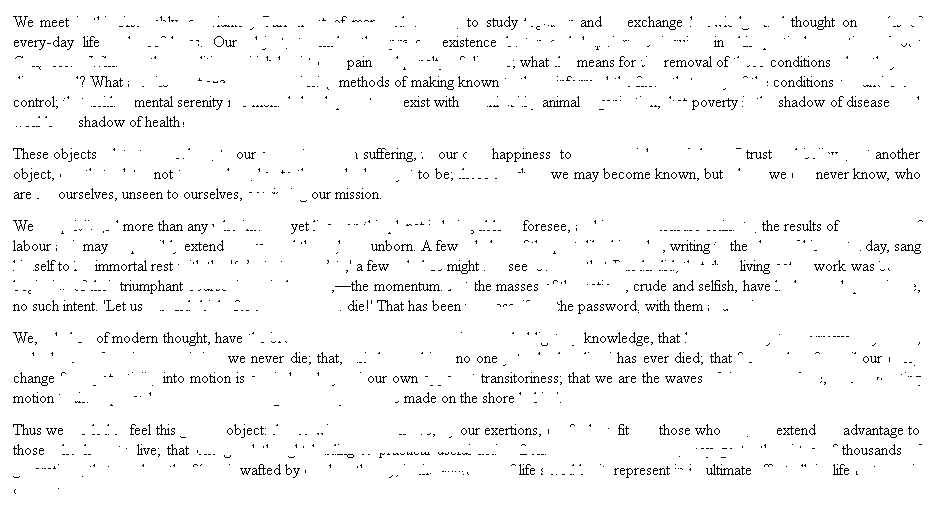
The first few pages of Book of Thoughts, an ongoing erasure project
[click images to enlarge]
Posted by sean on December 16, 2014
https://sd-stewart.com/2014/12/16/another-excerpt-from-book-of-thoughts/
Recently I began reading Robert Walser’s novel The Assistant. I associate Walser with the winter season, and particularly the month of December, likely because that was when I first started reading his work. Walser also died in December; he was found lying in the snow on Christmas Day 1956, having suffered a heart attack during one of his frequent and much-loved walks.
The Assistant has been a joy to read so far, brimming with Walser’s off-kilter cheekiness and his typically exuberant scenic descriptions. And so, with my enthusiasm for his writing in its current heightened state, I thought I’d share another of my Walser reviews from the archive, with the hope of encouraging others to investigate this still tragically under-read writer.
____________________________________________________
The Tanners by Robert Walser
I don’t want to go running down some career path—supposedly such a grand enterprise. What’s so grand about it: people acquiring crooked backs at an early age from stooping at undersized desks, wrinkled hands, pale faces, mutilated workday trousers, trembling legs, fat bellies, sour stomachs, bald spots upon their skulls, bitter, snappish, leathery, faded, insipid eyes, ravaged brows and the consciousness of having been conscientious fools. No thank you!
Robert Walser was an odd fish and I like him a lot. Even though he once said, as W. G. Sebald reports in the introduction to this book, that he was essentially always writing the same novel, one which he said could be described as “a much-chopped up or dismembered Book of Myself,” I will continue reading his same-as-before novels because they captivate me. I like to think of him up in his stuffy attic room, frantically writing on borrowed paper with stolen pens, gripped in the passion of that writing, of hurling his herky-jerky version of the world down onto the page.
The Tanners is the disjointed story of the Tanner siblings: Simon, Klaus, Kaspar, and Hedwig (oh, and the mysterious Emil, who later randomly shows up in another character’s anecdote). Primarily, the “plot” (such as it is) follows the adventures of Simon as he bounces around from job to job while basically pursuing the sublime. From the start, Simon reminded me of Jakob from Walser’s anti-Bildungsroman Jakob von Gunten, with his similar tendency toward mockery traced with veins of sincerity. Or maybe it was just straight mockery, maybe I imagined the traces of sincerity—it’s really so hard for me to say for sure. When Simon refers to his own cheekiness, I couldn’t stop thinking about that Saturday Night Live sketch where Mike Myers plays Simon, the kid in the bath making drawings who calls people “cheeky monkeys.” It’s always unsettling for me when pop culture and literature suddenly collide in my head. And yet the two Simons do share a similarity, if only a superficial one. But I digress. Simon is a self-described ne’er-do-well prone to walking all night through the mountains to visit his artist brother Kaspar, his closest sibling. Simon’s gleeful flippancy is infectious and makes him a likely candidate for the reader’s sympathy. Hedwig is the only sister in the bunch, a small town schoolteacher who Simon also stays with for an extended visit. They bond, but she suspects him of being a freeloader, which he sort of is. Hedwig is an interesting character, and Walser allots her some good speeches. Finally, Klaus is the oldest brother, a stodgy straight-arrow type who thinks he knows what’s best for all of his siblings. He is annoyingly overbearing, though probably well-meaning.
In the introduction, Sebald draws some parallels between Gogol and Walser that I found to be relevant, having just finished a book of Gogol’s short fiction. Like Gogol, Walser has a tendency to introduce characters who at the time seem like they may come to play important roles in his narrative, only to either suddenly kill them off or fade them into the background. Sometimes they also reappear later, just out of the blue, and fill us in on what they’ve been up to for the past year or however long they’ve been gone from the narrative. The aimless plot wanders down side streets, dead-ends, turns around, leaves the city, climbs a mountain, walks off a cliff, gets a concussion, and turns up back in the city again a few chapters later with a new lease on life. Or something like that. I was anthropomorphizing the plot just then. I would imagine that the general unreliability of Walser’s prose could easily become maddening for some readers. The key is to float along with Walser wherever he chooses to take you. One must surrender completely in order to enjoy reading; there is no fighting it because Walser will always win. Always. We are on an adventure with him, as he discovers his own truths in his writing. In this way he is also very much like Gogol, who eschewed the narrative traditions of the time and instead went off happily exploring in his prose.
Throughout the book, Walser spins a gauzy web of natural beauty around his characters who, when not walking around outside enjoying the weather or laying stretched out in the forest, very much tend to spout off lengthy monologues in the general direction of each other, not seeming to expect responses and, in fact, rarely getting them. Walser’s prose is so sensual, his descriptions of both urban and rural settings sparkle with crisp detail clearly borne of a sharply observant mind. Half the novel one falls into a reverie, while the other half one stares at the closest wall, noting the intricate cracks in the plaster with genuine interest.
Despite the lack of plot, there are certain themes to pick out. With Simon and Hedwig, we find themes of youthful self-discovery, the search for meaning and happiness in one’s life, and the ever-painful plight of the daydreamers among us. With Kaspar, there are the ideals of art and the difficulties inherent in one’s pursuit of those ideals. In Klaus, we see a rather sharp critique of mainstream society and the trappings of materialism and the pursuit of wealth. Readers who have siblings, particularly multiple siblings, will also likely enjoy the novel on another level less accessible to those who don’t, for Walser does an admirable job of portraying the complicated and contradictory dynamics that often characterize sibling relationships.
As Simon opines late in the book, “How tedious it was always to be doing exactly the same thing.” Some books always do the exactly the same thing, what we expect them to do, over and over. Not with Walser. Even if he did claim to be writing the same novel over and over, his prose is always worth reading, because it’s granular yet dissimilar; it’s made up of life’s strikingly mundane and spectacular moments, as pointed out by the likes of Simon, who, after all, claims to be “an outlandish figure in my own homeland.”
Posted by sean on December 10, 2014
https://sd-stewart.com/2014/12/10/the-tanners-book-review/
“It is conceivable for a writer to take the pulse of his era and make it come alive in language and images, yet still be out of his depth when it comes to palpable engagement with the world, although this constellation is exceedingly rare. Far more often someone who is truly at home in two worlds is misunderstood as being ‘out of touch’ in the public, social cosmos, which he shapes and endures in combination with others, and in an interior psychic space dominated by feelings, dreams, fantasies, associations, and ideas, which he inhabits alone. Anyone whose experience inside his head offers as vast and constant a stream of impressions as the world outside cannot stay focused on the here and now. But where is he then? In a different realm.
An individual who appears to be out of touch with reality is rarely in the privileged position of being able to open and close the subtle locks between inside and outside at will. The vortex pulling him inside his head is always palpable, but the reality principle demands that he remain perpetually alert; people expect him to limit himself to things that can be communicated. Anyone who starts talking about daydreams on the street, in a store, or at the workplace alienates people, no matter how intense and meaningful those daydreams are. He remains alien because he understands and acknowledges a second world, and for the most part, and to his detriment, he remains just as alien in that interior world for the same reason. He is present, but neither here nor there.
That condition can culminate in insanity, and Kafka justifiably feared winding up insane throughout his life. But it has little to do with the accomplishment society expects of the individual. Someone who is alienated from the world might function perfectly well as a craftsman, attorney, teacher, or politician, or as a vice secretary of an insurance institute, and his struggle to balance himself—poised like a man with one foot off the ground—can easily remain hidden from view, without a trace, as it probably has in thousands upon thousands of brains.”
—Reiner Stach, Kafka: The Years of Insight
Posted by sean on November 6, 2014
https://sd-stewart.com/2014/11/06/kafka-in-a-different-realm/
Fascinating critical essay on Austrian poet Georg Trakl and the influence of cocaine and other intoxicants on his work.
(via Public Domain Review)
Posted by sean on October 29, 2014
https://sd-stewart.com/2014/10/29/george-trakls-snowy-descent/
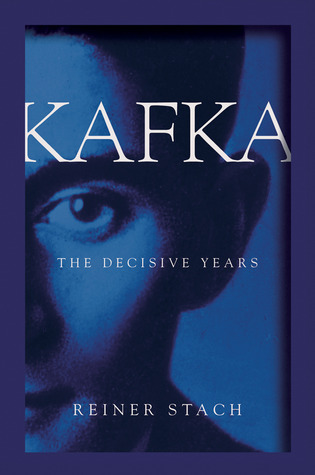
[Please forgive the momentary fixation on F.K. again. I often return to him for comfort, especially when I can’t write. Reiner Stach has done K. devotees a remarkable service with his meticulous biographical research and synthesis. I have fallen into this book like I haven’t fallen into a book in a long time. And to think, there is one more published volume yet to read! Not to mention the early years that Stach still hopes to cover, should he ever gain access to Brod’s vault.]
Here are a couple of passages related to K.’s creative process…
“He knew that his best, most profound writing sometimes came from a heightened consciousness of depression. However, complete inertia and indifference lurked no more than a breath away.” (p. 151)
“If we were to observe the ebb and flow of Kafka’s literary productivity from a great height, we would see a wave pattern: an initial phase of intensive, highly productive work that comes on suddenly and lasts several hours a day, followed by a gradual decline in his powers of imagination, lasting for weeks, and then finally, in spite of his desperate attempts to fight it, a standstill and feelings of despair for months on end. We do not know why he had to go through this cycle several times, and we will not know until we have a categorical paradigm of artistic creativity. Kafka himself never uncovered the logic behind the igniting and extinguishing of his art; he was always too deeply enmeshed in the effort of tapping whatever reservoir was accessible to him at the moment.” (p. 175)
—Reiner Stach, Kafka: The Decisive Years (English translation © 2005; original German edition © 2002)
Posted by sean on September 23, 2014
https://sd-stewart.com/2014/09/23/k-and-the-creative-process/
“Kafka missed nothing, forgot nothing. There is little evidence of the absentmindedness and boredom he always complained about; on the contrary, his incessant presence of mind is almost painful to witness, because it renders him unapproachable. Someone must stay awake, but this wakefulness deprived him of a sense of home and alienated him from the world and from people, in a mundane and sometimes comical sense. Nabokov’s novel The Real Life of Sebastian Knight, which highlights the impossibility of writing an adequate biography, expresses the suffering associated with profound wakefulness from the point of view of someone experiencing it:
[…] in my case all the shutters and lids and doors of the mind would be open at once at all times of the day. Most brains have their Sundays, mine was even refused a half-holiday. That state of constant wakefulness was extremely painful not only in itself, but in its direct results. Every ordinary act which, as a matter of course, I had to perform, took on such a complicated appearance, provoked such a multitude of associative ideas in my mind, and these associations were so tricky and obscure, so utterly useless for practical application, that I would either shirk the business at hand or else make a mess of it out of sheer nervousness.
This statement applies to Kafka word for word. It is astonishing how little he ‘made a mess of’ in spite of everything: wherever his life took him, he stood the test, as a pupil, student, and official. But nothing came easily to him; every decision, even the most trivial, had to be wrenched from that stream of associations. He once wrote, ‘Everything sets me thinking’. Everything set him writing. But first he had to translate life.”
—Reiner Stach, Kafka: The Decisive Years
Posted by sean on September 16, 2014
https://sd-stewart.com/2014/09/16/a-profound-wakefulness/
Yesterday cigar-smoking man was again observed sitting in his chair and smoking. He had a bike with him, though a different bike from his original bike. Meanwhile, someone wrote the word ‘WEED’ in multicolored chalk on the brick promenade. There are now many tourists, both of the large and confused varieties. They approach anyone around them with desperate pleas for directions to destinations that tourists frequent, such as restaurants where they can attempt for a time to assuage their unending hunger. They walk around talking about when to eat, concerned that a late lunch will push dinner back too far. Managing one’s meals whilst vacationing is difficult. It requires careful planning and continuous discussion.
The fake pirate ship drifts into view and executes a tight 90-degree turn in the channel, as the few customers on board respond with halfhearted movements to the ‘deckhands’ capering to the awful pulsing reggae music. It may be an elaborate game of musical chairs, but the distance is too great to permit an accurate, detailed report.
A police helicopter incessantly buzzes overhead, an unusual occurrence in this sanitized sector of the city. Perhaps it makes the tourists feel protected.
One-sided exchange overheard between two restaurant employees who were setting up outdoor seating:
“[…]”
“No, I would say I’m spiritual, but I don’t believe in organized religion.”
On a certain bridge, someone scrawled ‘It feels so good to do it’ with spray paint. After a while, the graffiti clean-up squad covered it up with neutral paint. Several weeks or months later, the same scrawl appeared but this time it said, ‘It feels so good to do it again’. The clean-up squad covered that one much quicker, only for the scrawl to reappear a few days later as ‘It feels so good to do it again and again’. No one will win this war.
In Winterreise, Nagl has moved on from thinking his life is still lying ahead of him:
‘Now that life is no longer ahead of me, now that it’s really started, there’s nothing else but senseless thoughts. I’ve done everything almost automatically. I made it a point of honor to have everything I did look as if I wanted it. In reality, it just happened.’
Is it the beginning of the end or the end of the beginning.
Posted by sean on July 24, 2014
https://sd-stewart.com/2014/07/24/more-data-in-the-imaginary-spreadsheet/
“I always think that life still lies ahead of me, as though I had organized my previous life only for a short while and I were about to start my real life not too far in the future,” thought Nagl.
“It all simply happens to me,” he kept thinking. “I live from day to day, without asking many questions. Mostly I take everything for granted so that I don’t think about it. I don’t resist, nor do I give in, nor do I tell myself I have no choice.”
—Gerhard Roth, Winterreise
Posted by sean on July 22, 2014
https://sd-stewart.com/2014/07/22/words-from-winterreise-by-gerhard-roth/
I am imbued with the notion that a Muse is necessarily a dead woman, inaccessible or absent; that the poetic structure—like the canon, which is only a hole surrounded by steel—can be based only on what one does not have; and that ultimately one can write only to fill a void or at the least to situate, in relation to the most lucid part of ourselves, the place where this incommensurable abyss yawns within us.
—Michel Leiris, L’Age d’Homme (published in English as Manhood)
The quote above is one of two epigraphs introducing John Hawkes’ short novel Travesty. It struck me as akin to my own feelings about writing. And in Hawkes’ case it is particularly apropos; for he “situates” the abyss like no other, and in reading him one gets the impression that he knows this is all he can do. An early American postmodernist, Hawkes wrote in an incomparable style, fashioning rich, mythic worlds peopled by characters that are so fully formed they seem real. His work often carries an air of menace, a peering over the edge of the abyss, and sometimes a dangling over it, held tenuously by the ankles. He leaves a lot unwritten, and part of the pleasure in reading him is the struggle to fill in these gaps.
I wasn’t familiar with Leiris, so I looked him up. I found this review of Manhood, which stoked my interest. Leiris was a French Surrealist writer and ethnographer who, in the reviewer’s words, “experimented with the consolidation of mythology, ritual and autobiography-writing.” In reading the review, I could see parallels between Hawkes and Leiris; it seems as if the latter could have been an influence on the former.
So one can write to fill a void, and in that respect, any subject is fair game. The trouble is that the abyss seems too overwhelming at times, too deep to fill and too hazardous to permit even the most cautious approach. Hurling a few sentences over the edge and listening for them to hit bottom feels like a lonely and futile exercise. In response, the temptation arises to shy away from it and instead dwell in more “lucid” inner locales.
Habit, the great deadener, must also be considered with regard to writing. But let’s take a step back for a moment and reflect on habit. Do you ever do something after not doing it for a long time and think: Wow, that thing is great! Why don’t I do that more often?? And yet this is the thing you were doing every day for months until you grew tired of it and stopped, thinking why do I bother? Habit, as a word, has a negative connotation. It’s always, Oh, that’s a bad habit. She picked up a bad habit. I’ve got to stop this bad habit. No one talks about good habits. It’s never, Oh, I recently picked up this good habit and it’s really helping me out. We need more talk about the value of good habits.
When it comes to writing, a moldy old adage dictates that one should write every day, no matter what the subject or form. This is considered a good writing habit. Just sit there and write and write and write for X amount of time each day and it will be fine. Yet many writers do not write every day. Some don’t write for months, until one day they fly into a manic state and write nonstop. It’s all about which practice works for you. But for those writers in this latter camp, those dry periods can run one ragged. Self-doubt creeps in and one wonders if the words will ever come again. Next comes a turning against the words. Hatred for words! Frustration at their failure to capture anything but a rapid-fade vapor trail of emotion and sensation; anger at their crude rigidity in the face of life’s constant flux.
Which returns us to Travesty. Because it seems to me that this strange little novel might be what a writer writes out of desperation when faced with one of these dreaded dry periods. The Leiris quote is the clue here, for an epigraph hints at the meaning of what is to come. The entirety of Travesty consists of one side of a conversation between the driver and one of the two passengers in a car speeding through the night in rural France toward a planned murder-suicide. Mostly it is a monologue by the driver, though the passenger does interject from time to time, which the reader discerns from the driver’s reactions. There is an absent woman who could be construed as a Muse for these two men; she is not dead, yet her distance from the story renders her near-dead. Even for Hawkes the scenario playing out in this novel is bleak, if not nihilistic. At a surface level, it reads as a piece composed on the brink of the void, a stream of dispassionate vitriol spit over the edge from dry, cracked lips.
It’s worth noting at this point that the second epigraph to the book is from Camus’ The Fall (a book which I have not read). Other reviewers have commented that Travesty reads as either homage to or parody of Camus. And in fact, in a 1976 interview¹ with Paul Emmett and Richard Vine, Hawkes mentions that he’d read The Fall a few months before several incidents that had partly inspired the book. While he evades admission that Travesty is indeed a “travesty” of The Fall, he does say he thinks “The Fall is in some way related to Travesty.” Of course, Camus also died in a car accident, which yields yet another Camus parallel to the book.
Returning to the void, though…in the final line of the conversation, while discussing Travesty, Hawkes says, “The ultimate power of the imagination is to create anything and everything—out of nothing…” Elsewhere in the interview, Hawkes is adamant that none of his fictional work is autobiographical (though he admits stray bits make their way into a text on occasion), and so the Leiris epigraph again rises up (“the poetic structure […] can be based only on what one does not have”). We cannot know if Hawkes was in a desperate dry period when he conceived the idea for Travesty. But it’s obvious that the text is at least in part concerned with this “ultimate power of the imagination.” For the narrator carefully constructs his murderous plan and describes it in calm, precise detail, just as Hawkes crafted the story and everything within it. And they are both empowered by their creations.
Maybe the “nothing” Hawkes refers to is equal to the void, or at least an alternate way of thinking about the void. Rather than a yawning abyss that swallows words (or prevents their creation) it should be thought of as a source for them. In this, the act of writing draws closer to Leiris’ idea of “situating” rather than “filling” the void. Situating the location of a void implies we have some control over it or at least knowledge of it, while filling a void seems an impossible task. If we know where the void is in relation to the “lucid part of ourselves,” it’s easier to manage our exposure to it, and even to draw upon it as a stimulus for creation.
_____________________________________________________________________
¹Emmett, Paul, and Richard Vine. “A Conversation with John Hawkes.” Chicago Review 28.2 (Fall 1976): 163-171. Accessed through JSTOR, 9 Jul. 2014.
Posted by sean on July 10, 2014
https://sd-stewart.com/2014/07/10/john-hawkes-encounters-with-the-abyss/
Some books demand to be read based on their covers alone. Such is the case with The Calm Ocean by Gerhard Roth, which I was surprised to find sans ugly hardcover binding on the university library’s shelves. The bright red background initially draws the eye, which may then focus on the fox, specifically the head, also depicted in primary color. Illuminated by the rising sun (or moon) behind it, the highly stylized fox is looking back across the face of the book, into the unknown. The eye might now wander up to the title of the novel, which seems to contradict the rural scene represented on the cover. One begins to wonder about this contrast, and whether the fox is significant in any way, as well as what the title says about the book.
The Austrian writer Roth is a relatively new discovery for me, thanks to a recommendation last year from a friend over at Goodreads. Roth’s early work falls into the broad soup of ‘experimental’ fiction, lacking the more traditional trappings found in realist fiction. But he grew closer to realism over the years, though I find his take on it to be palatable. It’s as if he took the experimental skeleton he crafted as a younger writer and hung some strange costumes on those angular bones. Murky and sometimes even hallucinatory, Roth’s post-experimental fiction is not to be overlooked simply because it began to dress in new and bizarre realist outfits. Of course I say this while now reading only my second of these later works (the first Roth book I read, The Will to Sickness, was much more experimental; the second one, The Lake is a later work). But I have a feeling (partly based on other descriptions/reviews I’ve read), that I am right about Roth in this regard.
In his writing, Roth is concerned with sifting through the social and political culture of his home country of Austria, both past and present. Most of his books resemble mystery novels, at least superficially. They are not traditional mysteries at all, though, and readers who simply must find out all the details of what happened should probably stay away. At this point in my reading of the book, The Calm Ocean already recalls the The Lake in that it also concerns a man away from home, in an unfamiliar provincial place, feeling disoriented and alienated. Since my reading thrives on characters like this, I was drawn in immediately. I’m still early on, but I already know that it will live up to the promise of the cover.
Roth has completed two ambitious cycles of works, each of which consists of novels, essays, and documentary volumes: Die Archive des Schweigens (The Archives of Silence) and Orkus (Hades), the former consisting of seven works, and the latter of eight. Unfortunately, many of these works are still unavailable in English, though Ariadne Press has been doing an admirable job in bringing some of them into English translation, with their focus centered on ‘Studies in Austrian Literature, Culture & Thought’. Hopefully these current offerings from Ariadne, as well as Atlas Press and Burning Deck (each of which has published one of Roth’s earlier books in English), will grow in popularity among English readers and thus attract more translation efforts in the future. Roth certainly ranks with Thomas Bernhard as a contemporary Austrian writer very much worth reading (Elfriede Jelinek and Peter Handke being two others on my list of to-reads).
Posted by sean on June 17, 2014
https://sd-stewart.com/2014/06/17/allure-of-the-cover/