Austrian writer Thomas Bernhard forged a wholly unique body of fictional work. One could class his writing as postmodern, but that label seems limiting and insufficient. An accomplished poet at a young age, Bernhard turned to fiction soon after a publisher rejected the manuscript for his fourth book of poetry. It’s uncertain how connected these two events were, but Bernhard never pursued publication of that manuscript again. Later in his career he did publish a chapbook of his early poems, and made certain that his extant published poetry would remain in print. So clearly poetry still mattered to him. As a youth, Bernhard also trained as a musician and fostered his innate talent in that realm for some time.
Both of these creative pursuits, music and poetry, channeled directly into Bernhard’s prose, in both form and content. His inimitable style recalls the structure and repetition of a classical music piece. Likewise, the cadence and repetition found in his sentences reflect a poet’s sensibility. Bernhard’s primary characters are almost always failed (or failing) artists, writers, scientists, engineers, or other passionate, single-minded individuals. These people live on the fringes of society, often in small towns or rural locales, where they are marginalized from their neighbors, on whom they chiefy look with disdain. Prone to lengthy monologues, internal or external, they are monomaniacal in their pursuits, though always hampered from seeing them to fruition. Often there is a secondary character who is there to simply listen and, in some cases, made to feel inferior to the primary character. That is, the secondary character will look up to the primary character, despite that character’s failings, or the secondary character will feel an unusual, inexplicable attraction to the primary character. This dynamic between the two characters drives the plot, such as it is.
Thomas Bernhard could now be classified as a cult writer, although in the U.S. he remains virtually unknown to mainstream readers. But among his limited readership there is a rabid dedication. In my view, much of Bernhard’s allure lies in the uncompromising nature of both his prose and his public persona, which there is no reason to believe was any different from his private persona. In fact, everything points to the two being one and the same. Part of this, though, is due to how little is known about him, outside his own words. Much like American writer J.D. Salinger, Bernhard kept strict control over his papers. Nothing was published that he did not authorize. As a result, for the most part, he retained complete authority over the world’s access to Thomas Bernhard. He left explicit directions regarding his literary estate following his death, one of which states that his plays are never to be performed in his home country again. Unlike Salinger, he did give interviews, though he grew a reputation for being cranky and reticent during them. Still, there are a number of interviews available online that are worth reading. And then there is his memoir, Gathering Evidence.
Bernhard originally published his memoir in five discrete parts under separate titles. These were collected into one volume for the English translation. As a whole, it represents his own excavation of his past in order to understand his development. As a young person he lived through many difficult experiences, including WWII bombings, hospitalization for tuberculosis, and the death of his beloved grandfather, the person who meant the most to him. He explicates all of this in the memoir, which he uses to fashion his own truth, a slippery concept for a writer who believes that “truth is always wrong, even if it is one hundred percent truth.”
I decided to read Gathering Evidence early on in my exploration of Thomas Bernhard’s work. This is not a normal inclination of mine, but with Bernhard it felt right. And I’m glad that I read the memoir, for it has enriched my further reading of his novels, of which I still have a few to go. Below is the review of Gathering Evidence I wrote just about a year ago. It reveals much of the book’s contents, so if you are considering reading the book and would prefer to start with a fresh slate, you may not want to read further.
____________________________________________________________________________
Gathering Evidence by Thomas Bernhard
(Review by S. D. Stewart)
I have listened to everything and conformed with nothing.
All I ever wanted was to be myself.
Absurdity is the only way forward. It was a way I knew, the only one that led anywhere.
Why write memoir? So many lives and why should we care. We want to read about our own lives, don’t we. We fantasize about the biographies, the obituaries, the glowing words written about us in the future, after we are dead, after the world has finally recognized our genius. Or maybe we don’t do that. Regardless, writing memoir is rooted, at least in part, in narcissism. Writing in general, for publication at least, is a narcissistic pursuit. Indulging in the activity, for the purpose of publication, shouts out to the world, “Listen to me, what I have to say is worth reading!” One must believe that to do it. And what could be easier than writing about oneself. Nothing. Nothing could be easier than that. No research required. No fact-checking. No need to even tell the truth. If there even is such a thing. Thomas Bernhard doesn’t think there is, or rather he doesn’t believe the truth is right. He says, “Truth is always wrong, even if it is one hundred percent truth.” That is some helpful advice to keep in mind when writing memoir. Bernhard “had an obsessive desire to gather the evidence in [his] head.” Evidence of what, you may be wondering. Well, evidence that his grandfather had been right, “that his assertions had been correct.” But, correct about what. Oh, I don’t think I can say it, not yet. No, I don’t think Bernhard would want me to say it. Not now. He waited a long time in the book, almost to the very end, to say it himself, to spell it out in explicit terms, what every sentence, every word, had been pointing toward from the very first page.
In the beginning, we find young Thomas (age eight) astride a bicycle for the first time (“I am the ruler of the world”), on a mission to ride some miles away from his home to Salzburg in order to visit his aunt. But this is a clandestine mission, and one that sadly fails, quite spectacularly, in fact. Young Thomas runs to his grandfather for support, fearing his mother’s reproach (she whipped him regularly, taking out on him her anger at his father, who had run off early on, refusing to even acknowledge he had a son). His grandfather thinks that “anarchists are the salt of the earth” and teaches young Bernhard the alluring idea that, in theory, he can destroy everything every day. In theory. Kill, demolish, destroy, whenever one chose, in theory. A theory that fascinates Bernhard for the rest of his life. This sets the tone for the book.
Reading Bernhard’s fiction will likely lead one to suspect much about the man’s beliefs. This book will confirm those suspicions and explain the reasons behind them, at least in theory. For example, he hated teachers and all other authority figures: “Policemen and teachers spread a foul smell over the surface of the earth.” Never shying away from hyperbole, he goes on to explain that “schools actually murdered the children who attended them.” Looking for the right school in which to enroll your child? Maybe you’ll consider homeschooling instead after reading this: “We sent our children to school so that they would become as repulsive as the grown-ups we met every day in the street, the scum of humanity.” But lest you begin thinking Bernhard has nothing positive to say, I present to you this statement, from the very next page:
“We should always remember that there’s something else in the world apart from the commonplace.”
Yes! Yes, we very well should remember that. The commonplace has a stranglehold on the world. Everywhere we look is sameness. The world revels in it! The rulers count on it! (“For no government has any use for someone who is enlightened and thus actually in tune with the times.”) But it doesn’t have to be that way. Unfortunately, most of us are not raised to know this. If anything, Bernhard’s memoir underlines the brutal effects one’s upbringing can have; it shows us over and over how what happens to us when we are young can wreak havoc in our later lives. Some of us may find ourselves nodding along when Bernhard states emphatically that “the world was for years an intolerable burden which constantly threatened to crush me.” But! But…that does not have to be the way it ends.
World War II comes along and suddenly young Thomas is surrounded by death. People faint in the air raid tunnels burrowed into the mountainsides; they suffocate and never recover, later to be dragged out for removal by the ambulances. After many false alarms, Salzburg also endures bomb blasts, some of which utterly destroy the old section of the city. At first, Bernhard is fascinated by the rubble, and sees the destruction of the cathedral in particular as beautiful. But then, after stepping on what he at first thinks is a doll’s hand and soon realizes is actually the severed hand of a child, he sees war as the atrocity that it truly is. He is affected for life by the sight of the sheet-covered bodies. One day he goes for his English lesson and finds that his tutor’s house has been bombed to rubble while she was inside. He sees the ugliness of humanity surge to the forefront as people push, shove, and trample their way in and out of the air raid tunnels, these supposed places of safety that in fact caused disease and death. Later, as an adult, he is angered when those who went through the same experiences he had act like they don’t remember, or simply refuse to talk about it: “It is like being confronted with a concerted determination not to know, and I find this offensive—offensive to the spirit.” Instead, he insists that “one must not stop telling people the truth; and the shocking and appalling things one observes must under no circumstances be suppressed or even doctored.”
While Bernhard places his grandfather on the highest (and only) pedestal in his life, he is dismayed that his grandfather thinks it is a good idea for him to attend grammar school, which he hates. His grandfather, perceiving that he is artistic, is determined to make an artist out of him. Thus, while attending boarding school during the war, Bernhard takes violin lessons. Although he finds an affinity for music within himself, he abhors music theory and fails at reading music. So he makes up his own music, which was, as he says, “conceived as an accompaniment to my melancholy broodings.” He practices the violin in a closet, where he dwells almost exclusively on thoughts of suicide while playing. Meanwhile, children all around him are killing themselves. Living at the boarding school was a dark time for him, being in Salzburg amidst the “deadly spirit of the city” (suicide capital of Austria) almost destroys him: “during that time my spirit was almost broken; and nobody, not one single person, perceived this darkening of my spirit, this virtual destruction of my spirit.”
Eventually, he cannot stand the grammar school any longer, and though pained at the thought of disappointing his grandfather, he quits and secures an apprenticeship “in the opposite direction.” There is an amusing passage where he is attempting to find an apprenticeship at the labour exchange, and the woman working there keeps offering him good jobs in nice parts of the city. Yet he wants to go “in the opposite direction” and is having trouble getting this through to her. When he finally does, he reports that “the woman was on the one hand glad to have satisfied me but on the other hand horrified at the workings of my mind, of which I had allowed her a glimpse.” Instead of walking to school along the Reichenhaller Strasse, he would now be walking along the Rudolf-Biebl-Strasse, “the street that led me to myself.” At the age of 15, he was starting a three-year apprenticeship in the poor section of town, the Scherzhauserfeld Project, at a grocery store housed in a cellar. This turning point was crucial, leading him away from thoughts of suicide toward passion for survival.
Music comes back to him, and this time he sings. When he goes for singing lessons, he realizes, “I had a strong voice, and it occurred to me that I could probably use it, if I chose, to shatter everything in the drawing room.” Unfortunately, he contracts tuberculosis soon afterward. A terrible ordeal begins at the hands of incompetent medical “professionals” in various horrifying public hospitals. His grandfather also becomes ill at the same time, and they both end up in the same hospital. Bernhard is housed in the “death ward” as he likes to call it, where he sets up his observation post and offers a scathing commentary on the medical establishment: “Among a hundred so-called doctors there is seldom one genuine doctor, and so to this extent the sick are inevitably condemned to protracted illness and eventual death.” Meanwhile, his grandfather comes to the conclusions that “the sick are the ones who have real clarity of vision; no one else sees the world so clearly” and artists, particularly writers, need to go into hospitals from time to time, even under false pretenses, in order to dwell on life and existence and avoid falling “victim to futility by getting caught up in the superficial.”
As an aside, I will point out that, from time to time, Bernhard reminds his readers that these are the thoughts of a youth and that he often sees things differently as an adult. However, one must pay attention to his shifting point of view in the narrative, for sometimes he also steps back without warning and writes from the present, as an adult.
In the death ward, Bernhard sees more death (of course). Dead bodies are stacking up around him. Death is looming all around. He sees the dying sometimes “summon up all their strength in their last moments in order to wrest death to themselves after it has tormented them too long by failing to come of its own accord.” With all of this death permeating his surroundings, Bernhard focuses in over and over on the indignities that the dying suffer before their day finally comes. There is injustice everywhere, but perhaps it is nowhere more pronounced than in the public hospitals.
His grandfather dies. Not too much later his mother dies, when he is in the sanatorium, attempting to recover from tuberculosis. In both cases, he discovers their deaths through reading their obituaries in the newspaper. He despises journalism. The two people he loved most are now dead before he has even made it out of his teenage years.
“When we come to consider the matter, we realize that our whole life is nothing but a grubby calendar of events and that by the end of it all the pages have been torn out.”
It is heartbreaking to read of his experience with tuberculosis and the hospital, the sanatorium, the futility of it all, the colossal failures of the doctors, the doom and gloom and likelihood of his own death. He writes of it all in his straightforward yet musical way, like beating a drum in varying syncopated rhythms, and in no way does one ever feel a sense that he is looking for sympathy. He is stating what happened and he is clearly and harshly denouncing it, but he is also stating that this is simply how it is, this is how the world works and, yes, it’s warped, but it’s been like that for a long, long time and it will never change. Given all of this, he also realizes what speaking such truth often results in:
“A record like the present one must naturally always be made in the knowledge that it is likely to be attacked or denounced, or quite simply dismissed as the product of a deranged mind. The writer must guard against letting himself be irritated by such a reaction or by the prospect of it, however ridiculous it may be. After all, he is used to having everything he says or writes attacked and denounced and dismissed as madness—everything he has ever written throughout his life in order to express what he thinks and feels, everything he has been impelled to write for whatever reason. When he is dealing with facts he has no interest in opinion, from whatever quarter it comes. He is not for one moment prepared to alter his conduct or his way of thinking and feeling and thus become untrue to his own nature, even though he is of course aware that nothing can ever be more than an approximation of the truth.”
He goes on to say that these are merely fragments of his childhood and youth that he is reporting, and that they can be put together if the reader chooses to, in order to form a whole.
After these two deaths, realizing he is now alone comes with an unexpected benefit: “I suddenly saw that it was possible to be alone and to make one’s way forward with one’s own unaided resources: I discovered not only that it was possible but that there was an incredible existential impulse to do so, of which I had until now been quite unaware.”
When he is forced to return to the sanatorium, to Grafenhof, he makes a pact with himself to take control of his recovery: “The patient has to take hold of his suffering with his own hands—and above all with his own head—and work against the doctors […] I had confidence in myself but in no one else. The greater my distrust of the doctors, the greater my trust in myself.” He manipulates the system and the doctors into thinking his desires are their ideas, and therefore he gets what he wants. He also breaks the rules constantly: he goes out into the village, befriends a church organist and begins singing again, all against the doctors’ orders. Eventually he walks away into a life free of bondage in hospitals.
“I had been through the elementary school of sickness, and also the middle school. I had mastered the multiplication tables of sickness and death, and now I was attending classes on the higher mathematics.”
He now feels like his time to write has come, after the passing of his grandfather. He does not want anything else, can do no job, is “revolted by the thought of any work, any job,” does not want to be anything, other than himself.
“My grandfather had been a writer, and he was now dead. Now I was entitled to write; now I myself had the chance. This was my goal, and I now had the means to attain it. I threw all my energies into writing, exploiting the whole world by transforming it into poetry. My poems may have been worthless, but to me they meant everything. There was nothing more important in the entire world. I no longer possessed anything but the possibility of writing poetry.”
His curiosity is what will save him: “Throughout my life I have been consumed with a shameless curiosity which has repeatedly put a stop to thoughts of suicide.” And it is this shamelessness that also marks him as a writer, for “the writer is always devoid of shame. Only a person who has no shame is qualified to take hold of sentences and bring them out and throw them down. Only the most shameless writer is authentic.”
It’s interesting to see Bernard’s form of self-deprecation take shape and occasionally leak out into the flowing invective, the routine desolation. He refers to himself as “a good-for-nothing who clings to life, no matter how dreadful and valueless it is,” while at the same time holding the highest regard for those who take their own lives: “All my life I have had the utmost admiration for suicides. I have always considered them superior to me in every way.”
He never knew his father, knows so little about him. Yet what he knows makes him wonder about the source of his traits: his distrustfulness, his “unfathomable contradictions,” his melancholy, his despair. But he never asked his mother the questions that may have told him more about his father, because he is afraid of the questions. And he is afraid because of how his mother reacted when he was younger and went looking for his father. Bernhard has important lessons to teach us about these questions: “All our lives we put off the big questions until they form a huge mountain which darkens our lives. But by then it is too late. We ought to have enough courage not to be afraid of other people or of ourselves; we ought not to spare them, to deceive them by sparing them.”
It may seem odd to say, but there is hope in this book. There are answers to some questions. There is the old adage of what doesn’t kill us makes us stronger. I think Bernhard lived out that adage in spades. He knows the world is “a cesspit” as his grandfather before him knew it. But he did what he wanted. He didn’t work some crap job for someone else. He didn’t become something. He was himself and he stayed that way. It is a hard thing to do in this world. He wrote and he wrote successfully enough to live his life without bending his will to anyone else. He saw a lot of hell when he was young and he lived through it and he was going to damn well tell us what he saw in that hell, that hell being our world full of our fellows, in many different ways that are actually always the same.
To recap:
Things Bernhard hates: education, sports, newspapers, Salzburg, National Socialists, policemen, judges, doctors, parents, war, organized religion (particularly Catholicism) and its representatives, governments, weekends (“murder for everyone and death for every family”), most people.
Things Bernhard likes: his grandfather, his mother (later on), a certain church organist, bicycles, music, gardening, working in a grocery store, literature (some of it, and not always), isolation, truth, absurdity.
In closing, I would like to say…nothing. Instead, here is this quote from an interview of sorts…
The human being refuses to believe that nature is far greater than a heart beat. A meadow full of flowers is such an elementary thing that one chokes with wonder thinking about it. But it will all be lost except for some cretin-like creatures. Maybe then there really will be something new.

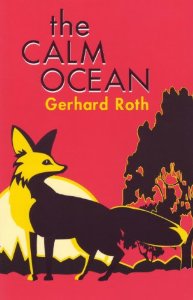 Some books demand to be read based on their covers alone. Such is the case with The Calm Ocean by Gerhard Roth, which I was surprised to find sans ugly hardcover binding on the university library’s shelves. The bright red background initially draws the eye, which may then focus on the fox, specifically the head, also depicted in primary color. Illuminated by the rising sun (or moon) behind it, the highly stylized fox is looking back across the face of the book, into the unknown. The eye might now wander up to the title of the novel, which seems to contradict the rural scene represented on the cover. One begins to wonder about this contrast, and whether the fox is significant in any way, as well as what the title says about the book.


