‘he walked arm in arm with his shadow’ (éric chevillard)

aural darkness in june. a way to refuse the heat. alice. another merciful release. a spiral of silence. another five minutes in this chair. jabès with his name in his pain but his pain with no name. writing about the book and its hold over us. the power of the word. meanwhile duras is looking at the time. ‘it was ten o’clock. in the evening. it was summer.’ and what could maria call the time opening ahead of her…’this incandescence, this bursting of a love at last without object.’

been here too long. here early / leave late / write in boxes / move on wheels back uphill. two legs, four legs, crossing thresholds over and over. sidewalks of daily desolation. tedium in quin’s ‘city where every street declares its defeat.’ consider bernhard and his ‘born barricade fanatics’the shared ‘desire to barricade ourselves from the world.’

but then there is jabès in unwilling exile from his beloved desert. everyone in some form of exilemental, physical, spiritual—feeling incapable of return. like robin about whom the baron thinks ‘there was in her every movement a slight drag, as if the past were a web about her, as there is a web of time about a very old building.’ and yet nora saying ‘robin can go anywhere, do anything, because she forgets, and i nowhere because i remember.’ because what bliss it would be to forget, right, to not always be dragging that chain of keyless padlocks behind. two (mis?)interpretations of another’s experience. dangers of outside looking in. but what of robin. what of robin. on the floor barking like a dog. a shattered mirror. surrendered to expectations. a final transition to conditioned response. or the ultimate shedding of humanity’s heavy carapace.

belated lists for 2014

Happy New Year! Here are my belated lists of favorite books read and music listened to in 2014. Neither list is in any particular order. My reading slowed down in autumn when I took on Reiner Stach’s Kafka biographies. They ended up being my top favorites for the year, reminding me once again of my love for a good literary biography. As for music, it wasn’t a big year for new discoveries, but plenty of indulging in old favorites and a few newer passions from recent years. I tend to listen to music seasonally, so not all of these are in rotation year-round. I also plan to post a list of favorite films for the year, but that will take some extra time to compile as I don’t always make notes of what I watch.

Books

Completed reads: 72
Abandoned reads: 4

1. Kafka: The Decisive Years by Reiner Stach
2. Kafka: The Years of Insight by Reiner Stach
3. The Notebook, The Proof, The Third Lie: Three Novels by Agota Kristof
4. To Whom It May Concern by Raymond Federman
5. The Will to Sickness by Gerhard Roth
6. Kaddish for an Unborn Child by Imre Kertész
7. Yes by Thomas Bernhard
8. It Then by Danielle Collobert
9. Selected Poems of René Char by René Char
10. Life, End of by Christine Brooke-Rose
11. I Am Lazarus: Stories by Anna Kavan
12. Topology of a Phantom City by Alain Robbe-Grillet
13. Mauve Desert by Nicole Brossard
14. Song of the West: Selected Poems by Georg Trakl
15. A Schoolboy’s Diary and Other Stories by Robert Walser

Music

1. The Smiths
2. The Cure
3. Swans
4. Grails
5. Nadja
6. Jesu
7. Om
8. Lycia
9. Caudal
10. Boards of Canada
11. Gravenhurst (thanks, Dan; RIP Nick Talbot)
12. Nick Drake (mostly Pink Moon)
13. Skinny Puppy (mostly Remission, Bites, Rabies, & The Singles Collect)
14. Front Line Assembly (mostly The Initial Command & State of Mind)
15. Slowdive, with Low [live show with JFaunt ♥]
16. Helicon’s 29th Annual Winter Solstice Concert [live show]
17. Danny Paisley & The Southern Grass, with Chester River Runoff [live show]

kafka: ‘in a different realm’

“It is conceivable for a writer to take the pulse of his era and make it come alive in language and images, yet still be out of his depth when it comes to palpable engagement with the world, although this constellation is exceedingly rare. Far more often someone who is truly at home in two worlds is misunderstood as being ‘out of touch’ in the public, social cosmos, which he shapes and endures in combination with others, and in an interior psychic space dominated by feelings, dreams, fantasies, associations, and ideas, which he inhabits alone. Anyone whose experience inside his head offers as vast and constant a stream of impressions as the world outside cannot stay focused on the here and now. But where is he then? In a different realm.

An individual who appears to be out of touch with reality is rarely in the privileged position of being able to open and close the subtle locks between inside and outside at will. The vortex pulling him inside his head is always palpable, but the reality principle demands that he remain perpetually alert; people expect him to limit himself to things that can be communicated. Anyone who starts talking about daydreams on the street, in a store, or at the workplace alienates people, no matter how intense and meaningful those daydreams are. He remains alien because he understands and acknowledges a second world, and for the most part, and to his detriment, he remains just as alien in that interior world for the same reason. He is present, but neither here nor there.

That condition can culminate in insanity, and Kafka justifiably feared winding up insane throughout his life. But it has little to do with the accomplishment society expects of the individual. Someone who is alienated from the world might function perfectly well as a craftsman, attorney, teacher, or politician, or as a vice secretary of an insurance institute, and his struggle to balance himself—poised like a man with one foot off the ground—can easily remain hidden from view, without a trace, as it probably has in thousands upon thousands of brains.”

Reiner Stach, Kafka: The Years of Insight

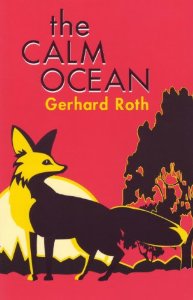
allure of the cover

The Calm Ocean Some books demand to be read based on their covers alone. Such is the case with The Calm Ocean by Gerhard Roth, which I was surprised to find sans ugly hardcover binding on the university library’s shelves. The bright red background initially draws the eye, which may then focus on the fox, specifically the head, also depicted in primary color. Illuminated by the rising sun (or moon) behind it, the highly stylized fox is looking back across the face of the book, into the unknown. The eye might now wander up to the title of the novel, which seems to contradict the rural scene represented on the cover. One begins to wonder about this contrast, and whether the fox is significant in any way, as well as what the title says about the book.

The Austrian writer Roth is a relatively new discovery for me, thanks to a recommendation last year from a friend over at Goodreads. Roth’s early work falls into the broad soup of ‘experimental’ fiction, lacking the more traditional trappings found in realist fiction. But he grew closer to realism over the years, though I find his take on it to be palatable. It’s as if he took the experimental skeleton he crafted as a younger writer and hung some strange costumes on those angular bones. Murky and sometimes even hallucinatory, Roth’s post-experimental fiction is not to be overlooked simply because it began to dress in new and bizarre realist outfits. Of course I say this while now reading only my second of these later works (the first Roth book I read, The Will to Sickness, was much more experimental; the second one, The Lake is a later work). But I have a feeling (partly based on other descriptions/reviews I’ve read), that I am right about Roth in this regard.

In his writing, Roth is concerned with sifting through the social and political culture of his home country of Austria, both past and present. Most of his books resemble mystery novels, at least superficially. They are not traditional mysteries at all, though, and readers who simply must find out all the details of what happened should probably stay away. At this point in my reading of the book, The Calm Ocean already recalls the The Lake in that it also concerns a man away from home, in an unfamiliar provincial place, feeling disoriented and alienated. Since my reading thrives on characters like this, I was drawn in immediately. I’m still early on, but I already know that it will live up to the promise of the cover.

Roth has completed two ambitious cycles of works, each of which consists of novels, essays, and documentary volumes: Die Archive des Schweigens (The Archives of Silence) and Orkus (Hades), the former consisting of seven works, and the latter of eight. Unfortunately, many of these works are still unavailable in English, though Ariadne Press has been doing an admirable job in bringing some of them into English translation, with their focus centered on ‘Studies in Austrian Literature, Culture & Thought’. Hopefully these current offerings from Ariadne, as well as Atlas Press and Burning Deck (each of which has published one of Roth’s earlier books in English), will grow in popularity among English readers and thus attract more translation efforts in the future. Roth certainly ranks with Thomas Bernhard as a contemporary Austrian writer very much worth reading (Elfriede Jelinek and Peter Handke being two others on my list of to-reads).

books!

Since I shut down my Goodreads account, I plan to post more book reviews and bookish thoughts here. This doesn’t mean the blog will morph into a reading blog, but as I’m experiencing a bit of a creative impasse at the moment, there may be more book talk in the near future than anything else. Curiously, even when I’m in a fallow creative writing period I find it possible to write about books. I think this is related to the schismatic phenomenon between reading and writing (creative writing, that is), so that during times of heavy reading one cannot write, and during times of heavy writing, one cannot read. Thomas Bernhard spoke of this (I will have to dig up the quote, as it is typically extreme, and hence, amusing), as have other writers. So, rather than let this blog languish during those times, which is what has occurred in the past, I will endeavor to post about books and writers.

There are a few books I originally wrote reviews of on Goodreads that I will be highlighting, interspersed with whatever books of significance to me that I have recently completed.

Stay tuned for an upcoming post on the elusive Gil Orlovitz.

And in the meantime enjoy this song by Caudal…it’s soothing in a rhythmic, hypnotic way.

Edit: Found the Bernhard quote. It’s from his memoir Gathering Evidence.

“When I am writing I read nothing, and when I am reading I write nothing. For long periods I read and write nothing, finding both equally repugnant.”

my austrian gorge

I rung in the New Year with a vicious bout of gastroenteritis. It felt like 2012 was clawing its way out of my body. And now that it is gone I am empty. Perhaps it is good to start another year empty. Fill me up, 2013.

People say don’t take your health for granted. Every time I am ill I am reminded of this. For the world seen through sickened eyes is not the same as that seen through healthy eyes. One moves through life with somnambulistic motions. Gone are the little tendrils of thought so often coursing off in all directions. A single-mindedness takes over. I must drink some water. I must lie down. I must walk the dog. I must lie down again. Mere survival. Reading becomes impossible. Too much focus required. Staring into space becomes commonplace. Or glazing over in front of the telescreen. Anything to dull consciousness of the ill feelings.

Yesterday I worked from home. I was not well enough to return to the office, but there was work to be done, and I felt capable of doing it. Besides, the last thing I wanted to do was spread this plague to anyone else. I always find that I am more productive and efficient when I work from home. I’m not sure why this is. It may be that I am able to work in front of a window at home. One might think that this would lead to distraction and daydreaming but such is oddly not the case. I find it comforting. My bird friends come to visit, alighting in the crepe myrtle branches and hopping about on the porch roof. It keeps my spirits up and my mind focused on task. At the office I sit in a dim windowless womb in front of two screens, impassively observing my soul die a laborious death, each email and meeting appointment a tiny wound I am too dulled to deflect (in his typically dark style, Thomas Bernhard once wrote: “Instead of committing suicide, people go to work”).

Coming out of illness now, I am feeling tentative. My diet remains bland and simple. I miss coffee. The world still seems an unforgiving place. Outside the wind howls, chilling my weakened frame. But I can read again, and I find solace in Bernhard’s novel Correction. It is the perfect book for right now, with its hypnotic cadence, repetition, lack of paragraph breaks, dark subject matter. I feel poised above a rushing gorge in the Austrian wilderness.

Perhaps this is the worst 2013 had to hurl at me. Toxins now purged, I feel ready.

Soundtrack to this post:

Red Lorry Yellow Lorry — Nothing Wrong
Shipping News — Flies the Field
Metroschifter — Schift-Ship

peering out from dormancy

The recently sliced up confetti of old words sifts through my fingers as the primitive beats of old heavy music pulses in the other room. Winter is upon us, oh yes, with the wind and the snow and the sleet and the penetrating coldness. Every year the shock of how slowly real winter arrives here beats me about the head with a large stick come late December, early Januaryish. Cold fingers tapping on the keys, the chill of the glass in these windows, how reading in the sunroom suddenly means reading in the ice fishing shack. And how I become a grumbly old man, rug thrown across my lap, scarf encircling my neck, unwashed hair standing on end, burning words in my brain to stay warm somewhere, if not on the outer surfaces, then at least on the inner ones.

I still prefer it to the stifling madness of a city summer. I find it easier to get warmer than to get cooler. The lack of mosquitoes in winter thrills me. Sometimes I loiter in my front yard, teeth chattering, for the mere joy of not being eaten alive by those tiny flying demons.

The bitter cold purifies. Most living things die out there. Or go dormant. I go semi-dormant myself, though this state is not dissimilar from other times of year for me.

On cold days, humans appear on the street as rapid bundles of fabric. On hot days, humans appear on the street as languid loops of flesh. Take your pick.

I’m making good use of my vacation from the-place-that-shall-not-be-mentioned-by-name. In addition to copious reading, I’m indulging in a bit of paper management, something which I tend to ignore the necessity of for months at a time. This activity chiefly entails clearing off a desk I no longer use, famed dumping ground of mail that may or may not require saving and paper scraps scrawled with cryptic notations that I must now decipher in order to determine their value. But it also extends to shredding old writing: abandoned manuscripts, hard copies of blog entries, failed stories, and handwritten pieces that have since been either typed up or rejected. Destroying my own words gives me secret pleasure (well, it’s no secret anymore). So much of what I’ve written is dead to me, and I am merely finalizing that. The end of the year is a good time to do this. One desires a clean slate, at least on some levels. We are of course multi-slated individuals, and not all slates require erasing.

Yes, so here I am talking about the weather and my fascinating domestic life. It’s not what I wanted to write about, but I have not figured out yet how to write about what it is that I want to write about. Oddly enough this past summer was more fertile for that, so perhaps the heat is good for something after all.

Playlist for above activities and subsequent transposition into words:

Universal Order of Armageddon – Discography
Sleep – Volume One
Charles Mingus – Mingus Moves

jakob von gunten [book review]

Jakob von Gunten by Robert Walser

I feel how little it concerns me, everything that’s called “the world,” and how grand and exciting what I privately call the world is to me.

I used to love a good Bildungsroman. Perhaps every young person does, as they are approaching the age where they will be cast unfeelingly out into the world, whether prepared or not. I guess I saw myself in these characters, encountering obstacles and slowly overcoming them—it gave me hope that I would also someday be prepared. But as I got older I never really did feel ready to be an ‘adult’ and so the Bildungsroman became a myth. Life was more a series of never-ending lessons that no amount of advance preparation seemed capable of preparing oneself for. I believe they also call this losing one’s naivete.

This novel is written as a journal by Jakob, who is attending a school for servants. Walser himself attended such a school, and likely based the book in some part on his experiences there. Some say that the novel is a parody of the Bildungsroman genre. To an extent I think this is true. Jakob does enter the world at the end, but in a bizarre and unexpected way, and it’s certainly questionable how prepared he really is. He never completely grows out of childhood because, as he says, “I was never really a child, and therefore something in the nature of childhood will cling to me always, I’m certain.”

In between his mockery of the Bildungsroman genre, Walser injects bits of his own truth. Jakob is a dreamer. In one entry, he writes, “With all my ideas and follies I could one day found a corporate company for the propagation of beautiful but unreliable imaginings.” Jakob doesn’t take school, or much of anything, seriously. He’s prone to reveries and cheekiness. He enjoys provoking the school’s principal, and yet he also maintains a hushed level of respect, largely kept to himself, for this complex man.

Jakob has a tenuous relationship with his brother Johann, who lives in the same city but operates in a higher echelon of society, one that Jakob privately mocks in his journal entries:

People who make efforts to be successful are terribly like each other. They all have the same face. Not really, and yet they do. They’re all alike in their rapid kindness, which just comes and goes, and I think this is because of the fear which these people feel. […] Whoever can feel right if he places value on the tokens of respect and the distinctions conferred by the world?

Walser himself likely thought this way, at least to an extent. While writing, he led a life balanced precariously on the precipice of financial disaster. He did not have concern for material things and perhaps felt out of place in the larger world outside his creative pursuits. Regrettably, he never found much literary success during his lifetime, later becoming suicidal and eventually institutionalized, at which point he stopped publishing altogether.

Jakob counters the boredom of life in his school with healthy amounts of daydreaming. He imagines things to be a certain way, such as the ‘chambers’ in which the principal and his sister, the instructress, live. For most of the novel Jakob is not allowed in this private area of the school, and dreams it up to be a network of intricate castle rooms and apartments, full of corridors and spiral staircases. And yet he is profoundly disappointed when finally he enters those rooms and finds them simple and frugally furnished. This clash of reality with his dream life constantly chafes at him:

Bare reality: what a crook it sometimes is. It steals things, and afterwards it has no idea what to do with them. It just seems to spread sorrow for fun.

Despite his sometimes uneven nature, Jakob is an immediately likeable narrator. And even though this is meant to be a journal, Walser uses certain literary devices to help string together what is largely an erratic and meandering narrative arc. For example, he has Jakob peer through the keyhole of the principal’s office and laugh following each meeting he has with Herr Benjamenta. This recalled to my mind a similar technique Thomas Wolfe used in Look Homeward, Angel, itself a Bildungsroman of the American variety. In that novel, Wolfe associates certain repetitive phrases and actions with particular characters, which I think helps maintain a tighter narrative flow, in addition to quickly endearing the characters to a reader.

The humor in this book frequently borders on the absurd, and is one of its strengths. Jakob likes to often end his entries with non sequiturs. He is snarky and usually perceptive in his snarkiness. Walser was clearly a close observer of human nature and behavior. He imbues Jakob with these skills, and so while we get a lot of ridiculous banter from him, we also glean sharp insights. The result is a short compact novel that generates both laughs and moments of contemplation, often on the same exact page.

digging in the shade of the vowel tree

Sylvia Plath wrote of
intolerable vowels
entering her heart
but what of ruthless
consonants headed
to our brains.

We all know about a-e-i-o-u and sometimes y. They may be intolerable but their numbers are small. And they are more easily made to do our bidding. The consonants, in contrast, are legion and their rigidity stifles. Perhaps the only way to harness their true power is to one-by-one start taking them away.

Anna Kavan wrote:

I had only learnt how to be friends with shadows; it might be too late to learn the way of friendship in the sun.

Friendship in the sun is a mirage. The way to it is false. The sun fades color and one day it will kill us all. Shadows make easy friends: we pass through them as they do through us. Few stay long. It is their nature. Sometimes it feels like it is in all our natures to expand and contract, pull away and grow close, like a squeezebox played by a jittery ghost.

Kafka wrote:

No one will want to lie in clouds of mist with me, and even if someone did, I couldn’t expel the mist from my head.

This gets at the heart of the problem, I think. One feels an isolation and maybe a desire to connect, sometimes even a desperate mania. But who can share a dreamy solitude? By definition, no one. And if it was at all even possible, the mist remains. How could we find each other. How could one’s dream self operate in reality? The pilot seat in your head is unlike the one outside of it. Out there, we cannot twist the knobs, adjust the instruments without consultation, without repercussions, without the sun blinding us. In the shadows, the mist, these difficulties melt away.

Jung wrote:

A man can hope for satisfaction and fulfillment only in what he does not yet possess; he cannot find pleasure in something of which he already had too much.

Yikes, Carl, that’s bleak, even by my admittedly generous standards. In fairness, on the next page of Modern Man in Search of a Soul, Jung also states: “The needs and necessities of individuals vary. What sets one free is for another a prison.” So I guess one could argue that for some people overindulgence sets them free, although I don’t think that’s his point with the former quote. I think it is about anticipation. Jung is talking about this concept in the context of the development of analytical psychology, and yet it stands out in the text as such a sweeping statement. But I don’t think this aphorism or whatever you want to call it can be universally applied. Certainly competitive eaters don’t find pleasure in the 18th hot dog in a row that they’ve shoved down their throats. But can Jung honestly think that attaining the love of another person does not lead to satisfaction and fulfillment? I mean, I will grant him that unrequited love is an exquisite thing, and possibly more intense on the whole than many long-term relationships. But no satisfaction and fulfillment for those in love? I don’t know, maybe he is not including love or other emotions here. Maybe he is referring strictly to material things, in which case I willingly concede his point.

Édouard Levé wrote:

The full weight of depression comes on between 1-5 PM, particularly when I am home by myself. Mornings and night are more filled with promise.

Filled with promise. Is that what we are after? Moments filled with promise? Is it merely the anticipation we crave, what Jung says we can find satisfaction and fulfillment in? Anticipation can be tantalizing, I’ll admit. But how. How can we be satisfied with mere promise. Inherent in promise is a pledge to fulfill at some point in the future, not at the moment of the promise. Like an IOU. Is it the step we take to accept the promise that is meant to satisfy? Is it the mental and/or emotional trust fall we allow ourselves to take? If so, what of broken promises. Do those negate the previous gain in fulfillment? Well, do they, Jung? If he were here, I’d have more than a few questions for him.

Levé also wrote: “Above a certain height I like what I see. Below it I don’t.” I suppose we can read this on a literal or a metaphorical level. What is the certain height. And is it a chronological point, a philosophical one, a spiritual one. Who knows. I think we can safely say, though, that whatever the certain height represents, it changes between individuals. Remember how Jung said what sets one person free is another person’s prison.  Some people don’t like what they see above a certain height, while others crane their necks for a peek. Some spend their lives craning for that view, but some are content to not look. They don’t want to know…they look away in fear, shame, embarrassment, whatever.

So what is the conclusion. Is Kafka’s mist the same as Carson’s foam? Sometimes it’s a strain to make all the connections. Certainly reading and writing are key decoder rings. Endless battles, ceasefires, sneak attacks, and truces with the vowel and consonant armies. And maybe the ladder stretches high enough to see above the mist. I think others have ladders high enough, too. If we squint hard enough we can probably see each other, mouths flecked with foam, across the scorched battlefield strewn with bloody words and mangled sentences. Hello there! I do not have rabies. I am merely seeking the sublime. Perhaps you’d care to meet in the mist and discuss for a few moments. I’ll be waiting.

salvation

© 2012 S. D. Stewart

Rage simmered and eventually overflowed in the library when I found only two of eight books on the shelf (Endgame and 77 Dream Songs [depicted as that glowing white brick at the bottom of the pile]). There was one Virginia Woolf book on the fiction shelves. One! Do you know how many the library owns? 22!! When I harassed the librarian about the library’s practice of storing books out of public view without indicating their status in the public catalog she shrugged off my indignation with some syrupy party line about the many hundreds of thousands of books in their collection and the sheer lack of space. “The general rule is if a book is five or six years old, chances are it will be in storage.” Yes, I understand the need for storage when you have such a meager number of shelves devoted to fiction in a library serving a population of over 600,000 people! But please, for the love of everything that is decent in the world, the least you can do is flag the books in the catalog that are not on the shelf! I cannot assume a book is in storage and go directly to the desk because what if it is not…then I look like an ass. Besides, the librarian in the Humanities Department always checks the shelf anyway. Not to mention the tragic loss of browsing capability. I don’t always know what books I want. I want to handle them, to caress their covers, to whisper sweet nothings into their bindings. When I brought this up it was met with a vacant stare and an empty smile. So much for a user-centric attitude.

  • Recent Posts

  • Navigation Station

    The links along the top of the page are rudimentary attempts at trail markers. Otherwise, see below for more search and browse options.

  • In Search of Lost Time

  • Personal Taxonomy

  • Common Ground

  • Resources

  • BOOKS BOOKS BOOKS