
Two-way interview with David Bowie and William Burroughs (Rolling Stone, 1974)
Two-way interview with David Bowie and William Burroughs (Rolling Stone, 1974)
Posted by sean on January 11, 2016
https://sd-stewart.com/2016/01/11/rip-david-bowie/
Feature article at Resident Advisor
“We should be careful to consider exactly what future we are defaulting to, and what ways we have been taught to engage this default-future,” she says. “As someone who is brown, someone who is queer—struggling to exist as both—my relationship with the future has been precious because it’s where my positivity can take flight, where the narratives I embody / live / create, jettison out and into being, full of hope and energy.”
Feature article at TinyMixTapes
“My body a dwelling between colonized and colonizer, I once carried a shame of my brownness. It was as though my whiteness wanted to purge my mother’s blood from me; I would even pray that I would wake up to find myself not only entirely white, but entirely a ‘real boy,’ because even then, I already knew I didn’t fit in with the gender assigned to me. Contact with my Bolivian/indigenous heritage — whether that was through music, language, food, or literally touching the ground of La Paz — was crucial to undoing this mental fixation, this internalized hatred. My encountering with landscape, my reaching out to it, gave clarity to concepts still difficult to put into/retain with languages. In Mexico, the rules were different: as a child, I could ride deep into the countryside, unsupervised. I became aware of my own longing, isolation, hysterical positioning, while at the same time uncovering a new relationship with (and very disanthropocentric companion in) landscape. It was by this encountering that I found god, godness — this thing in me that was also an excess, indifferent yet total grace, this thing that embraces, hides, moves through what I am, surviving what I am, yet always dying in order to be new (its newness is ancient).”
See also: Moth / Lake
(Happy New Year!)
Posted by sean on January 5, 2016
https://sd-stewart.com/2016/01/05/elysia-crampton/
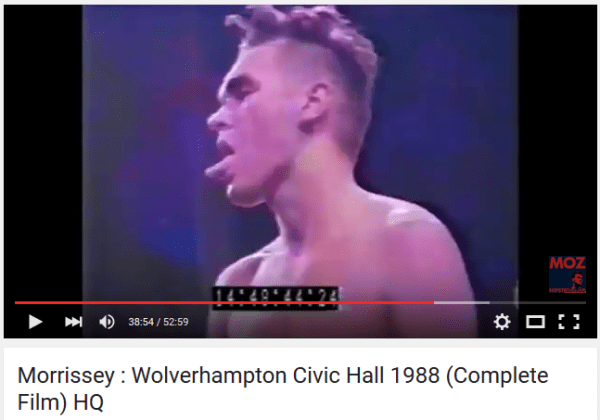
Debut solo gig / farewell Smiths concert – click to watch – the band comes on stage at about 12:00
Posted by sean on November 5, 2015
https://sd-stewart.com/2015/11/05/morrissey/
Belgian coldwave band Spiral of Silence.
Posted by sean on August 20, 2015
https://sd-stewart.com/2015/08/20/spiral-of-silence-across/
More evidence of the mysterious power of music…
Maybe most notably, patients listening to music used significantly less pain medication. Meads says, on average, music helped the patients drop two notches on the 10-point pain scale. That’s the same relief typically reported with a dose of pain-killing medicine.
Posted by sean on August 13, 2015
https://sd-stewart.com/2015/08/13/self-medication-with-music/
Do you love folk music? It may be due to your empathetic nature. A new study in PLOS One shows there is a relationship between musical preferences and personality, as well as how we think.
(That is clearly the most journalistic lead I’ve ever written on this blog. Absurd! Who do I think I am.)
Recent reports on the study have appeared in The Atlantic, the BBC, and on NPR.
Says The Atlantic:
[Study author] Greenberg found that people who scored high on empathy tended to prefer music that was mellow (like soft rock and R&B), unpretentious (country and folk), and contemporary (Euro pop and electronica.) What they didn’t like, meanwhile, was “intense” music, which he classified as things like punk and heavy metal. People who scored high on systemizing, meanwhile, had just the opposite preferences—they kick back to Slayer and could do without Courtney Barnett.
To get even more specific, the music empathizers liked tended to be softer, more depressing, and have more emotional depth. Systemizers, meanwhile, grooved to things that were high-energy, animated, and complex. Empathizers liked strings; systemizers liked distorted, loud, and “percussive.”
Loving both mellow and intense music apparently indicates my empathetic systemizing nature. I straddle the line, which I already knew. But what I’m curious to know is if at any given moment musical preference can indicate current capacity for empathy. For example, if I’m listening to Skinny Puppy would I be less inclined to listen to someone’s troubles than if I were listening to Nick Drake?
Posted by sean on August 8, 2015
https://sd-stewart.com/2015/08/08/personality-and-musical-preferences/
The new trail opens up the wildest area in this urban forest oasis. Clusters of mushroom sprout from the center of the path. Few have walked here yet. It is high summer and the wood thrush yet sings. Cicadas offer up a constant backing drone. Point of fact: dogs don’t process the switchback concept. It conflicts with their innate knowledge of the shortest distance rule. As the trail climbs from the deepest shaded low point, the morning heat barges uninvited into the cool air space. Sounds of the nearby freeway intrude. As I struggle to adapt, a certain chorus tears through my head in response. This walk is soon over.
Posted by sean on July 31, 2015
https://sd-stewart.com/2015/07/31/ravine-trail/
Posted by sean on July 30, 2015
https://sd-stewart.com/2015/07/30/the-cure-the-forest-live-on-french-tv-1979/
I spend a lot of time trolling YouTube for obscure punk, post-punk, darkwave, and associated fringe music. It’s a compulsion, although I remain conflicted over listening to this music without paying for it. If YouTube was like an all-you-can-eat buffet where you paid one price and could gorge on as much music as you wanted, I would gladly pay that fixed price (provided it went directly to the musicians). And frankly, I’m surprised YouTube has not yet gone the subscription route, though I suspect such a fate is not far off. The fact is that I cannot afford to individually support every musician I listen to on YouTube by buying their music, if it’s even still available for purchase, which it very often is not since most of these bands are inactive and/or have no web presence. And I should clarify that I do still pay for music. If there is a band that I really enjoy and find myself repeatedly wanting to listen to their music, I will seek them out and if their music is available to purchase somewhere I will buy it. But with many of the bands I find, I’m just sampling them and moving on. Only a select few do I find myself returning to listen again. In this respect YouTube is a good place to do music research, and so perhaps it’s not such a bad thing if it leads to people buying music they otherwise would not have known about. With that in mind here are a couple of my recent finds below. And I should add, as many music-uploading YouTube users often do: if you like these bands, please support them by buying their albums! The Au Pairs albums can be hard to find but they are still out there in various formats. And the Poison Girls website offers most of their releases as downloads, with a PayPal ‘honesty box’ for payments.
Au Pairs – Fronted by lesbian-feminist Lesley Woods, whose lyrics both skewered sexual and social politics and celebrated sexuality from a woman’s perspective, the Au Pairs played post-punk occasionally reminiscent of Gang of Four, with its prominent funk-inspired bass and trebly guitar. Their second LP ‘Sense and Sensuality’ found them straying even more into jazz and funk territory. Here’s a fantastic live track from that album. Also check out this episode of Post Punk Britain from earlier this year featuring an interview with Woods, a playlist chosen by her (including several Au Pairs songs), and a new song she recorded for the show.
Poison Girls – An anarcho-punk band led by Vi Subversa, a middle-aged mother of two, Poison Girls were early contemporaries of Crass and recorded their first single on Crass Records. But they weren’t a typical anarcho-punk band (if there is such a thing), and later went their own musical way. From what I’ve read of their story, it’s more interesting than that of Crass and the rest of that milieu, but I’m always more captivated by the outsiders, even in a scene already far outside the mainstream. Vi’s lyrics, capturing the perspective of a smart woman growing older as she continues to rail against the patriarchy, communicated an experience not commonly heard at the time in punk music. And the music was certainly not run-of-the-mill, either.
Posted by sean on June 25, 2015
https://sd-stewart.com/2015/06/25/two-feminist-punkpost-punk-classics-and-some-thoughts-on-youtube/

 s. d. stewart