150 years of alice’s adventures

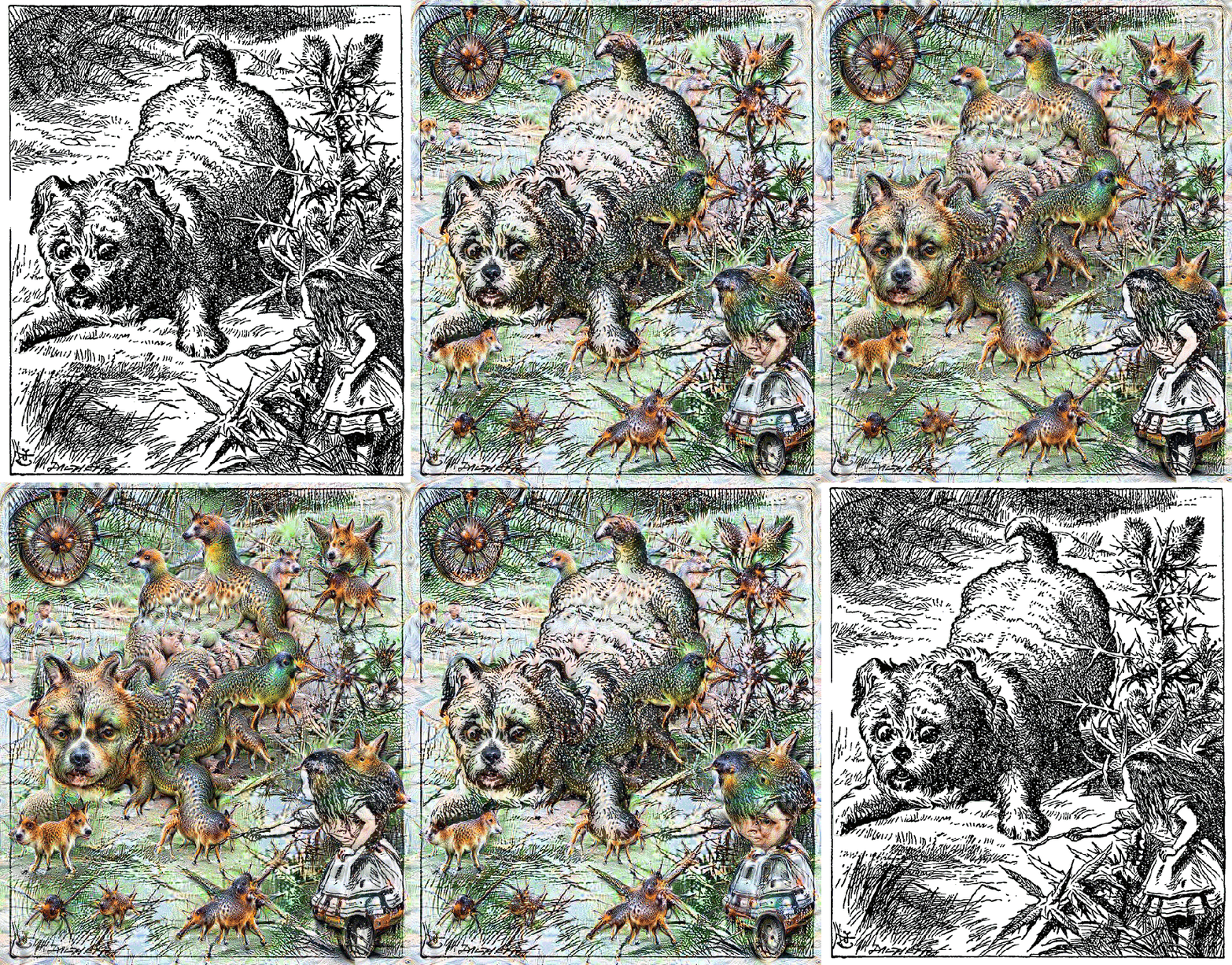
Illustration remix by Anna Vignet.

Illustration remix by Anna Vignet from Alice’s Adventures in Wonderland, an online annotated edition featuring twelve Lewis Carroll scholars taking one chapter each, plus new artwork and remixes from classic 1865 and 1905 illustrations. A joint project from The Public Domain Review and Medium, on the occasion of the story’s 150th anniversary.

‘he walked arm in arm with his shadow’ (éric chevillard)

aural darkness in june. a way to refuse the heat. alice. another merciful release. a spiral of silence. another five minutes in this chair. jabès with his name in his pain but his pain with no name. writing about the book and its hold over us. the power of the word. meanwhile duras is looking at the time. ‘it was ten o’clock. in the evening. it was summer.’ and what could maria call the time opening ahead of her…’this incandescence, this bursting of a love at last without object.’

been here too long. here early / leave late / write in boxes / move on wheels back uphill. two legs, four legs, crossing thresholds over and over. sidewalks of daily desolation. tedium in quin’s ‘city where every street declares its defeat.’ consider bernhard and his ‘born barricade fanatics’the shared ‘desire to barricade ourselves from the world.’

but then there is jabès in unwilling exile from his beloved desert. everyone in some form of exilemental, physical, spiritual—feeling incapable of return. like robin about whom the baron thinks ‘there was in her every movement a slight drag, as if the past were a web about her, as there is a web of time about a very old building.’ and yet nora saying ‘robin can go anywhere, do anything, because she forgets, and i nowhere because i remember.’ because what bliss it would be to forget, right, to not always be dragging that chain of keyless padlocks behind. two (mis?)interpretations of another’s experience. dangers of outside looking in. but what of robin. what of robin. on the floor barking like a dog. a shattered mirror. surrendered to expectations. a final transition to conditioned response. or the ultimate shedding of humanity’s heavy carapace.

coleman dowell, from island people

You drive, walk, eat, look at television, read, and all the while, beyond you and the cozy circle created by your lady around herself and you, like the natural emanations of stars, other lives circle yours, seeds still winged and wind-borne, looking for sympathetic soil. You feel the juices and solids of your body in attempted rearrangement, or, more disturbing, making an effort to create a stillness that approximates death, beyond which the body does become soil, receptive to all wind-borne seeds. In a not especially prolonged stillness, as though no chances could be taken that you might decide to become perpetual motion, words fall out of the air, a random fall from which you might be tempted to make selection, and as you do not move, cannot, a string of words falls onto you, and from you, onto the paper: winter rye greening up, smoothing the old brown earth with a fine new plane: Carpenter Rye, neighbor.

–Coleman Dowell, Island People

belated lists for 2014

Happy New Year! Here are my belated lists of favorite books read and music listened to in 2014. Neither list is in any particular order. My reading slowed down in autumn when I took on Reiner Stach’s Kafka biographies. They ended up being my top favorites for the year, reminding me once again of my love for a good literary biography. As for music, it wasn’t a big year for new discoveries, but plenty of indulging in old favorites and a few newer passions from recent years. I tend to listen to music seasonally, so not all of these are in rotation year-round. I also plan to post a list of favorite films for the year, but that will take some extra time to compile as I don’t always make notes of what I watch.

Books

Completed reads: 72
Abandoned reads: 4

1. Kafka: The Decisive Years by Reiner Stach
2. Kafka: The Years of Insight by Reiner Stach
3. The Notebook, The Proof, The Third Lie: Three Novels by Agota Kristof
4. To Whom It May Concern by Raymond Federman
5. The Will to Sickness by Gerhard Roth
6. Kaddish for an Unborn Child by Imre Kertész
7. Yes by Thomas Bernhard
8. It Then by Danielle Collobert
9. Selected Poems of René Char by René Char
10. Life, End of by Christine Brooke-Rose
11. I Am Lazarus: Stories by Anna Kavan
12. Topology of a Phantom City by Alain Robbe-Grillet
13. Mauve Desert by Nicole Brossard
14. Song of the West: Selected Poems by Georg Trakl
15. A Schoolboy’s Diary and Other Stories by Robert Walser

Music

1. The Smiths
2. The Cure
3. Swans
4. Grails
5. Nadja
6. Jesu
7. Om
8. Lycia
9. Caudal
10. Boards of Canada
11. Gravenhurst (thanks, Dan; RIP Nick Talbot)
12. Nick Drake (mostly Pink Moon)
13. Skinny Puppy (mostly Remission, Bites, Rabies, & The Singles Collect)
14. Front Line Assembly (mostly The Initial Command & State of Mind)
15. Slowdive, with Low [live show with JFaunt ♥]
16. Helicon’s 29th Annual Winter Solstice Concert [live show]
17. Danny Paisley & The Southern Grass, with Chester River Runoff [live show]

the tanners [book review]

Recently I began reading Robert Walser’s novel The Assistant. I associate Walser with the winter season, and particularly the month of December, likely because that was when I first started reading his work. Walser also died in December; he was found lying in the snow on Christmas Day 1956, having suffered a heart attack during one of his frequent and much-loved walks.

The Assistant has been a joy to read so far, brimming with Walser’s off-kilter cheekiness and his typically exuberant scenic descriptions. And so, with my enthusiasm for his writing in its current heightened state, I thought I’d share another of my Walser reviews from the archive, with the hope of encouraging others to investigate this still tragically under-read writer.

____________________________________________________

The Tanners by Robert Walser

I don’t want to go running down some career path—supposedly such a grand enterprise. What’s so grand about it: people acquiring crooked backs at an early age from stooping at undersized desks, wrinkled hands, pale faces, mutilated workday trousers, trembling legs, fat bellies, sour stomachs, bald spots upon their skulls, bitter, snappish, leathery, faded, insipid eyes, ravaged brows and the consciousness of having been conscientious fools. No thank you!

Robert Walser was an odd fish and I like him a lot. Even though he once said, as W. G. Sebald reports in the introduction to this book, that he was essentially always writing the same novel, one which he said could be described as “a much-chopped up or dismembered Book of Myself,” I will continue reading his same-as-before novels because they captivate me. I like to think of him up in his stuffy attic room, frantically writing on borrowed paper with stolen pens, gripped in the passion of that writing, of hurling his herky-jerky version of the world down onto the page.

The Tanners is the disjointed story of the Tanner siblings: Simon, Klaus, Kaspar, and Hedwig (oh, and the mysterious Emil, who later randomly shows up in another character’s anecdote). Primarily, the “plot” (such as it is) follows the adventures of Simon as he bounces around from job to job while basically pursuing the sublime. From the start, Simon reminded me of Jakob from Walser’s anti-Bildungsroman Jakob von Gunten, with his similar tendency toward mockery traced with veins of sincerity. Or maybe it was just straight mockery, maybe I imagined the traces of sincerity—it’s really so hard for me to say for sure. When Simon refers to his own cheekiness, I couldn’t stop thinking about that Saturday Night Live sketch where Mike Myers plays Simon, the kid in the bath making drawings who calls people “cheeky monkeys.” It’s always unsettling for me when pop culture and literature suddenly collide in my head. And yet the two Simons do share a similarity, if only a superficial one. But I digress. Simon is a self-described ne’er-do-well prone to walking all night through the mountains to visit his artist brother Kaspar, his closest sibling. Simon’s gleeful flippancy is infectious and makes him a likely candidate for the reader’s sympathy. Hedwig is the only sister in the bunch, a small town schoolteacher who Simon also stays with for an extended visit. They bond, but she suspects him of being a freeloader, which he sort of is. Hedwig is an interesting character, and Walser allots her some good speeches. Finally, Klaus is the oldest brother, a stodgy straight-arrow type who thinks he knows what’s best for all of his siblings. He is annoyingly overbearing, though probably well-meaning.

In the introduction, Sebald draws some parallels between Gogol and Walser that I found to be relevant, having just finished a book of Gogol’s short fiction. Like Gogol, Walser has a tendency to introduce characters who at the time seem like they may come to play important roles in his narrative, only to either suddenly kill them off or fade them into the background. Sometimes they also reappear later, just out of the blue, and fill us in on what they’ve been up to for the past year or however long they’ve been gone from the narrative. The aimless plot wanders down side streets, dead-ends, turns around, leaves the city, climbs a mountain, walks off a cliff, gets a concussion, and turns up back in the city again a few chapters later with a new lease on life. Or something like that. I was anthropomorphizing the plot just then. I would imagine that the general unreliability of Walser’s prose could easily become maddening for some readers. The key is to float along with Walser wherever he chooses to take you. One must surrender completely in order to enjoy reading; there is no fighting it because Walser will always win. Always. We are on an adventure with him, as he discovers his own truths in his writing. In this way he is also very much like Gogol, who eschewed the narrative traditions of the time and instead went off happily exploring in his prose.

Throughout the book, Walser spins a gauzy web of natural beauty around his characters who, when not walking around outside enjoying the weather or laying stretched out in the forest, very much tend to spout off lengthy monologues in the general direction of each other, not seeming to expect responses and, in fact, rarely getting them. Walser’s prose is so sensual, his descriptions of both urban and rural settings sparkle with crisp detail clearly borne of a sharply observant mind. Half the novel one falls into a reverie, while the other half one stares at the closest wall, noting the intricate cracks in the plaster with genuine interest.

Despite the lack of plot, there are certain themes to pick out. With Simon and Hedwig, we find themes of youthful self-discovery, the search for meaning and happiness in one’s life, and the ever-painful plight of the daydreamers among us. With Kaspar, there are the ideals of art and the difficulties inherent in one’s pursuit of those ideals. In Klaus, we see a rather sharp critique of mainstream society and the trappings of materialism and the pursuit of wealth. Readers who have siblings, particularly multiple siblings, will also likely enjoy the novel on another level less accessible to those who don’t, for Walser does an admirable job of portraying the complicated and contradictory dynamics that often characterize sibling relationships.

As Simon opines late in the book, “How tedious it was always to be doing exactly the same thing.” Some books always do the exactly the same thing, what we expect them to do, over and over. Not with Walser. Even if he did claim to be writing the same novel over and over, his prose is always worth reading, because it’s granular yet dissimilar; it’s made up of life’s strikingly mundane and spectacular moments, as pointed out by the likes of Simon, who, after all, claims to be “an outlandish figure in my own homeland.”

john hawkes: encounters with the abyss

I am imbued with the notion that a Muse is necessarily a dead woman, inaccessible or absent; that the poetic structure—like the canon, which is only a hole surrounded by steel—can be based only on what one does not have; and that ultimately one can write only to fill a void or at the least to situate, in relation to the most lucid part of ourselves, the place where this incommensurable abyss yawns within us.

            —Michel Leiris, L’Age d’Homme (published in English as Manhood)

The quote above is one of two epigraphs introducing John Hawkes’ short novel Travesty. It struck me as akin to my own feelings about writing. And in Hawkes’ case it is particularly apropos; for he “situates” the abyss like no other, and in reading him one gets the impression that he knows this is all he can do. An early American postmodernist, Hawkes wrote in an incomparable style, fashioning rich, mythic worlds peopled by characters that are so fully formed they seem real. His work often carries an air of menace, a peering over the edge of the abyss, and sometimes a dangling over it, held tenuously by the ankles. He leaves a lot unwritten, and part of the pleasure in reading him is the struggle to fill in these gaps.

I wasn’t familiar with Leiris, so I looked him up. I found this review of Manhood, which stoked my interest. Leiris was a French Surrealist writer and ethnographer who, in the reviewer’s words, “experimented with the consolidation of mythology, ritual and autobiography-writing.” In reading the review, I could see parallels between Hawkes and Leiris; it seems as if the latter could have been an influence on the former.

So one can write to fill a void, and in that respect, any subject is fair game. The trouble is that the abyss seems too overwhelming at times, too deep to fill and too hazardous to permit even the most cautious approach. Hurling a few sentences over the edge and listening for them to hit bottom feels like a lonely and futile exercise. In response, the temptation arises to shy away from it and instead dwell in more “lucid” inner locales.

Habit, the great deadener, must also be considered with regard to writing. But let’s take a step back for a moment and reflect on habit. Do you ever do something after not doing it for a long time and think: Wow, that thing is great! Why don’t I do that more often?? And yet this is the thing you were doing every day for months until you grew tired of it and stopped, thinking why do I bother? Habit, as a word, has a negative connotation. It’s always, Oh, that’s a bad habit. She picked up a bad habit. I’ve got to stop this bad habit. No one talks about good habits. It’s never, Oh, I recently picked up this good habit and it’s really helping me out. We need more talk about the value of good habits.

When it comes to writing, a moldy old adage dictates that one should write every day, no matter what the subject or form. This is considered a good writing habit. Just sit there and write and write and write for X amount of time each day and it will be fine. Yet many writers do not write every day. Some don’t write for months, until one day they fly into a manic state and write nonstop. It’s all about which practice works for you. But for those writers in this latter camp, those dry periods can run one ragged. Self-doubt creeps in and one wonders if the words will ever come again. Next comes a turning against the words. Hatred for words! Frustration at their failure to capture anything but a rapid-fade vapor trail of emotion and sensation; anger at their crude rigidity in the face of life’s constant flux.

Which returns us to Travesty. Because it seems to me that this strange little novel might be what a writer writes out of desperation when faced with one of these dreaded dry periods. The Leiris quote is the clue here, for an epigraph hints at the meaning of what is to come. The entirety of Travesty consists of one side of a conversation between the driver and one of the two passengers in a car speeding through the night in rural France toward a planned murder-suicide. Mostly it is a monologue by the driver, though the passenger does interject from time to time, which the reader discerns from the driver’s reactions. There is an absent woman who could be construed as a Muse for these two men; she is not dead, yet her distance from the story renders her near-dead. Even for Hawkes the scenario playing out in this novel is bleak, if not nihilistic. At a surface level, it reads as a piece composed on the brink of the void, a stream of dispassionate vitriol spit over the edge from dry, cracked lips.

It’s worth noting at this point that the second epigraph to the book is from Camus’ The Fall (a book which I have not read). Other reviewers have commented that Travesty reads as either homage to or parody of Camus. And in fact, in a 1976 interview¹ with Paul Emmett and Richard Vine, Hawkes mentions that he’d read The Fall a few months before several incidents that had partly inspired the book. While he evades admission that Travesty is indeed a “travesty” of The Fall, he does say he thinks “The Fall is in some way related to Travesty.” Of course, Camus also died in a car accident, which yields yet another Camus parallel to the book.

Returning to the void, though…in the final line of the conversation, while discussing Travesty, Hawkes says, “The ultimate power of the imagination is to create anything and everything—out of nothing…” Elsewhere in the interview, Hawkes is adamant that none of his fictional work is autobiographical (though he admits stray bits make their way into a text on occasion), and so the Leiris epigraph again rises up (“the poetic structure […] can be based only on what one does not have”). We cannot know if Hawkes was in a desperate dry period when he conceived the idea for Travesty. But it’s obvious that the text is at least in part concerned with this “ultimate power of the imagination.” For the narrator carefully constructs his murderous plan and describes it in calm, precise detail, just as Hawkes crafted the story and everything within it. And they are both empowered by their creations.

Maybe the “nothing” Hawkes refers to is equal to the void, or at least an alternate way of thinking about the void. Rather than a yawning abyss that swallows words (or prevents their creation) it should be thought of as a source for them. In this, the act of writing draws closer to Leiris’ idea of “situating” rather than “filling” the void. Situating the location of a void implies we have some control over it or at least knowledge of it, while filling a void seems an impossible task. If we know where the void is in relation to the “lucid part of ourselves,” it’s easier to manage our exposure to it, and even to draw upon it as a stimulus for creation.

_____________________________________________________________________

 ¹Emmett, Paul, and Richard Vine. “A Conversation with John Hawkes.” Chicago Review 28.2 (Fall 1976): 163-171. Accessed through JSTOR, 9 Jul. 2014.

allure of the cover

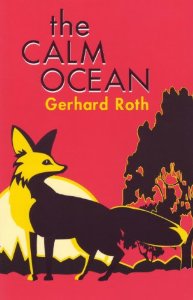
The Calm Ocean Some books demand to be read based on their covers alone. Such is the case with The Calm Ocean by Gerhard Roth, which I was surprised to find sans ugly hardcover binding on the university library’s shelves. The bright red background initially draws the eye, which may then focus on the fox, specifically the head, also depicted in primary color. Illuminated by the rising sun (or moon) behind it, the highly stylized fox is looking back across the face of the book, into the unknown. The eye might now wander up to the title of the novel, which seems to contradict the rural scene represented on the cover. One begins to wonder about this contrast, and whether the fox is significant in any way, as well as what the title says about the book.

The Austrian writer Roth is a relatively new discovery for me, thanks to a recommendation last year from a friend over at Goodreads. Roth’s early work falls into the broad soup of ‘experimental’ fiction, lacking the more traditional trappings found in realist fiction. But he grew closer to realism over the years, though I find his take on it to be palatable. It’s as if he took the experimental skeleton he crafted as a younger writer and hung some strange costumes on those angular bones. Murky and sometimes even hallucinatory, Roth’s post-experimental fiction is not to be overlooked simply because it began to dress in new and bizarre realist outfits. Of course I say this while now reading only my second of these later works (the first Roth book I read, The Will to Sickness, was much more experimental; the second one, The Lake is a later work). But I have a feeling (partly based on other descriptions/reviews I’ve read), that I am right about Roth in this regard.

In his writing, Roth is concerned with sifting through the social and political culture of his home country of Austria, both past and present. Most of his books resemble mystery novels, at least superficially. They are not traditional mysteries at all, though, and readers who simply must find out all the details of what happened should probably stay away. At this point in my reading of the book, The Calm Ocean already recalls the The Lake in that it also concerns a man away from home, in an unfamiliar provincial place, feeling disoriented and alienated. Since my reading thrives on characters like this, I was drawn in immediately. I’m still early on, but I already know that it will live up to the promise of the cover.

Roth has completed two ambitious cycles of works, each of which consists of novels, essays, and documentary volumes: Die Archive des Schweigens (The Archives of Silence) and Orkus (Hades), the former consisting of seven works, and the latter of eight. Unfortunately, many of these works are still unavailable in English, though Ariadne Press has been doing an admirable job in bringing some of them into English translation, with their focus centered on ‘Studies in Austrian Literature, Culture & Thought’. Hopefully these current offerings from Ariadne, as well as Atlas Press and Burning Deck (each of which has published one of Roth’s earlier books in English), will grow in popularity among English readers and thus attract more translation efforts in the future. Roth certainly ranks with Thomas Bernhard as a contemporary Austrian writer very much worth reading (Elfriede Jelinek and Peter Handke being two others on my list of to-reads).

thomas bernhard: internal archaeologist

Austrian writer Thomas Bernhard forged a wholly unique body of fictional work. One could class his writing as postmodern, but that label seems limiting and insufficient. An accomplished poet at a young age, Bernhard turned to fiction soon after a publisher rejected the manuscript for his fourth book of poetry. It’s uncertain how connected these two events were, but Bernhard never pursued publication of that manuscript again. Later in his career he did publish a chapbook of his early poems, and made certain that his extant published poetry would remain in print. So clearly poetry still mattered to him. As a youth, Bernhard also trained as a musician and fostered his innate talent in that realm for some time.

Both of these creative pursuits, music and poetry, channeled directly into Bernhard’s prose, in both form and content. His inimitable style recalls the structure and repetition of a classical music piece. Likewise, the cadence and repetition found in his sentences reflect a poet’s sensibility. Bernhard’s primary characters are almost always failed (or failing) artists, writers, scientists, engineers, or other passionate, single-minded individuals. These people live on the fringes of society, often in small towns or rural locales, where they are marginalized from their neighbors, on whom they chiefy look with disdain. Prone to lengthy monologues, internal or external, they are monomaniacal in their pursuits, though always hampered from seeing them to fruition. Often there is a secondary character who is there to simply listen and, in some cases, made to feel inferior to the primary character. That is, the secondary character will look up to the primary character, despite that character’s failings, or the secondary character will feel an unusual, inexplicable attraction to the primary character. This dynamic between the two characters drives the plot, such as it is.

Thomas Bernhard could now be classified as a cult writer, although in the U.S. he remains virtually unknown to mainstream readers. But among his limited readership there is a rabid dedication. In my view, much of Bernhard’s allure lies in the uncompromising nature of both his prose and his public persona, which there is no reason to believe was any different from his private persona. In fact, everything points to the two being one and the same. Part of this, though, is due to how little is known about him, outside his own words. Much like American writer J.D. Salinger, Bernhard kept strict control over his papers. Nothing was published that he did not authorize. As a result, for the most part, he retained complete authority over the world’s access to Thomas Bernhard. He left explicit directions regarding his literary estate following his death, one of which states that his plays are never to be performed in his home country again. Unlike Salinger, he did give interviews, though he grew a reputation for being cranky and reticent during them. Still, there are a number of interviews available online that are worth reading. And then there is his memoir, Gathering Evidence.

Bernhard originally published his memoir in five discrete parts under separate titles. These were collected into one volume for the English translation. As a whole, it represents his own excavation of his past in order to understand his development. As a young person he lived through many difficult experiences, including WWII bombings, hospitalization for tuberculosis, and the death of his beloved grandfather, the person who meant the most to him. He explicates all of this in the memoir, which he uses to fashion his own truth, a slippery concept for a writer who believes that “truth is always wrong, even if it is one hundred percent truth.”

I decided to read Gathering Evidence early on in my exploration of Thomas Bernhard’s work. This is not a normal inclination of mine, but with Bernhard it felt right. And I’m glad that I read the memoir, for it has enriched my further reading of his novels, of which I still have a few to go. Below is the review of Gathering Evidence I wrote just about a year ago. It reveals much of the book’s contents, so if you are considering reading the book and would prefer to start with a fresh slate, you may not want to read further.

____________________________________________________________________________

Gathering Evidence by Thomas Bernhard

(Review by S. D. Stewart)

I have listened to everything and conformed with nothing.
All I ever wanted was to be myself.
Absurdity is the only way forward. It was a way I knew, the only one that led anywhere.

Why write memoir? So many lives and why should we care. We want to read about our own lives, don’t we. We fantasize about the biographies, the obituaries, the glowing words written about us in the future, after we are dead, after the world has finally recognized our genius. Or maybe we don’t do that. Regardless, writing memoir is rooted, at least in part, in narcissism. Writing in general, for publication at least, is a narcissistic pursuit. Indulging in the activity, for the purpose of publication, shouts out to the world, “Listen to me, what I have to say is worth reading!” One must believe that to do it. And what could be easier than writing about oneself. Nothing. Nothing could be easier than that. No research required. No fact-checking. No need to even tell the truth. If there even is such a thing. Thomas Bernhard doesn’t think there is, or rather he doesn’t believe the truth is right. He says, “Truth is always wrong, even if it is one hundred percent truth.” That is some helpful advice to keep in mind when writing memoir. Bernhard “had an obsessive desire to gather the evidence in [his] head.” Evidence of what, you may be wondering. Well, evidence that his grandfather had been right, “that his assertions had been correct.” But, correct about what. Oh, I don’t think I can say it, not yet. No, I don’t think Bernhard would want me to say it. Not now. He waited a long time in the book, almost to the very end, to say it himself, to spell it out in explicit terms, what every sentence, every word, had been pointing toward from the very first page.

In the beginning, we find young Thomas (age eight) astride a bicycle for the first time (“I am the ruler of the world”), on a mission to ride some miles away from his home to Salzburg in order to visit his aunt. But this is a clandestine mission, and one that sadly fails, quite spectacularly, in fact. Young Thomas runs to his grandfather for support, fearing his mother’s reproach (she whipped him regularly, taking out on him her anger at his father, who had run off early on, refusing to even acknowledge he had a son). His grandfather thinks that “anarchists are the salt of the earth” and teaches young Bernhard the alluring idea that, in theory, he can destroy everything every day. In theory. Kill, demolish, destroy, whenever one chose, in theory. A theory that fascinates Bernhard for the rest of his life. This sets the tone for the book.

Reading Bernhard’s fiction will likely lead one to suspect much about the man’s beliefs. This book will confirm those suspicions and explain the reasons behind them, at least in theory. For example, he hated teachers and all other authority figures: “Policemen and teachers spread a foul smell over the surface of the earth.” Never shying away from hyperbole, he goes on to explain that “schools actually murdered the children who attended them.” Looking for the right school in which to enroll your child? Maybe you’ll consider homeschooling instead after reading this: “We sent our children to school so that they would become as repulsive as the grown-ups we met every day in the street, the scum of humanity.” But lest you begin thinking Bernhard has nothing positive to say, I present to you this statement, from the very next page:

“We should always remember that there’s something else in the world apart from the commonplace.”

Yes! Yes, we very well should remember that. The commonplace has a stranglehold on the world. Everywhere we look is sameness. The world revels in it! The rulers count on it! (“For no government has any use for someone who is enlightened and thus actually in tune with the times.”) But it doesn’t have to be that way. Unfortunately, most of us are not raised to know this. If anything, Bernhard’s memoir underlines the brutal effects one’s upbringing can have; it shows us over and over how what happens to us when we are young can wreak havoc in our later lives. Some of us may find ourselves nodding along when Bernhard states emphatically that “the world was for years an intolerable burden which constantly threatened to crush me.” But! But…that does not have to be the way it ends.

World War II comes along and suddenly young Thomas is surrounded by death. People faint in the air raid tunnels burrowed into the mountainsides; they suffocate and never recover, later to be dragged out for removal by the ambulances. After many false alarms, Salzburg also endures bomb blasts, some of which utterly destroy the old section of the city. At first, Bernhard is fascinated by the rubble, and sees the destruction of the cathedral in particular as beautiful. But then, after stepping on what he at first thinks is a doll’s hand and soon realizes is actually the severed hand of a child, he sees war as the atrocity that it truly is. He is affected for life by the sight of the sheet-covered bodies. One day he goes for his English lesson and finds that his tutor’s house has been bombed to rubble while she was inside. He sees the ugliness of humanity surge to the forefront as people push, shove, and trample their way in and out of the air raid tunnels, these supposed places of safety that in fact caused disease and death. Later, as an adult, he is angered when those who went through the same experiences he had act like they don’t remember, or simply refuse to talk about it: “It is like being confronted with a concerted determination not to know, and I find this offensive—offensive to the spirit.” Instead, he insists that “one must not stop telling people the truth; and the shocking and appalling things one observes must under no circumstances be suppressed or even doctored.”

While Bernhard places his grandfather on the highest (and only) pedestal in his life, he is dismayed that his grandfather thinks it is a good idea for him to attend grammar school, which he hates. His grandfather, perceiving that he is artistic, is determined to make an artist out of him. Thus, while attending boarding school during the war, Bernhard takes violin lessons. Although he finds an affinity for music within himself, he abhors music theory and fails at reading music. So he makes up his own music, which was, as he says, “conceived as an accompaniment to my melancholy broodings.” He practices the violin in a closet, where he dwells almost exclusively on thoughts of suicide while playing. Meanwhile, children all around him are killing themselves. Living at the boarding school was a dark time for him, being in Salzburg amidst the “deadly spirit of the city” (suicide capital of Austria) almost destroys him: “during that time my spirit was almost broken; and nobody, not one single person, perceived this darkening of my spirit, this virtual destruction of my spirit.

Eventually, he cannot stand the grammar school any longer, and though pained at the thought of disappointing his grandfather, he quits and secures an apprenticeship “in the opposite direction.” There is an amusing passage where he is attempting to find an apprenticeship at the labour exchange, and the woman working there keeps offering him good jobs in nice parts of the city. Yet he wants to go “in the opposite direction” and is having trouble getting this through to her. When he finally does, he reports that “the woman was on the one hand glad to have satisfied me but on the other hand horrified at the workings of my mind, of which I had allowed her a glimpse.” Instead of walking to school along the Reichenhaller Strasse, he would now be walking along the Rudolf-Biebl-Strasse, “the street that led me to myself.” At the age of 15, he was starting a three-year apprenticeship in the poor section of town, the Scherzhauserfeld Project, at a grocery store housed in a cellar. This turning point was crucial, leading him away from thoughts of suicide toward passion for survival.

Music comes back to him, and this time he sings. When he goes for singing lessons, he realizes, “I had a strong voice, and it occurred to me that I could probably use it, if I chose, to shatter everything in the drawing room.” Unfortunately, he contracts tuberculosis soon afterward. A terrible ordeal begins at the hands of incompetent medical “professionals” in various horrifying public hospitals. His grandfather also becomes ill at the same time, and they both end up in the same hospital. Bernhard is housed in the “death ward” as he likes to call it, where he sets up his observation post and offers a scathing commentary on the medical establishment: “Among a hundred so-called doctors there is seldom one genuine doctor, and so to this extent the sick are inevitably condemned to protracted illness and eventual death.” Meanwhile, his grandfather comes to the conclusions that “the sick are the ones who have real clarity of vision; no one else sees the world so clearly” and artists, particularly writers, need to go into hospitals from time to time, even under false pretenses, in order to dwell on life and existence and avoid falling “victim to futility by getting caught up in the superficial.”

As an aside, I will point out that, from time to time, Bernhard reminds his readers that these are the thoughts of a youth and that he often sees things differently as an adult. However, one must pay attention to his shifting point of view in the narrative, for sometimes he also steps back without warning and writes from the present, as an adult.

In the death ward, Bernhard sees more death (of course). Dead bodies are stacking up around him. Death is looming all around. He sees the dying sometimes “summon up all their strength in their last moments in order to wrest death to themselves after it has tormented them too long by failing to come of its own accord.” With all of this death permeating his surroundings, Bernhard focuses in over and over on the indignities that the dying suffer before their day finally comes. There is injustice everywhere, but perhaps it is nowhere more pronounced than in the public hospitals.

His grandfather dies. Not too much later his mother dies, when he is in the sanatorium, attempting to recover from tuberculosis. In both cases, he discovers their deaths through reading their obituaries in the newspaper. He despises journalism. The two people he loved most are now dead before he has even made it out of his teenage years.

“When we come to consider the matter, we realize that our whole life is nothing but a grubby calendar of events and that by the end of it all the pages have been torn out.”

It is heartbreaking to read of his experience with tuberculosis and the hospital, the sanatorium, the futility of it all, the colossal failures of the doctors, the doom and gloom and likelihood of his own death. He writes of it all in his straightforward yet musical way, like beating a drum in varying syncopated rhythms, and in no way does one ever feel a sense that he is looking for sympathy. He is stating what happened and he is clearly and harshly denouncing it, but he is also stating that this is simply how it is, this is how the world works and, yes, it’s warped, but it’s been like that for a long, long time and it will never change. Given all of this, he also realizes what speaking such truth often results in:

“A record like the present one must naturally always be made in the knowledge that it is likely to be attacked or denounced, or quite simply dismissed as the product of a deranged mind. The writer must guard against letting himself be irritated by such a reaction or by the prospect of it, however ridiculous it may be. After all, he is used to having everything he says or writes attacked and denounced and dismissed as madness—everything he has ever written throughout his life in order to express what he thinks and feels, everything he has been impelled to write for whatever reason. When he is dealing with facts he has no interest in opinion, from whatever quarter it comes. He is not for one moment prepared to alter his conduct or his way of thinking and feeling and thus become untrue to his own nature, even though he is of course aware that nothing can ever be more than an approximation of the truth.”

He goes on to say that these are merely fragments of his childhood and youth that he is reporting, and that they can be put together if the reader chooses to, in order to form a whole.

After these two deaths, realizing he is now alone comes with an unexpected benefit: “I suddenly saw that it was possible to be alone and to make one’s way forward with one’s own unaided resources: I discovered not only that it was possible but that there was an incredible existential impulse to do so, of which I had until now been quite unaware.”

When he is forced to return to the sanatorium, to Grafenhof, he makes a pact with himself to take control of his recovery: “The patient has to take hold of his suffering with his own hands—and above all with his own head—and work against the doctors […] I had confidence in myself but in no one else. The greater my distrust of the doctors, the greater my trust in myself.” He manipulates the system and the doctors into thinking his desires are their ideas, and therefore he gets what he wants. He also breaks the rules constantly: he goes out into the village, befriends a church organist and begins singing again, all against the doctors’ orders. Eventually he walks away into a life free of bondage in hospitals.

“I had been through the elementary school of sickness, and also the middle school. I had mastered the multiplication tables of sickness and death, and now I was attending classes on the higher mathematics.”

He now feels like his time to write has come, after the passing of his grandfather. He does not want anything else, can do no job, is “revolted by the thought of any work, any job,” does not want to be anything, other than himself.

“My grandfather had been a writer, and he was now dead. Now I was entitled to write; now I myself had the chance. This was my goal, and I now had the means to attain it. I threw all my energies into writing, exploiting the whole world by transforming it into poetry. My poems may have been worthless, but to me they meant everything. There was nothing more important in the entire world. I no longer possessed anything but the possibility of writing poetry.”

His curiosity is what will save him: “Throughout my life I have been consumed with a shameless curiosity which has repeatedly put a stop to thoughts of suicide.” And it is this shamelessness that also marks him as a writer, for “the writer is always devoid of shame. Only a person who has no shame is qualified to take hold of sentences and bring them out and throw them down. Only the most shameless writer is authentic.”

It’s interesting to see Bernard’s form of self-deprecation take shape and occasionally leak out into the flowing invective, the routine desolation. He refers to himself as “a good-for-nothing who clings to life, no matter how dreadful and valueless it is,” while at the same time holding the highest regard for those who take their own lives: “All my life I have had the utmost admiration for suicides. I have always considered them superior to me in every way.”

He never knew his father, knows so little about him. Yet what he knows makes him wonder about the source of his traits: his distrustfulness, his “unfathomable contradictions,” his melancholy, his despair. But he never asked his mother the questions that may have told him more about his father, because he is afraid of the questions. And he is afraid because of how his mother reacted when he was younger and went looking for his father. Bernhard has important lessons to teach us about these questions: “All our lives we put off the big questions until they form a huge mountain which darkens our lives. But by then it is too late. We ought to have enough courage not to be afraid of other people or of ourselves; we ought not to spare them, to deceive them by sparing them.”

It may seem odd to say, but there is hope in this book. There are answers to some questions. There is the old adage of what doesn’t kill us makes us stronger. I think Bernhard lived out that adage in spades. He knows the world is “a cesspit” as his grandfather before him knew it. But he did what he wanted. He didn’t work some crap job for someone else. He didn’t become something. He was himself and he stayed that way. It is a hard thing to do in this world. He wrote and he wrote successfully enough to live his life without bending his will to anyone else. He saw a lot of hell when he was young and he lived through it and he was going to damn well tell us what he saw in that hell, that hell being our world full of our fellows, in many different ways that are actually always the same.

To recap:

Things Bernhard hates: education, sports, newspapers, Salzburg, National Socialists, policemen, judges, doctors, parents, war, organized religion (particularly Catholicism) and its representatives, governments, weekends (“murder for everyone and death for every family”), most people.

Things Bernhard likes: his grandfather, his mother (later on), a certain church organist, bicycles, music, gardening, working in a grocery store, literature (some of it, and not always), isolation, truth, absurdity.

In closing, I would like to say…nothing. Instead, here is this quote from an interview of sorts

The human being refuses to believe that nature is far greater than a heart beat. A meadow full of flowers is such an elementary thing that one chokes with wonder thinking about it. But it will all be lost except for some cretin-like creatures. Maybe then there really will be something new.

gil orlovitz: an astonishing faith in words

Gil Orlovitz was a writer who never quite made it, though not for lack of trying. Known primarily for his poetry, though even then not widely and more so after his death, Orlovitz also wrote and published two novels and many short stories, as well as penning and producing several plays. Born and raised in Philadelphia, Orlovitz served four years in the Army during WWII, after which he wrote and published prolifically during the 1950s and 1960s. He died in 1973 alone and destitute at age 55, a few years after the publication of his second published novel, Ice Never F.

Orlovitz’s writing can be described as avant-garde or experimental, and his novels as anti-novels or “no-novels,” as Book World reviewer (and Joycean scholar) Kevin Sullivan designated Milkbottle H, Orlovitz’s first published novel. Sullivan goes on to suggest a definition for this new “no-novel,” as a “genre that no longer experiments with form but discards all form and concentrates on the presentation of immediately felt experience or, more accurately, allows that experience to present itself.” Certainly Orlovitz read Joyce, and there is a Joycean flavor to Ice Never F, written as it is in an impressionistic, stream-of-consciousness style. But being a self-contained novel, microcosmic in its deep reflection of the author’s own experiences, it bears little resemblance to Joyce’s work in content. This novel was part of a planned trilogy and, according to Guy Daniels in his “Notes Toward a Bibliography of Gil Orlovitz,” was actually intended to precede Milkbottle H. The third book, known in manuscript form as “WFFM,” was never published, though according to Daniels, it had been read by Anais Nin, who tried unsuccessfully to get it published. At the time of writing (1978), Daniels noted his suspicion that the manuscript was “still around in somebody’s files.” A short story manuscript also came into the custody of UK publisher Marion Boyars, publisher of Orlovitz’s first two novels, but this collection never saw publication.

Milkbottle H, while received quite favorably by critics in the UK and Germany, did not fare so well in Orlovitz’s home country. American critics for the most part panned the book, with only one extant positive review to be (easily) found (the Sullivan one referred to above). Reviews of the second book, Ice Never F, are even more difficult to track down, suggesting that it received even less attention. While I have not yet read Milkbottle H, from both my understanding of that book and through having already read Ice Never F, I wonder if the critical reception would have been better if that latter novel had indeed been published first, as Orlovitz intended, for it may have been a degree or two more accessible. Certainly if either book had appeared just a few years later when the American postmodern novel was beginning to more widely infiltrate popular readership, it would likely have fared better.

If Gil Orlovitz had not passed on so prematurely, would he have finally found wider success? It’s hard to say. He wrote from the margins of society, and certainly some writers who share that marginal ground have eventually garnered a larger readership. But the literary past abounds with so-called experimental writers whose popularity rose and waned during their lifetimes, or never even exceeded a modest plateau. Once they are gone, though, it is ultimately up to us as readers (and reviewers) to resurrect them. The fate of their literary legacies rests solely in our willingness to read and share the wonders of their words. It is in this spirit that I share my review of Gil Orlovitz’s novel Ice Never F.

References:

Chatfield, Hale. Literary Exile in Residence. The Kenyon Review, Vol. 31, No. 4 (1969), pp. 545-553
Daniels, Guy. Notes Toward a Bibliography of Gil Orlovitz. The American Poetry Review. Vol. 7, No. 6 (Nov/Dec 1978), pp. 31-32
Fagan, Edward R. Disjointed Time and the Contemporary Novel. The Journal of General Education. Vol. 23, No. 2 (Jul 1971), pp. 151-160

_______________________________________________________

Ice Never F, a novel by Gil Orlovitz

(Review by S. D. Stewart)

Did you ever experience the sensation of shaking your brains loose from their moorings so that they become a sort of fish swimming around in your skull and once in a while look through your eyes. The fish looks at you now…

Lee Emanuel is the fish. Your skull is the book. Or you are the fish and the book is your skull. Or is it Lee’s skull…

I want to see something come out of the wall, that’s why I stare at it so intently, I want a transformation to take place in my loneliness up there on the wall that Sam Abrams paints.

The book opens with disorientation. but a creeping awareness occurs through lucid moments embedded in a rush of fractured memories. The prose is hypnotic with sentences stopping short and pulling up stakes to move elsewhere, while prior nomadic sentences slide in to occupy the now vacant real estate. Plot, such as it is, advances imperceptibly. Lee Emanuel as child, as teenager, as young adult, as approaching middle age, married, single, pursuing any number of women, all intervals interwoven with dense and coruscant (borrowed from Gil!) stitching. Lush impressionistic prose thick with neologistic flights of poetic fancy describes life anchor-moments and intricate sketches of family members and friends, the characters materializing over time, sometimes through wandering perspective, but by the end all becoming known.

Orlovitz owes a stylistic debt to James Joyce, although he is still doing his own thing here. Time is not finite as in Ulysses, for example, but rather spreads out and contracts over decades. Both time and space explode into dust. There are also some surface similarities to Virginia Woolf’s The Waves, concerning time, nature as a character, interiority of multiple persons (though less regularity of shifting here, with primary focus on Lee). Imagine a compendium of several decades of one’s life, all of the pivotal events that one returns to over and over, carefully directing each scene, often unaware of how it changes from one performance to the next, only convinced of its significance as an ingredient in the substrate on which one grows one’s understanding of oneself.

Faith in words is what Orlovitz exhibits. It is definitely a poet’s novel. There is some humor here and there, perhaps just enough. One on hand we see the complicated love of a son for his parents dissected while on the other hand we experience the exquisite visceral pleasure of a child picking his nose. Lee’s world is tactile, sensual, bursting with color (violet repeats itself, for one). Some of the interior babble is just that, but it never lasts long enough to engender frustration.

A partial list of themes treated in varying degrees of depth: family relationships, romantic relationships, war, Army life, madness, mystery and confusion of childhood, interpersonal attraction in its many forms, urban life (specifically Philadelphia) both pre- and post-WWII, first and second generation immigrant experience in America (specifically Jewish), coming-of-age, death, personal and societal morality, love (its glory and its passing), spirituality (specifically Judeo-Christian), art and creativity, humanity, existence…

Style notes: Orlovitz eschews apostrophes and chapter breaks, while wreaking havoc with capitalization and sentence structure. (It’s a lot of fun.)

Either it is the astonishment of the absolute indifference, that defense against astonishment, the ultimate defense, the complete absence of feeling except that which informs you you operate in a body. But at any time the astonishment may burst open, and I am not Lee Emanuel, I tell you I have no name, I tell you I have not been born, I tell you I know nothing about death—I can tell you only that I fornicate, eat, shit, feel terror—but that that could be anyone walking down the street, ascending a stairway, interviewing a prospective employee, compassionating a beggar—I ask you; who does not feel all these things? Is this a distinctive personality? a precisely differentiated human being? who can possess at times the faculty of total recall and in other hours remember only a jumble.

books!

Since I shut down my Goodreads account, I plan to post more book reviews and bookish thoughts here. This doesn’t mean the blog will morph into a reading blog, but as I’m experiencing a bit of a creative impasse at the moment, there may be more book talk in the near future than anything else. Curiously, even when I’m in a fallow creative writing period I find it possible to write about books. I think this is related to the schismatic phenomenon between reading and writing (creative writing, that is), so that during times of heavy reading one cannot write, and during times of heavy writing, one cannot read. Thomas Bernhard spoke of this (I will have to dig up the quote, as it is typically extreme, and hence, amusing), as have other writers. So, rather than let this blog languish during those times, which is what has occurred in the past, I will endeavor to post about books and writers.

There are a few books I originally wrote reviews of on Goodreads that I will be highlighting, interspersed with whatever books of significance to me that I have recently completed.

Stay tuned for an upcoming post on the elusive Gil Orlovitz.

And in the meantime enjoy this song by Caudal…it’s soothing in a rhythmic, hypnotic way.

Edit: Found the Bernhard quote. It’s from his memoir Gathering Evidence.

“When I am writing I read nothing, and when I am reading I write nothing. For long periods I read and write nothing, finding both equally repugnant.”

  • Recent Posts

  • Navigation Station

    The links along the top of the page are rudimentary attempts at trail markers. Otherwise, see below for more search and browse options.

  • In Search of Lost Time

  • Personal Taxonomy

  • Common Ground

  • Resources

  • BOOKS BOOKS BOOKS