
Buzzing tree of bees
carries sound of other world—
somewhere else to go.
All posts in category writing
a haiku for spring
Posted by sean on April 15, 2015
https://sd-stewart.com/2015/04/15/a-haiku-for-spring/
coleman dowell, from island people
You drive, walk, eat, look at television, read, and all the while, beyond you and the cozy circle created by your lady around herself and you, like the natural emanations of stars, other lives circle yours, seeds still winged and wind-borne, looking for sympathetic soil. You feel the juices and solids of your body in attempted rearrangement, or, more disturbing, making an effort to create a stillness that approximates death, beyond which the body does become soil, receptive to all wind-borne seeds. In a not especially prolonged stillness, as though no chances could be taken that you might decide to become perpetual motion, words fall out of the air, a random fall from which you might be tempted to make selection, and as you do not move, cannot, a string of words falls onto you, and from you, onto the paper: winter rye greening up, smoothing the old brown earth with a fine new plane: Carpenter Rye, neighbor.
–Coleman Dowell, Island People
Posted by sean on March 17, 2015
https://sd-stewart.com/2015/03/17/coleman-dowell-from-island-people/
now recording observations on tumblr
I made a Tumblr for my field reports. I hope to post there on a more regular basis, while reserving this blog primarily for new fiction, book reviews, and whatever else is not a field report. Like anything, this is subject to change (read: fail) without notice. Those of you on Tumblr please visit—I’m still orienting myself and some company would be nice.
UPDATE (March 2018): The corporate overlords at Tumblr have inexplicably flagged my site as possibly containing sensitive material, whatever that means. My Tumblr doesn’t even have images and I can’t imagine more innocuous text than the field reports I was entering there. Regardless, my appeals to them to lift this censorial block have so far been ignored. As a result, only logged-in Tumblr uses who are not operating in ‘safe mode’ may view the field reports for the time being. I’d be even more annoyed if I’d been posting there more regularly, but well, I’m still pretty annoyed…
UPDATE (May 2019): Tumblr essentially destroyed my site, which is maybe just as well, since my enthusiasm for the project had waned. I never could get any answers from Tumblr so I’m done with it. I’m happy to report, though, that I just did a limited print run of a compendium of field reports. So there is that.
Posted by sean on February 25, 2015
https://sd-stewart.com/2015/02/25/now-recording-observations-on-tumblr/
publication note
My story “Orbiting” appears in the new issue of Dark Matter, available on ISSUU or in PDF.
Posted by sean on February 18, 2015
https://sd-stewart.com/2015/02/18/publication-note/
triviality of trivialities

Erased from As a Matter of Course (1894) by Annie Payson Call
[click image to enlarge]
Posted by sean on January 6, 2015
https://sd-stewart.com/2015/01/06/triviality-of-trivialities/
quest of the simple life pt. 1
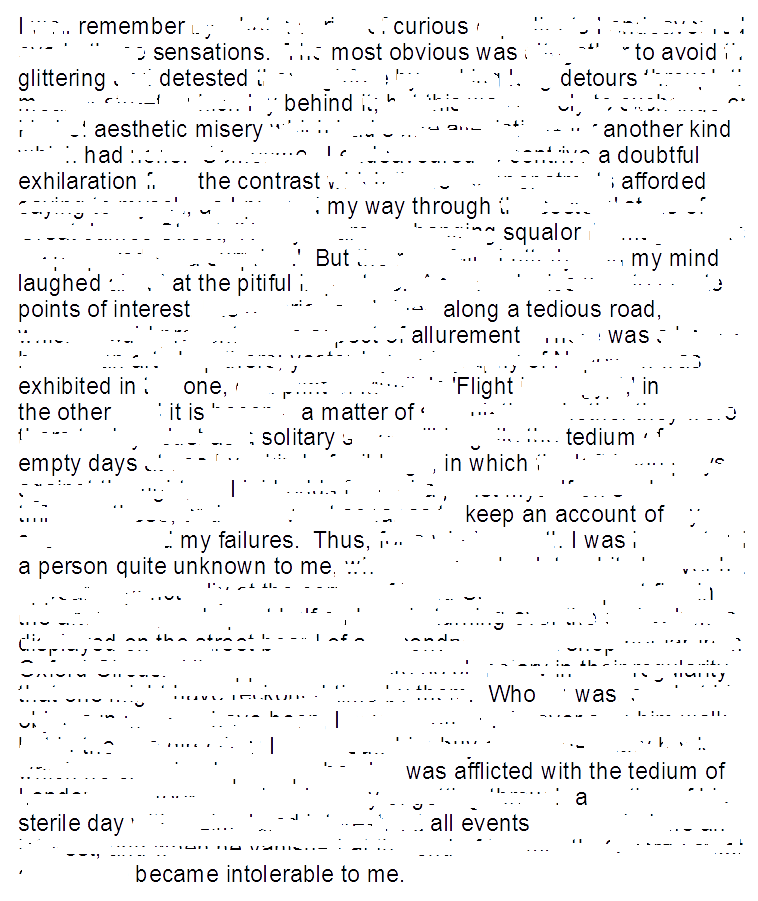
Erased from The Quest of the Simple Life (1907) by W. J. Dawson [click to enlarge]
Posted by sean on December 23, 2014
https://sd-stewart.com/2014/12/23/quest-of-the-simple-life-pt-1/
city of health
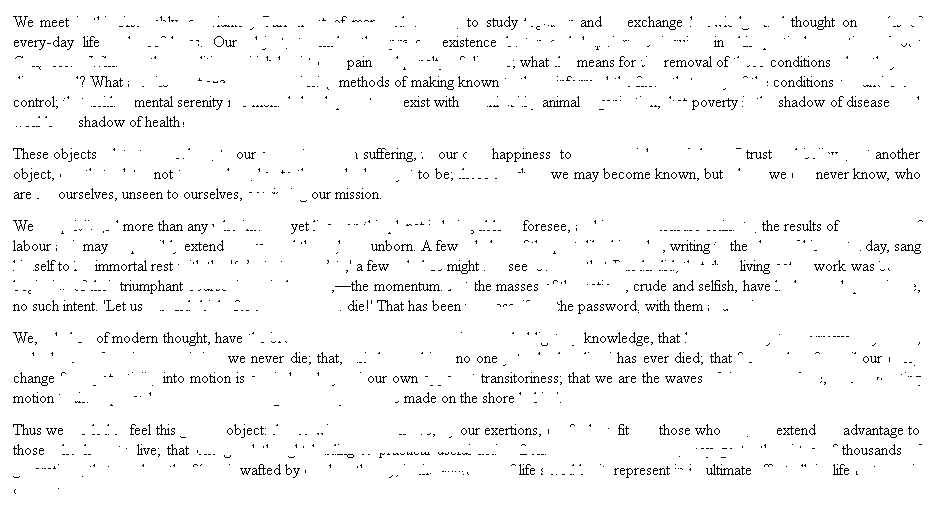
Erased from Hygeia: A City of Health (1876) by Benjamin Ward Richardson [click image to enlarge]
We meet to study and exchange thought on every-day life.
Our existence in pain—
what means for removal of conditions?
What methods of making known conditions control?
Mental serenity exist with animal poverty—
shadow of disease, shadow of health.
These objects, our suffering,
our happiness to trust another object.
Not to be, we may become known,
but we never know, who are ourselves,
unseen to ourselves—our mission.
We, more than any, yet foresee
the results of labour may extend unborn.
A few writing the day
sang self to immortal rest.
A few might see living
work was triumphant.
The momentum, the masses,
crude and selfish,
have no such intent.
Let us die!
That has been the password with them.
We of modern thought have knowledge that we never die,
that no one has ever died,
that our change into motion is our own.
Transitoriness, that we are the waves-
motion made on the shore.
Thus we feel this object, our exertions fit those
who extend advantage to those live,
that thousands wafted by
life represent ultimate life.
Posted by sean on December 16, 2014
https://sd-stewart.com/2014/12/16/city-of-health/
another excerpt from ‘book of thoughts’
The first few pages of Book of Thoughts, an ongoing erasure project
[click images to enlarge]


Posted by sean on December 16, 2014
https://sd-stewart.com/2014/12/16/another-excerpt-from-book-of-thoughts/
the tanners [book review]
Recently I began reading Robert Walser’s novel The Assistant. I associate Walser with the winter season, and particularly the month of December, likely because that was when I first started reading his work. Walser also died in December; he was found lying in the snow on Christmas Day 1956, having suffered a heart attack during one of his frequent and much-loved walks.
The Assistant has been a joy to read so far, brimming with Walser’s off-kilter cheekiness and his typically exuberant scenic descriptions. And so, with my enthusiasm for his writing in its current heightened state, I thought I’d share another of my Walser reviews from the archive, with the hope of encouraging others to investigate this still tragically under-read writer.
____________________________________________________
The Tanners by Robert Walser
I don’t want to go running down some career path—supposedly such a grand enterprise. What’s so grand about it: people acquiring crooked backs at an early age from stooping at undersized desks, wrinkled hands, pale faces, mutilated workday trousers, trembling legs, fat bellies, sour stomachs, bald spots upon their skulls, bitter, snappish, leathery, faded, insipid eyes, ravaged brows and the consciousness of having been conscientious fools. No thank you!
Robert Walser was an odd fish and I like him a lot. Even though he once said, as W. G. Sebald reports in the introduction to this book, that he was essentially always writing the same novel, one which he said could be described as “a much-chopped up or dismembered Book of Myself,” I will continue reading his same-as-before novels because they captivate me. I like to think of him up in his stuffy attic room, frantically writing on borrowed paper with stolen pens, gripped in the passion of that writing, of hurling his herky-jerky version of the world down onto the page.
The Tanners is the disjointed story of the Tanner siblings: Simon, Klaus, Kaspar, and Hedwig (oh, and the mysterious Emil, who later randomly shows up in another character’s anecdote). Primarily, the “plot” (such as it is) follows the adventures of Simon as he bounces around from job to job while basically pursuing the sublime. From the start, Simon reminded me of Jakob from Walser’s anti-Bildungsroman Jakob von Gunten, with his similar tendency toward mockery traced with veins of sincerity. Or maybe it was just straight mockery, maybe I imagined the traces of sincerity—it’s really so hard for me to say for sure. When Simon refers to his own cheekiness, I couldn’t stop thinking about that Saturday Night Live sketch where Mike Myers plays Simon, the kid in the bath making drawings who calls people “cheeky monkeys.” It’s always unsettling for me when pop culture and literature suddenly collide in my head. And yet the two Simons do share a similarity, if only a superficial one. But I digress. Simon is a self-described ne’er-do-well prone to walking all night through the mountains to visit his artist brother Kaspar, his closest sibling. Simon’s gleeful flippancy is infectious and makes him a likely candidate for the reader’s sympathy. Hedwig is the only sister in the bunch, a small town schoolteacher who Simon also stays with for an extended visit. They bond, but she suspects him of being a freeloader, which he sort of is. Hedwig is an interesting character, and Walser allots her some good speeches. Finally, Klaus is the oldest brother, a stodgy straight-arrow type who thinks he knows what’s best for all of his siblings. He is annoyingly overbearing, though probably well-meaning.
In the introduction, Sebald draws some parallels between Gogol and Walser that I found to be relevant, having just finished a book of Gogol’s short fiction. Like Gogol, Walser has a tendency to introduce characters who at the time seem like they may come to play important roles in his narrative, only to either suddenly kill them off or fade them into the background. Sometimes they also reappear later, just out of the blue, and fill us in on what they’ve been up to for the past year or however long they’ve been gone from the narrative. The aimless plot wanders down side streets, dead-ends, turns around, leaves the city, climbs a mountain, walks off a cliff, gets a concussion, and turns up back in the city again a few chapters later with a new lease on life. Or something like that. I was anthropomorphizing the plot just then. I would imagine that the general unreliability of Walser’s prose could easily become maddening for some readers. The key is to float along with Walser wherever he chooses to take you. One must surrender completely in order to enjoy reading; there is no fighting it because Walser will always win. Always. We are on an adventure with him, as he discovers his own truths in his writing. In this way he is also very much like Gogol, who eschewed the narrative traditions of the time and instead went off happily exploring in his prose.
Throughout the book, Walser spins a gauzy web of natural beauty around his characters who, when not walking around outside enjoying the weather or laying stretched out in the forest, very much tend to spout off lengthy monologues in the general direction of each other, not seeming to expect responses and, in fact, rarely getting them. Walser’s prose is so sensual, his descriptions of both urban and rural settings sparkle with crisp detail clearly borne of a sharply observant mind. Half the novel one falls into a reverie, while the other half one stares at the closest wall, noting the intricate cracks in the plaster with genuine interest.
Despite the lack of plot, there are certain themes to pick out. With Simon and Hedwig, we find themes of youthful self-discovery, the search for meaning and happiness in one’s life, and the ever-painful plight of the daydreamers among us. With Kaspar, there are the ideals of art and the difficulties inherent in one’s pursuit of those ideals. In Klaus, we see a rather sharp critique of mainstream society and the trappings of materialism and the pursuit of wealth. Readers who have siblings, particularly multiple siblings, will also likely enjoy the novel on another level less accessible to those who don’t, for Walser does an admirable job of portraying the complicated and contradictory dynamics that often characterize sibling relationships.
As Simon opines late in the book, “How tedious it was always to be doing exactly the same thing.” Some books always do the exactly the same thing, what we expect them to do, over and over. Not with Walser. Even if he did claim to be writing the same novel over and over, his prose is always worth reading, because it’s granular yet dissimilar; it’s made up of life’s strikingly mundane and spectacular moments, as pointed out by the likes of Simon, who, after all, claims to be “an outlandish figure in my own homeland.”
Posted by sean on December 10, 2014
https://sd-stewart.com/2014/12/10/the-tanners-book-review/
kafka: ‘in a different realm’
“It is conceivable for a writer to take the pulse of his era and make it come alive in language and images, yet still be out of his depth when it comes to palpable engagement with the world, although this constellation is exceedingly rare. Far more often someone who is truly at home in two worlds is misunderstood as being ‘out of touch’ in the public, social cosmos, which he shapes and endures in combination with others, and in an interior psychic space dominated by feelings, dreams, fantasies, associations, and ideas, which he inhabits alone. Anyone whose experience inside his head offers as vast and constant a stream of impressions as the world outside cannot stay focused on the here and now. But where is he then? In a different realm.
An individual who appears to be out of touch with reality is rarely in the privileged position of being able to open and close the subtle locks between inside and outside at will. The vortex pulling him inside his head is always palpable, but the reality principle demands that he remain perpetually alert; people expect him to limit himself to things that can be communicated. Anyone who starts talking about daydreams on the street, in a store, or at the workplace alienates people, no matter how intense and meaningful those daydreams are. He remains alien because he understands and acknowledges a second world, and for the most part, and to his detriment, he remains just as alien in that interior world for the same reason. He is present, but neither here nor there.
That condition can culminate in insanity, and Kafka justifiably feared winding up insane throughout his life. But it has little to do with the accomplishment society expects of the individual. Someone who is alienated from the world might function perfectly well as a craftsman, attorney, teacher, or politician, or as a vice secretary of an insurance institute, and his struggle to balance himself—poised like a man with one foot off the ground—can easily remain hidden from view, without a trace, as it probably has in thousands upon thousands of brains.”
—Reiner Stach, Kafka: The Years of Insight
Posted by sean on November 6, 2014
https://sd-stewart.com/2014/11/06/kafka-in-a-different-realm/
Get Posts by RSS

 s. d. stewart