2025 in reading

This year I read far fewer books than I’ve read in a year since 2012, which is the first year for which I have a readily accessible total on hand. I’d like to say I’m striving for quality over quantity, but the fact is that I find it harder than ever to engage in the act of reading for long periods at a time. Of course, if a book doesn’t offer an immersive reading experience, then that is also a contributing factor. In an effort to combat this problem, I spent some time this year rereading a few of Anna Kavan’s books, which I’d not read in 10 or more years. This was a deeply satisfying experience, as reading her work always is.

I only gave two books five-star ratings on Goodreads: Matthew Kinlin’s novella So Tender a Killer and Leonora Carrington’s The Stone Door (of which I’d only previously read the abridged version). Below are my favorite reads of the year in chronological order by date read, with links to my reviews:

Prairie, Dresses, Art, Other by Danielle Dutton (Coffee House Press, 2024) Review

The Man in the High Castle by Philip K. Dick (Putnam, 1962) Review

Happy Bunny and Other Mischiefs by Rebecca Gransden (Cardboard Wall Empire, 2024) Review

So Tender a Killer by Matthew Kinlin (Filthy Loot, 2025) Review

Mevlido’s Dreams: A Post-Exotic Novel by Antoine Volodine (University of Minnesota Press, 2024) Review

The Veldt Institute by Samuel M. Moss (Double Negative, 2025) Review

The Stone Door by Leonora Carrington (NYRB, 2025; first published 1976) Review

Escapade by Evelyn Scott (Thomas Seltzer, Inc, 1923) Review

new review at heavy feather

My review of The Veldt Institute by Samuel M. Moss has been published at Heavy Feather Review.

review of the faces of pluto

My review of Ansgar Allen’s novel The Faces of Pluto is up today at Heavy Feather Review.

…Allen organizes the book into a sequence of text blocks of varying lengths that twine together, repeating and reexamining its ideas throughout, offering space for us to ruminate on them and second-guess our credibility.

2024 in reading

While in general 2024 was hit-or-miss (with the unspeakable horror of November 5th as the most egregious example of a miss), I am pleased to report that it was at least a fine reading year. Looking back on previous end-of-year book posts, it seems that I was past due for a good year, and so I am grateful for this one. Although the jaded reader inside me still finds it less likely each year to discover new writers I’ve not previously read who bowl me over, this year yielded an iota of hope. I came across not just one, but two writers new to me who stimulated and challenged my reading mind, while also reinvigorating my interest in the novel as a form capable of further manipulation, however slight.

These two contemporary British writers, Thomas Kendall and Ansgar Allen, captured my attention in a way that I have sorely missed. As such, during 2024 I read both of Kendall’s novels and much of Allen’s fiction corpus to date. Although I connected on a more emotional level with Kendall’s debut novel The Autodidacts, which was my favorite book of 2024, it is his second novel, How I Killed the Universal Man, that is more exciting in terms of literary achievement, for it envisions a possible very near future for humanity with all the attendant ramifications therein, all laid out in a way that does not cater to reader comprehension. It feels prophetic in the most frightening (and depressing) ways.

Similarly, Ansgar Allen’s fiction does not waste time courting the reader. Over the past five years, Allen has been quietly yet fiercely challenging the status quo of literature with his disruptive approaches to the act of writing. His work is not easy to categorize, which I believe is his intent. I was so intrigued by Allen’s work that I reached out to him for an interview, which will be published in February 2025 at Heavy Feather Review. In the interview, we discuss his work, the acts of writing and reading, the future of ‘the book’, and how sound can affect writing, among other topics. I also reviewed Allen’s latest novel The Faces of Pluto, and that review will be published at HFR in January 2025. I will add a link to it in this post once it has been published.

Since I focused a good amount of my reading energy this year on reading multiple books by individual authors, some of the books in the list are grouped by author. As usual, unless indicated otherwise, the links are to my Goodreads reviews.

Authors new to me

Thomas Kendall

The Autodidacts

How I Killed the Universal Man

Ansgar Allen

The Faces of Pluto (link to HFR review to be added)

The Wake and the Manuscript

Jesse Ball

Ball is a writer who has been on my radar for a few years, and I am very glad to have finally read some of his work. The two novels that I list here were my favorites of the four that I read. However, I am sufficiently interested that I will likely read more of his work.

The Repeat Room (review written on the day after the 2024 U.S. election)

A Cure for Suicide (no review written)

Maryse Meijer

Meijer was yet another writer who I had heard good things about, but I hadn’t read anything by her before this year. On the basis of my response to her first short story collection (Heartbreaker), I ended up reading her second collection of stories (review) and her novel The Seventh Mansion (no review).

Drain Songs: Stories and a Novella by Grant Maierhofer

Maierhofer is another writer whose name I regularly see mentioned in various literary haunts, but I hadn’t gotten to his work (apparently this was the year for trying to catch up on my to-read list). I had mixed reactions to some of the stories in this collection, but a couple of them and the title novella were excellent. The ‘review’ is just some minimal notes.

The Stories of Breece D’J Pancake by Breece D’J Pancake

This book languished on my to-read list for a decade before I finally got to it this year. It is a fantastic collection, and I think D’J Pancake could probably have eclipsed Raymond Carver if he’d lived longer than his brief 26 years.

Depressive Realism: Interdisciplinary Perspectives by Colin Feltham

This is a nonfiction book published by an academic press, but the ebook can be found at the Internet Archive. Despite its origins in academia, I think it is accessible to general readers, and I found it replete with compelling arguments.

Undercurrents by Marie Darrieussecq

Sometimes vagueness in writing can be hauntingly beautiful.

The Spectacle at the Tower by Gert Hofmann

One of those special books that masterfully maintains a sense of dread throughout, which I’m always seeking and rarely finding. For comparison, Paul Bowles comes to mind.

Mockingbird by Walter Tevis

A very fine dystopian novel from 1980.

Erasure by Percival Everett

This is deeply effective satire and very much on point. I read the book before watching the film adaptation (American Fiction), which is also good but unsurprisingly not quite as nuanced.

A Month in the Country by J. L. Carr

Carr’s atmospheric novel had been on my to-read list for nearly 10 years. It was very good, but I didn’t write a review. It seems at first to be a relatively simple story, but as the pathos builds it grows more complex.

Previously read writers

James Purdy

I read Narrow Rooms as a follow-up to In a Shallow Grave, which was a highlight of last year, and in the review of which I boldly claimed I would now read everything Purdy wrote. However, having since been underwhelmed by two of his other novels—Mourners Below (review) and The Nephew (review)—I am now skeptical of the veracity of that claim.

Philip K. Dick

I feel certain that in my lifetime I will complete my reading of all of PKD’s published work, but I am in no hurry. These three were all very good additions to the list of those I’ve read to date.

VALIS

Lies, Inc.

Do Androids Dream of Electric Sheep?

Gary J. Shipley

Shipley is an acquired taste and not for the squeamish. But he is one of the few writers in whose use of explicit horror I can discern a purpose apart from purely shock value. For that reason, I will continue to read his work, despite not always having the stomach for it.

So Beautiful and Elastic

The Unyielding

Crypt(o)spasm

Other noteworthy books by previously read writers

Burning Your Boats: The Collected Short Stories by Angela Carter

The Complete Short Stories: Volume 2 by J.G. Ballard

Alice Knott by Blake Butler

Rusticles by Rebecca Gransden

Dark Property: An Affliction by Brian Evenson (no review)

Mice 1961 by Stacey Levine: I neglected to include this in my original post because I technically read it in 2023, though it wasn’t published until 2024. I would be remiss in not mentioning it, though, as it was among the most unique novels I’ve read in recent years. The arrival of a new book by Stacey Levine is no small thing, and the long wait for this one was worthwhile. A polyphonic novel entwining sisterhood with the uncertain paranoia of the early Cold War, Mice 1961 takes place in small-town Florida, primarily during the course of a rollicking community house party. Certain novels offer the reader with an immersive experience, where one truly feels as if they have entered the book as an observer. This is one of those rare novels.

A few other notes: This year I finally finished reading Infinite Jest, which I had been reading on and off for the past two years or so (I liked Don Gately and the addiction recovery storyline best, but overall I preferred The Pale King, despite its unfinished status); I also finished the Gormenghast trilogy; I read two more of Clarice Lispector’s novels (The Hour of the Star and The Besieged City) and continue to be boggled by the inscrutability of her fiction; and I read Michel Houellebecq for the first time after years of reading reviews of his novels (I chose Serotonin and had mixed feelings).

Adventures in Immediate Irreality by Max Blecher

Reread October 2024. Still fantastic. Still an all-time favorite. Original 2019 review below.


Much how Bruno Schulz’s masterpiece of 20th century literature The Street of Crocodiles defies adequate description, so too does this book by Max Blecher, affirmed by this edition’s two introductions, both of which rely heavily on extended quotations from the book itself to make their points, which in essence are that this is a particularly special book. Perhaps this is also one of those rare cases where the title of the work itself provides the most apropos description of what lies in wait for the reader. Blecher’s protagonist sees the world through the lens of illness, which can always alter reality, but he is also a sensitive and gifted young man struck by the ‘immediate irreality’ of everything around him. As in Schulz’s work, objects here take on monumental significance; the most innocuous things throb and seethe in unexpected ways.

All at once the surfaces of things surrounding me took to shimmering strangely or turning vaguely opaque like curtains, which when lit from behind go from opaque to transparent and give a room a sudden depth. But there was nothing to light these objects from behind, and they remained sealed by their density, which only rarely dissipated enough to let their true meaning shine through.

As Andrei Codrescu writes in his introduction, what thus flows from Blecher’s pen is not so much Surrealism as it is ‘hyperrealism’ (which I find even more interesting, though also much rarer). There are no flights of fancy beyond reality; there is instead total immersion in an over-exposed reality enhanced by the protagonist’s unique point of view. There is the discovery of places in the everyday world imbued with a special significance, offering refuge from the the heavy burden of sickness and the overwhelming weight of mere existence.

Above the room there were two garrets, one of which gave access to the roof via a small window. I often climbed through it and stood on top of of the house. The entire city spread out before me, amorphous and gray, and beyond it the fields, where miniature toylike trains crossed a fragile bridge. What I wanted most of all was to feel free of vertigo, as stable as if my feet were planted on the ground; I wanted to lead my ‘normal life’ on the roof, to move about in the fresh, bracing air of the heights without fear or awareness of the void. I felt that if I succeeded I would make my body lighter and more supple and, thus transformed, I would have turned into a kind of bird-man.

Blecher’s protagonist explores many such hidden places during his ‘adventures’, feeling drawn to them as inevitably as iron filings are pulled to a magnet. Not all of them offer succor; yet even the bleakest ones, those known as a ‘cursed space’, still beckon to him.

One of the spaces was in the town park in a small clearing at the end of a tree-lined path no one used anymore. The only gap in the dogrose and acacia bushes surrounding it opened onto a desolate piece of wasteland. There was no sadder or more forsaken place on earth. Silence lay heavy on the dusty leaves in the stagnant summer heat. From time to time the echoes of the bugles of a regiment filtered through long-drawn-out cries in the wilderness, heartbreakingly sad. Far off the air baked by the sun quivered vaporously like the transparent steam hovering over a boiling liquid.

It was a wild, isolated spot, as lonely as could be. The heat of the day felt more enervating there, the air i breathed more dense. The dusty bushes blazed yellow in the sun in an atmosphere of utter solitude. A bizarre feeling of futility hovered over the clearing, which existed ‘somewhere on earth’, a place where I myself would end up quite by chance on a summer afternoon with no rhyme or reason of its own, an afternoon that had lost its chaotic way in the heat of the sun amidst bushes fixed in space ‘somewhere on earth’. At that time I felt more deeply and painfully that I had nothing to do in this world, nothing to do but saunter through parks, through dusty clearings burnt by the sun, desolate and wild. But the saunter would turn into a heart-rending experience.

I could go on, transcribing more and more evocative passages from this brief yet incredibly dense work that so gracefully traces an ornate border encircling the ineffable. But I have sauntering of my own to do, so I will instead encourage you to read it for yourself if you have not already done so.

review of disembodied

My review of Christina Tudor-Sideri’s novel Disembodied (Sublunary Editions, 2022) has been published at Heavy Feather Review.

…Tudor-Sideri’s novel queries the nature of being, relentlessly pondering bodies, souls, memory, death, and time—spoken through the voice of a narrator experiencing her own disappearance.

The Edge of the Object [book review]

A tripartite journey—both geographical and emotional—Daniel Williams’s debut novel The Edge of the Object follows the highs and lows of a young Englishman living in France for a period of six months. The book as an object is striking to behold: three perfect-bound A4-sized volumes smartly dressed in the colors of the French flag and packaged in a screenprinted and letterpressed case—all designed and produced by Tim Hopkins of London’s The Half Pint Press. The prose found within is equally well crafted, with the book’s design complementing it nicely.

Taking cues in part from the work of Georges Perec, this novel is simultaneously a celebration of French culture as seen through the Francophilic eyes of a post-collegiate young man, and a keen look into the headspace of a person far from home, isolated by way of a language barrier he is only partly able to breach and yearning for human connections beyond what he often feels capable of. An erstwhile photographer, the unnamed narrator feels alternately liberated and hamstrung by the absence of his Leica—the camera offering a valid excuse to be present at a remove while also preventing true engagement in any given experience. This tension resulting from being camera-less clings to the narrative, as we watch the narrator struggle to engage with his surroundings—taking as many steps backward as forward in this endeavor—as he moves from place to place.

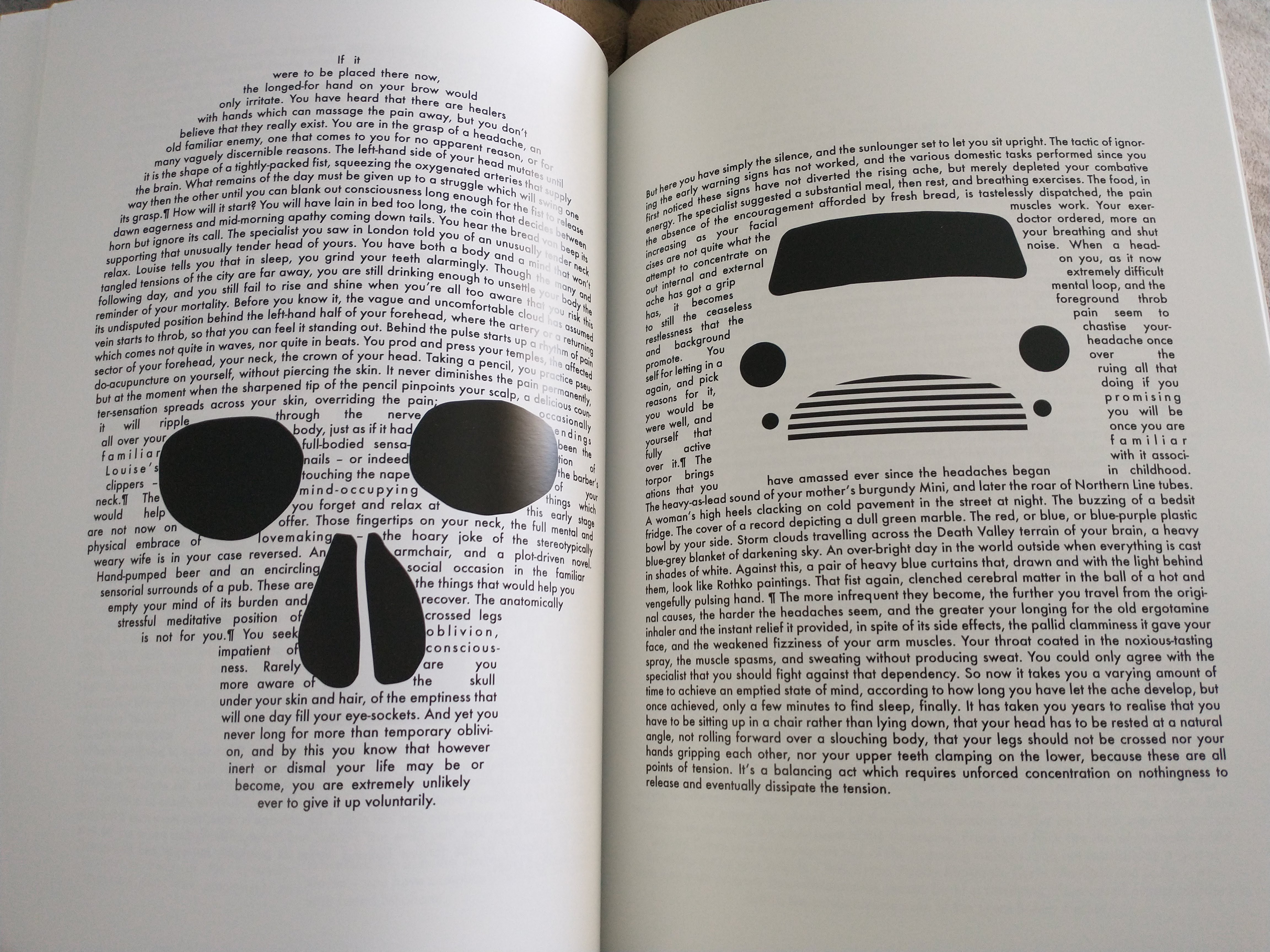
Williams writes with exacting precision—mapping the interior emotional journey of his narrator as carefully as he describes his geographical progress through France. He has a journalistic eye for detail, snapping word-images in lieu of photos and placing scene after scene in front of the reader with aplomb. Moments of wry humor and painterly passages of the French countryside counter the heaviness of themes of left-behind love and debilitating incidents of migraine headaches. Also tempering the at times somber subject matter, the pages of the first and third sections of the book are graced with striking calligrams—images sculpted from the words on the page and representative of a central theme or object on each page. These calligrams gently encourage the reader to slow down or speed up accordingly, keeping step with the pacing of the story.

The first part of the book is written in second-person point-of-view—unusual but appropriate to the experience of being in a rural area of a foreign country, surrounded by its natives, yet only with a workmanlike grasp of its language. The central character is living in a falling-apart cottage, not much more refined than a cave (and perhaps even less dry). Whenever nature calls, he must journey through a warren of gardens to reach the privy, and—adding to the inconvenience—the only running water for washing up is also located outside. It is hard living, made even harder by his isolation.

In the second part, the point-of-view segues to first person as our man reaches the big city of Paris and makes contact with the first of a series of friends he will spend time with over the coming weeks. Gone are the calligrams in favor of straightforward text blocks, as the focus in narration begins to point outwards in concert with the narrator’s efforts to interact more with the people around him. He soon meets up with a friend’s indie pop group on tour and joins them for a number of club dates around the country, during which he becomes interested in a woman whose feelings toward him are slippery at best.

The final part of the book returns to calligrams and the second-person distance, as the narrator backtracks to his lonely cottage existence. Here he comes to a decision about one last adventure to embark upon before his trip comes to a close. This jaunt provides a suitable denouement to his time in France, as we feel this fellow we’ve traveled so closely with start winding down and perhaps pine a bit harder for home. And indeed, the last page finds him back in England with his camera once again in hand—facing a future unknown but now fertilized with a rich new layer of experience from which to grow, perhaps out beyond the self he became too much of while away.

And yet, while these six months have taken you further from the excesses of the world than ever before, they have plunged you into an excess of time, of memory, and of yearning. If anything, you have become too much yourself.

[Limited print copies of the book may still be available, and the ebook has recently been released. Details at The Edge of the Object site. See also Williams’s essay in The Quietus on Perec’s novella A Man Asleep and its connection to this novel.]

‘caught between writing and life’: peter holm jensen’s the moment

The first psithuristic wisp of autumn arrived this week. Early August and the heat retreated with a whimper in the presence of the death season’s harbinger. Odd to experience this with all the news of raging fires out west. It has been dry here, though, it has been that. Will we too one day be engulfed in flames? More likely floods.

I have been occupied with and preoccupied by disruptions and transitions in my quotidian existence. This has led to feeling disconnected from the written word, excepting my dealings with it for which I receive monetary compensation. However, I did finish reading a book—The Moment by Peter Holm Jensen. A subdued but riveting read, it was calling to me from a special box I’d packed of most-likely-to-be-read-next books. So I answered its call.

Per its publisher Splice, The Moment is a novel but it reads like a journal of its author. Is this an important consideration? Probably not, at least not to me. Frankly I long ago grew tired of the inevitable questions around the mingling of autobiography and fiction. I like works that resist being genrefied. Even the term autofiction seems absurd to me—as if any fiction exists that does not contain parts of its author. What exactly those parts are and what percentage of a book they represent should not matter when it comes to evaluating and appreciating the finished work.

These days I find it far easier to filter my reflections through others’ written words (or music) rather than document them using my own words. It actually feels like it has been this way for far too long. And this is a significant part of what resonated so deeply with me in Holm Jensen’s book: the struggle of living with the paradox of a simultaneous passion for and distrust of language, and in particular the written word.

As the narrator grapples with this paradox, he is also documenting a blurring of the intentional and unintentional experience of living in ‘the moment’—of finding over time that opening into greater awareness, from which more insight may flow. And because the transition to moment living is continuing to happen as the narrator is writing about it, there is a sense of gradual unfolding, with attendant periods of uncertainty and confusion. But what accumulates through the narrator’s journal is evidence that each moment is indeed unique, provided one is open to noticing it.

I was reminded of how all the books I’ve read by Buddhist teachers seem to repeat the same simple ideas over and over until it eventually becomes clear that what at first appear to be the simplest concepts are actually the most complex when it comes to putting them into practice. While Holm Jensen’s book is not overtly Buddhist in nature, it does touch on ideas and questions common to Buddhist practice. But it also entwines these with questions around the act of writing and its significance, leaving those questions—as they can only ever remain—unanswered.

The Moment is a book I think best read without much foreknowledge of its contents, which is why I’ve not delved into any of its narrative specifics here. However, I did write a brief review on Goodreads that offers just a skeletal overview. I hope you consider seeking out the book.

The moment lurks inside everyday time; always new, always the same. It waits to give you back your life, like an event long prepared without your knowledge, like an act of fate. It needs you: your ragged past, your timid present, your whirl of thoughts, your hoard of words. It waits for you to step into the light of day, where it can find you and let you come into your own.

—Peter Holm Jensen

2020 in books and music

The less said about this year the better (at the moment and in this space, at least).

My current total of books read for the year stands at 136 and I’m sure I’ll finish a few more before year’s end, though they probably won’t make this list, so I’m posting it earlier than usual. I will update later if this changes. As it turns out I read more books last year, but I suspect I spent more actual hours reading this year due to the circumstances. I think I read more longer books this year, which probably accounts for the difference. Once Goodreads provides my year-end stats I can compare number of pages read and see if this is the case (Update: turns out my suspicions were off the markso far I’ve read about 10,000 less pages this year than my total for last year. Definitely not going to make up that difference in the next couple of weeks).

Concentration was definitely a problem this year. As a result I found myself switching between books, starting and stopping books, and completely abandoning books more than usual. But reading remained my top leisure activity and provided a safe refuge from the chaos and negative energy in the world.

If you’re a Goodreads user you can view my entire list of books read here.

Top reads (in order within each genre by date read):

Note: in most cases links are to my Goodreads reviews, not all of which are actual reviews)

Novels/Novellas:

The Box Man / Kōbō Abe (review)
Wide Sargasso Sea / Jean Rhys (review)
The Atrocity Exhibition / J. G. Ballard (review)
The Doll / Lukas Tomin (review)
Dézafi / Frankétienne (review)
The Golden Cut / Merl Fluin (review)
The Diary of Mr. Pinke / Ewald Murrer (review)
Mount Analogue / René Daumal (review)
Rogomelec / Leonor Fini (review)
Mangled Hands / Johnny Stanton (review)
The Model / Robert Aickman (review)
The Narrator / Michael Cisco (review)
The Undying Present / Syd Staiti (review)
The Warren / Brian Evenson (review)
Yesterday / Ágota Kristóf (review)
Such Small Hands / Andrés Barba (review)
The Bridges / Tarjei Vesaas (review)
Malicroix / Henri Bosco (review)
The Left Hand of Darkness / Ursula K. Le Guin

Short Stories:

All of Your Most Private Places / Meghan Lamb (review)
Secret Hours / Michael Cisco (review)
The Sleep of the Righteous / Wolfgang Hilbig (review)
Waystations of the Deep Night / Marcel Brion (review)
Unreasonable Hours / Julio Cortázar (review)
The Delicate Prey and Other Stories / Paul Bowles (review)
Morbid Tales / Quentin S. Crisp (review)
The Doll Maker and Other Tales of the Uncanny / Sarban (review)
The Sea-Rabbit; Or, the Artist of Life / Wendy Walker (review)
The Unsettled Dust / Robert Aickman (review)
The Earth Wire / Joel Lane (review)

Poetry:

Autumn Sonata: Selected Poems / Georg Trakl (review)
A Certain Plume / Henri Michaux (review)
Coma Crossing: Collected Poems / Roger Gilbert-Lecomte (review)
The Last Gold of Expired Stars: Complete Poems 1908–1914 / Georg Trakl (review)

Drama:

Complete Plays / Sarah Kane (review)

Cross-Genre:

The House of Illnesses / Unica Zürn (review)
Nights as Day, Days as Night / Michel Leiris (review)
The Star Opens Slowly / Casi Cline (review)
Desire for a Beginning Dread of One Single End / Edmond Jabès (review)
Wasteland / New Juche (review)

Literary Anthologies:

Man in the Black Coat: Russia’s Literature of the Absurd / Oberiuty (review)

Nonfiction:

The Trouble With Being Born / E. M. Cioran (review)
Mutations: The Many Strange Faces of Hardcore Punk / Sam McPheeters (review)

Comix:

The Portable Frank / Jim Woodring (review)
Nijigahara Holograph / Inio Asano
Gast / Carol Swain (review)
My Favorite Thing Is Monsters: Vol. 1 / Emil Ferris (review)

________________________________________________________________

MUSIC

I listened to a lot of mixes this year, as opposed to full albums, so I’m keeping the list short, tailored mostly to bands whose songs I keep replaying. I will note that not much has changed with my favorites over the past few years. Occasionally a new band gets added to the heavy rotation roster, but it’s often within an existing favored genre. Nearly everything Justin Broadrick touches continues to floor me. The drone doom and wider post-metal genres in general are popular zones, supplemented with frequent forays into ambient, post-punk, industrial, and retro trips to hardcore, punk, and 80s alternative rock. Much like with my reading tastes, a solidification seems to have occurred. I blame middle age.

The (very) abridged list of what got me through 2020, in no particular order (links in most cases direct to artist Bandcamp pages):

True Widow
Emma Ruth Rundle
Helms Alee
Thou
Jesu
Final
Transitional
Scorn
Nadja
Pelican
Seefeel
Dead Can Dance

A Set of Lines review

A perceptive review of A Set of Lines comes by way of Daniel Williams, author of The Edge of the Object.

The novel’s terrain lies somewhere between the surreal, labyrinthine hell of Alasdair Gray’s Lanark and the apocalyptic imagery of Anna Kavan’s Ice, and the end result is worthy of being filed on your bookshelves alongside those two immersive, unsettling fables.

  • Recent Posts

  • Navigation Station

    The links along the top of the page are rudimentary attempts at trail markers. Otherwise, see below for more search and browse options.

  • In Search of Lost Time

  • Personal Taxonomy

  • Common Ground

  • Resources

  • BOOKS BOOKS BOOKS