
>All this death and illness lately has made me sort of nervous. For the most part, I am comfortable with my own mortality. But recent events have shook me. Scratchy’s death was one of the most difficult things I’ve had to face in a long time. The fact that it was so out of the blue scared me. My grip on reality shattered instantly as fear, despair, and helplessness ripped through me when I found him lying there, cold and motionless. I suppose it is common to write about the finality of death, but its irrevocable nature is uniquely difficult to process. It makes me think about all the people (and animals) that I love. They could all equally be harboring some unknown condition inside them that might lead to their death. The same can be said for me. What has now been drifting around in my head is what to do with this information. Maybe Scratchy’s death was an elaborate reminder to me of the fleeting nature of life, and also a wake-up call to plan better for an unknown future. And maybe it too is a simple reminder that I need to more gracefully accept the constant changes hurtling around and through my life.
juggling this mortal coil
Posted by sean on January 9, 2008
https://sd-stewart.com/2008/01/09/juggling-this-mortal-coil/
R.I.P. Scratchy, July 1996 – December 31, 2007
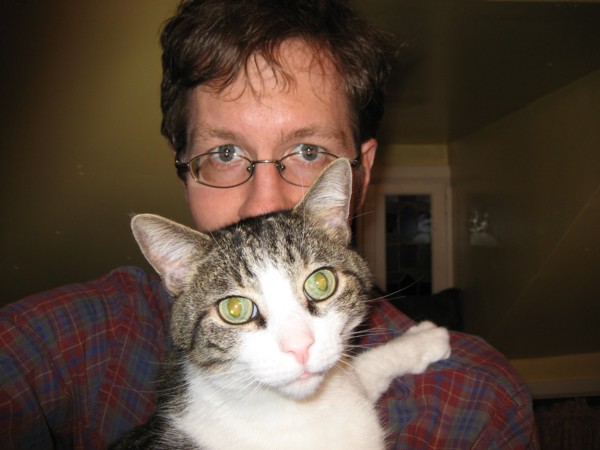
It is with the deepest sorrow that I write on here today to report the sudden death of my dear feline companion Scratchy. He passed away yesterday afternoon from a heart attack. Unbeknownst to me, Scratchy had developed a heart condition called feline hypertrophic cardiomyopathy (HCM), which is a heart muscle disease where the walls of the heart thicken over time, thus limiting the amount of blood that can be processed by the heart. Often, this condition develops with no visible symptoms, as it did in Scratchy’s case. He appeared lively and healthy up until the point of his death. Complicating the heart condition was another condition, of which I was also unaware. Scratchy was born with one kidney that worked at only a small fraction of the level of his other healthy kidney. With only one kidney filtering his blood, he endured an additional strain on his heart, which likely accelerated the effects of the HCM, leading to his sudden death before any symptoms ever appeared.
HCM is a serious condition for cats, often younger or middle-aged ones, with some evidence suggesting that male middle-aged cats are most frequently struck by it. Although there are medications to help treat the illness if it is caught early enough, the prognosis is rarely good, and most cats don’t live past a year or two after diagnosis. There is no known cure, and eventually the cat will suffer heart failure.
I am so thankful that Scratchy did not suffer. He knew very little pain during his full life, and he likely died almost instantaneously. I found him in the tub, where he had most certainly been engaging in one of his very favorite activities: drinking from the faucet.
As those of you who met him know, Scratchy was a very special cat and he touched a lot of people’s lives. He never failed to win over everyone who met him, even the most hardened of non-cat lovers. All he ever wanted was love, and he had plenty to give in return. He was such a sweet boy, so full of life, and he offered his love unconditionally. He will always remain in my heart in a very special place.
If any of you who read this have a memory or anecdote about Scratchy that you would like to share, I would love to hear it. Please either post it here or email it to me.
Posted by sean on January 1, 2008
https://sd-stewart.com/2008/01/01/r-i-p-scratchy-july-1996-december-31-2007/
somewhere else

Posted by sean on December 19, 2007
https://sd-stewart.com/2007/12/19/somewhere-else-2/
dialing in static
>I feel vaguely self-destructive. Flashes flood through the cracks in my psyche. I’m sliced down the middle, split in half, unable to walk on just one leg or the other. Not in the dark, at least. I need more sunlight. I need to not have what I don’t want. And then I need to want what I still have. And when I only have what I want, I should have nothing. Stitched up then, with two legs, and a psyche smooth as polished glass.
Posted by sean on December 18, 2007
https://sd-stewart.com/2007/12/18/dialing-in-static/
our eyes point forward, not backward
As I sat in the kitchen this morning, I looked up from my coffee and newspaper to see a pair of red-winged blackbirds alight on the feeder. What a pleasant surprise it was to see those bright red and yellow patches against a pitch black field of feathers, even more pronounced with the white snowy trees behind. It set my morning off right.
This recent trouble of straying from the now vexes me. It shakes me that even at this point in my life, those feelings can still find me and shuck away my not easily acquired confidence and security. As I stare down the irrational, shooing it away with the love pumping vigorous through my heart’s valves, I am reminded of the need for constant vigilance. I am a human and I am imperfect. At any time, I can unfortunately revisit my past, with all its mistakes, steps untaken, and warped thoughts and feelings. This keeps me vulnerable, while at the same time reminding me of how far I’ve come. The damage cannot be undone, but it can be healed. It can also, with practice, be looked at objectively, learned from, and recognized as a point I have moved far beyond. And I need to allow myself to also see other people’s pasts in this same light. For we are all living together in the now, and what matters most is what happens between us in the present. It is also in part what determines the future. So, in that regard, it is much stronger than what lies in the past. The now is the essence of our resilience as humans. The now is where you and I are, building our lives together one moment at a time.
Posted by sean on December 6, 2007
https://sd-stewart.com/2007/12/06/our-eyes-point-forward-not-backward/
floor to ceiling
>In the morning, I lie on the floor of my cube and do yoga poses. Lying on the floor, staring up at the ceiling tiles, I find myself truly immersed in my thoughts for a fleeting moment. I breathe in and I breathe out. I try to examine my thoughts objectively and I often fail. I try to clear my mind of the swirling eddies of worry, of frantic obsession, of irrational feelings of inadequacy. On the floor, with my back flat against a hard surface, looking up and not around, I feel a brief few minutes of control out of a long weary day. I savor this one moment when I take off my own self-constructed target, deflecting for a few precious seconds the darts dipped in my own poison sap.
Posted by sean on December 5, 2007
https://sd-stewart.com/2007/12/05/floor-to-ceiling/
an army in the trees
Red sentinels watch over this wooden womb, as breaths taken in fill with sorrow and exhale to unkind frigid air. A hollow place in heart and mind, an empty space once full of life for so long. This weight, though, shall lift one day; this fresh wound will slowly suture shut. And always keep in mind, too: our lives all circles, never lines…there is completion, life will renew.
Posted by sean on December 4, 2007
https://sd-stewart.com/2007/12/04/an-army-in-the-trees-2/
run
When in doubt, run. Run long, run far, run until you hurt. And then stop. Look up at the sky, look around at the trees, breathe in, breathe out. Remember why you did this before. Remember what it got you through, and how it made you feel. Alive. Remember what you need, and stop keeping it from yourself. Do not go to sleep standing up. Ever again.
Posted by sean on November 26, 2007
https://sd-stewart.com/2007/11/26/run/
losing my appetite for information
Today I heard, for the first time, the phrase “information snacks,” which refers to small easily digested chunks of information that readers gravitate toward because they’re too lazy to read an actual article. As with most terms related to the commodification of information, generally in reference to Web content, this one immediately turned my stomach. It sounds like the sort of phrase that someone in Knowledge Management (i.e. watered-down librarianship) would throw around during a meeting. “Let’s think of our website as the table, and our fat slovenly readers have just wedged their guts in between it and their office chairs. They are already beginning to salivate onto their keyboards, so what can we serve them as starters? Information wedges with ranch dressing, anyone?”
Since I have been doing way too much data entry lately for a person with a master’s degree, I have been thinking about automation and its role in information production, collection, retrieval, and dissemination. Inevitably, the more automation is introduced into information management, the greater the risk is of so-called “dirty data,” or information that has been soiled by the presence of odd characters, extra spaces, and other aberrations as a result of importing and exporting between different platforms and/or programs, the automatic populating of fields, etc. Cleaning up these aberrations is usually no small task, and therefore, to my knowledge, infrequently done. Many people consider the savings they gain from dispensing with personnel no longer needed to input data to be worth what they see as a minor loss in quality. These people think it’s more important to get more information out on the table than for that information to be in the best “digestible” condition possible. I think of these people as the fast food vendors of information, and frankly, they disgust me. They are usually people who have wormed their way into positions of influence regarding how information will be disseminated without having the proper credentials for doing so (e.g. training and education in librarianship). Often they are people with sales, marketing, and advertising backgrounds who think that the package the information comes wrapped in is more important than the information itself. Never mind that once you’ve opened the package, you can’t find what you’re looking for, and if you’re lucky enough to finally do so, it’s marred by weird characters and gaping holes in the text.
I realize I’ve begun to ramble here, but there is a point. Much like what happened to manufacturing with the Industrial Revolution is happening now with information. The Web has transformed how people think about and interact with information, and more than ever before it is being thought of as a product to be marketed and sold. In manufacturing, when transition occurred from handmade products to machine-made products, there was a tremendous increase in production numbers, but with an accompanying loss in quality and durability. This loss was considered to be of a collateral nature; it was offset by the huge increase in profit. Now, we see the same thing happening with information, but what are the implications of a loss in quality when it comes to information? It seems to me that there are potentially even more far-reaching effects than those that resulted from the Industrial Revolution. Often, the consumers of flawed information on the Web have no idea of the flaws, and so they take this information at face value. From working in a public library, I know that many people are indiscriminate in their consumption of online information. They do not know how to evaluate where the information is coming from; they think it is all legitimate. Getting them to the point where they can effectively evaluate the quality of the information is one step. But then it becomes even more important for the “respected” information purveyors (I’m thinking mainly of libraries and academic websites in general) to act responsible in terms of the information they are disseminating, and how easy they are making it for their users to discover.
Everyone is always looking for corners to cut, particularly where there is money to be made. Well, some things shouldn’t be done faster and more efficiently. Books should be cataloged by people, and catalog records shouldn’t be dumped into a library’s catalog from another source without first adapting them to local practice. Articles should be indexed by real live human beings using keywords from a thesaurus that was also created by humans. Search interfaces should be powerful, yet easy to use, and allow for searching with accuracy and precision. And the resulting information should be displayed in a clean and legible format. Is that so much to ask? Apparently it is.
Posted by sean on November 21, 2007
https://sd-stewart.com/2007/11/21/losing-my-appetite-for-information/
Get Posts by RSS


