coleman dowell, from island people

You drive, walk, eat, look at television, read, and all the while, beyond you and the cozy circle created by your lady around herself and you, like the natural emanations of stars, other lives circle yours, seeds still winged and wind-borne, looking for sympathetic soil. You feel the juices and solids of your body in attempted rearrangement, or, more disturbing, making an effort to create a stillness that approximates death, beyond which the body does become soil, receptive to all wind-borne seeds. In a not especially prolonged stillness, as though no chances could be taken that you might decide to become perpetual motion, words fall out of the air, a random fall from which you might be tempted to make selection, and as you do not move, cannot, a string of words falls onto you, and from you, onto the paper: winter rye greening up, smoothing the old brown earth with a fine new plane: Carpenter Rye, neighbor.

–Coleman Dowell, Island People

now recording observations on tumblr

I made a Tumblr for my field reports. I hope to post there on a more regular basis, while reserving this blog primarily for new fiction, book reviews, and whatever else is not a field report. Like anything, this is subject to change (read: fail) without notice. Those of you on Tumblr please visitI’m still orienting myself and some company would be nice.

UPDATE (March 2018): The corporate overlords at Tumblr have inexplicably flagged my site as possibly containing sensitive material, whatever that means. My Tumblr doesn’t even have images and I can’t imagine more innocuous text than the field reports I was entering there. Regardless, my appeals to them to lift this censorial block have so far been ignored. As a result, only logged-in Tumblr uses who are not operating in ‘safe mode’ may view the field reports for the time being. I’d be even more annoyed if I’d been posting there more regularly, but well, I’m still pretty annoyed…

UPDATE (May 2019): Tumblr essentially destroyed my site, which is maybe just as well, since my enthusiasm for the project had waned. I never could get any answers from Tumblr so I’m done with it. I’m happy to report, though, that I just did a limited print run of a compendium of field reports. So there is that.

publication note

My story “Orbiting” appears in the new issue of Dark Matter, available on ISSUU or in PDF.

favorite films watched in 2014

My film-watching habits are erratic to say the least, and there are often long periods where I don’t watch any films. I cannot claim to be a particularly informed or sophisticated viewer. I don’t see many films when they debut in the theater, relying instead on Netflix to manage my film viewing. If a film catches my eye in the media when it first appears, I add it to my queue for when it’s released on DVD. Other than that, I watch older films as they randomly come to my attention, through books, other people’s lists, interviews, etc. Often I watch films based on a particular actor or director. If I find someone I like, I’ll at least flirt with completism (a few examples are noted in the list below). But I don’t spend nearly as much time researching films to watch as I do researching books to read. As a result, I sometimes experience lackluster periods in my film viewing. This year, for example, was not particularly inspiring, and it was actually a little tough to come up with the arbitrary 10 I’ve included here, especially since I separated out the documentaries. Except as noted, I’ve included links to trailers, although in general I have some ambivalence toward trailers. The Bergman ones are notably bad, but they at least provide a taste of the films. I would’ve linked to the IMDB entries instead, but the ads on that site are oppressive. But enough apologies, here’s the list:

(Organized in descending order of film release date)

1. The Imitation Game (2014) – Benedict Cumberbatch – One of my favorite contemporary actors. This film was inspired by the book Alan Turing: The Enigma. I haven’t read the book, so can’t comment on how much the film departs from it. Seen in the theater.

2. The Grand Budapest Hotel (2014) – Wes Anderson [director] – I place this one above both The Life Aquatic with Steve Zissou and The Darjeeling Unlimited, but still not at the level of his finest work.

3. Ida (2014) – Dark subject matter filmed in black and white, atmospheric, i.e. the sort of film I tend to automatically like. Seen in the theater.

4. I Used to Be Darker (2013) – Matt Porterfield [Baltimore filmmaker] – I’m not sure how much I’d like Porterfield’s films if they weren’t filmed in Baltimore. That said, I liked this one more than his first two, and the Baltimore setting seemed less important this time. It was also fun to recognize someone in the film whom I wasn’t expecting to see.

5. The Iceman (2013) – Michael Shannon – Another favorite actor. This film is much more violent than most that I watch, but I made an exception because of both Shannon and Winona Ryder.

6. Dirty Pretty Things (2002) – Audrey Tautou – I watched this because I like Tautou, but Chiwetel Ejiofor is equally good here, if not better. The trailer is awful, especially the voice-over, so I linked to the film’s website instead. I don’t recommend watching the trailer if you’re thinking of seeing the film, as it distorts the storyline. Also, the film’s title is incongruous with its content.  I’m still puzzled by the title.

7. The Apostle (1997) – Robert Duvall – My film watching was especially sporadic during the 90s so I’m still catching up on the classics from that decade.

8. Persona (1966) – Ingmar Bergman – Still working my way through Bergman.

9. Winter Light (1963) – Ingmar Bergman – Ditto above. This is my second favorite of the Trilogy, the first being Through a Glass Darkly.

10. Last Year at Marienbad (1961) – Alain Robbe-Grillet [screenwriter] – Robbe-Grillet is known for his groundbreaking fictional work as part of the Nouveau Roman Movement. Some of his novels are favorites of mine and knowing he also wrote screenplays, I was curious about those. This is considered his masterpiece, and I found it to be deserving of that reputation.

Documentaries:

1. From One Second to the Next (2013) – Werner Herzog [director] – This link points to the full film. It’s only about 30 minutes long and is worth watching in its entirety, especially if you have ever used your mobile phone while driving. Herzog is a brilliant filmmaker whose other documentaries and feature films are also highly recommended.

2. Harry Dean Stanton: Partly Fiction (2012) – Harry Dean Stanton – Another favorite actor. This documentary is less about Stanton as a person, and more about his skills as an actor. It’s a somber portrait of a man who has made a career out of acting natural in his many roles, yet without giving much of himself away. In this age of celebrity, few actors anymore are known to the public almost exclusively through their work. Stanton has managed to be one of those rare exceptions, though likely not without exerting significant effort in maintaining his privacy.

3. Last Days Here (2011) – An often painful-to-watch, yet redemptive portrait of Bobby Liebling, the singer of cult doom metal band Pentagram, who spent decades struggling with drug addiction, to the detriment of his music career.

belated lists for 2014

Happy New Year! Here are my belated lists of favorite books read and music listened to in 2014. Neither list is in any particular order. My reading slowed down in autumn when I took on Reiner Stach’s Kafka biographies. They ended up being my top favorites for the year, reminding me once again of my love for a good literary biography. As for music, it wasn’t a big year for new discoveries, but plenty of indulging in old favorites and a few newer passions from recent years. I tend to listen to music seasonally, so not all of these are in rotation year-round. I also plan to post a list of favorite films for the year, but that will take some extra time to compile as I don’t always make notes of what I watch.

Books

Completed reads: 72
Abandoned reads: 4

1. Kafka: The Decisive Years by Reiner Stach
2. Kafka: The Years of Insight by Reiner Stach
3. The Notebook, The Proof, The Third Lie: Three Novels by Agota Kristof
4. To Whom It May Concern by Raymond Federman
5. The Will to Sickness by Gerhard Roth
6. Kaddish for an Unborn Child by Imre Kertész
7. Yes by Thomas Bernhard
8. It Then by Danielle Collobert
9. Selected Poems of René Char by René Char
10. Life, End of by Christine Brooke-Rose
11. I Am Lazarus: Stories by Anna Kavan
12. Topology of a Phantom City by Alain Robbe-Grillet
13. Mauve Desert by Nicole Brossard
14. Song of the West: Selected Poems by Georg Trakl
15. A Schoolboy’s Diary and Other Stories by Robert Walser

Music

1. The Smiths
2. The Cure
3. Swans
4. Grails
5. Nadja
6. Jesu
7. Om
8. Lycia
9. Caudal
10. Boards of Canada
11. Gravenhurst (thanks, Dan; RIP Nick Talbot)
12. Nick Drake (mostly Pink Moon)
13. Skinny Puppy (mostly Remission, Bites, Rabies, & The Singles Collect)
14. Front Line Assembly (mostly The Initial Command & State of Mind)
15. Slowdive, with Low [live show with JFaunt ♥]
16. Helicon’s 29th Annual Winter Solstice Concert [live show]
17. Danny Paisley & The Southern Grass, with Chester River Runoff [live show]

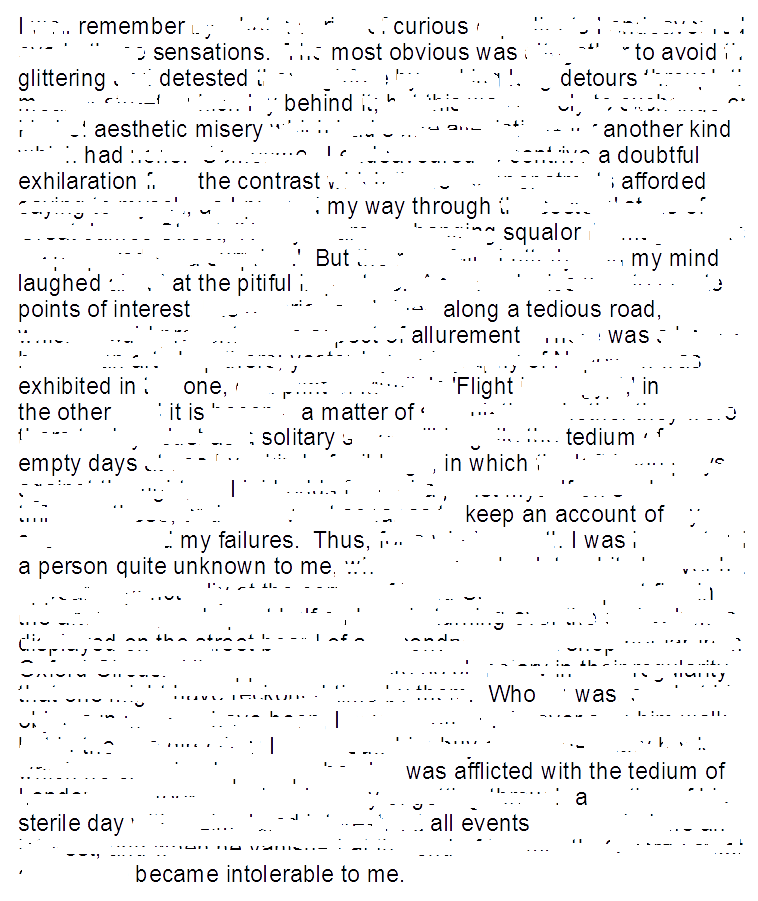
triviality of trivialities

Erased from As a Matter of Course (1894) by Annie Payson Call

Erased from As a Matter of Course (1894) by Annie Payson Call

[click image to enlarge]

quest of the simple life pt. 1

Quest of the Simple Life Pt. 1

Erased from The Quest of the Simple Life (1907) by W. J. Dawson [click to enlarge]

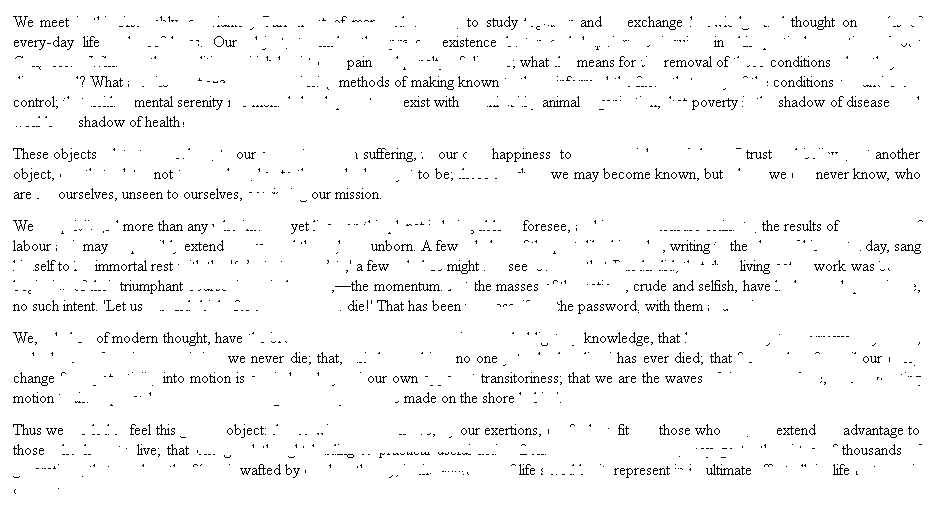
city of health

city of health

Erased from Hygeia: A City of Health (1876) by Benjamin Ward Richardson [click image to enlarge]

We meet to study and exchange thought on every-day life.
Our existence in pain
what means for removal of conditions?

What methods of making known conditions control?
Mental serenity exist with animal poverty
shadow of disease, shadow of health.

These objects, our suffering,
our happiness to trust another object.
Not to be, we may become known,
but we never know, who are ourselves,
unseen to ourselves—our mission.

We, more than any, yet foresee
the results of labour may extend unborn.
A few writing the day
sang self to immortal rest.
A few might see living
work was triumphant.
The momentum, the masses,
crude and selfish,
have no such intent.

Let us die!
That has been the password with them.
We of modern thought have knowledge that we never die,
that no one has ever died,
that our change into motion is our own.
Transitoriness, that we are the waves-
motion made on the shore.

Thus we feel this object, our exertions fit those
who extend advantage to those live,
that thousands wafted by
life represent ultimate life.

another excerpt from ‘book of thoughts’

The first few pages of Book of Thoughts, an ongoing erasure project

[click images to enlarge]

bookofthoughts_pg1

bookofthoughts_pg2

the tanners [book review]

Recently I began reading Robert Walser’s novel The Assistant. I associate Walser with the winter season, and particularly the month of December, likely because that was when I first started reading his work. Walser also died in December; he was found lying in the snow on Christmas Day 1956, having suffered a heart attack during one of his frequent and much-loved walks.

The Assistant has been a joy to read so far, brimming with Walser’s off-kilter cheekiness and his typically exuberant scenic descriptions. And so, with my enthusiasm for his writing in its current heightened state, I thought I’d share another of my Walser reviews from the archive, with the hope of encouraging others to investigate this still tragically under-read writer.

____________________________________________________

The Tanners by Robert Walser

I don’t want to go running down some career path—supposedly such a grand enterprise. What’s so grand about it: people acquiring crooked backs at an early age from stooping at undersized desks, wrinkled hands, pale faces, mutilated workday trousers, trembling legs, fat bellies, sour stomachs, bald spots upon their skulls, bitter, snappish, leathery, faded, insipid eyes, ravaged brows and the consciousness of having been conscientious fools. No thank you!

Robert Walser was an odd fish and I like him a lot. Even though he once said, as W. G. Sebald reports in the introduction to this book, that he was essentially always writing the same novel, one which he said could be described as “a much-chopped up or dismembered Book of Myself,” I will continue reading his same-as-before novels because they captivate me. I like to think of him up in his stuffy attic room, frantically writing on borrowed paper with stolen pens, gripped in the passion of that writing, of hurling his herky-jerky version of the world down onto the page.

The Tanners is the disjointed story of the Tanner siblings: Simon, Klaus, Kaspar, and Hedwig (oh, and the mysterious Emil, who later randomly shows up in another character’s anecdote). Primarily, the “plot” (such as it is) follows the adventures of Simon as he bounces around from job to job while basically pursuing the sublime. From the start, Simon reminded me of Jakob from Walser’s anti-Bildungsroman Jakob von Gunten, with his similar tendency toward mockery traced with veins of sincerity. Or maybe it was just straight mockery, maybe I imagined the traces of sincerity—it’s really so hard for me to say for sure. When Simon refers to his own cheekiness, I couldn’t stop thinking about that Saturday Night Live sketch where Mike Myers plays Simon, the kid in the bath making drawings who calls people “cheeky monkeys.” It’s always unsettling for me when pop culture and literature suddenly collide in my head. And yet the two Simons do share a similarity, if only a superficial one. But I digress. Simon is a self-described ne’er-do-well prone to walking all night through the mountains to visit his artist brother Kaspar, his closest sibling. Simon’s gleeful flippancy is infectious and makes him a likely candidate for the reader’s sympathy. Hedwig is the only sister in the bunch, a small town schoolteacher who Simon also stays with for an extended visit. They bond, but she suspects him of being a freeloader, which he sort of is. Hedwig is an interesting character, and Walser allots her some good speeches. Finally, Klaus is the oldest brother, a stodgy straight-arrow type who thinks he knows what’s best for all of his siblings. He is annoyingly overbearing, though probably well-meaning.

In the introduction, Sebald draws some parallels between Gogol and Walser that I found to be relevant, having just finished a book of Gogol’s short fiction. Like Gogol, Walser has a tendency to introduce characters who at the time seem like they may come to play important roles in his narrative, only to either suddenly kill them off or fade them into the background. Sometimes they also reappear later, just out of the blue, and fill us in on what they’ve been up to for the past year or however long they’ve been gone from the narrative. The aimless plot wanders down side streets, dead-ends, turns around, leaves the city, climbs a mountain, walks off a cliff, gets a concussion, and turns up back in the city again a few chapters later with a new lease on life. Or something like that. I was anthropomorphizing the plot just then. I would imagine that the general unreliability of Walser’s prose could easily become maddening for some readers. The key is to float along with Walser wherever he chooses to take you. One must surrender completely in order to enjoy reading; there is no fighting it because Walser will always win. Always. We are on an adventure with him, as he discovers his own truths in his writing. In this way he is also very much like Gogol, who eschewed the narrative traditions of the time and instead went off happily exploring in his prose.

Throughout the book, Walser spins a gauzy web of natural beauty around his characters who, when not walking around outside enjoying the weather or laying stretched out in the forest, very much tend to spout off lengthy monologues in the general direction of each other, not seeming to expect responses and, in fact, rarely getting them. Walser’s prose is so sensual, his descriptions of both urban and rural settings sparkle with crisp detail clearly borne of a sharply observant mind. Half the novel one falls into a reverie, while the other half one stares at the closest wall, noting the intricate cracks in the plaster with genuine interest.

Despite the lack of plot, there are certain themes to pick out. With Simon and Hedwig, we find themes of youthful self-discovery, the search for meaning and happiness in one’s life, and the ever-painful plight of the daydreamers among us. With Kaspar, there are the ideals of art and the difficulties inherent in one’s pursuit of those ideals. In Klaus, we see a rather sharp critique of mainstream society and the trappings of materialism and the pursuit of wealth. Readers who have siblings, particularly multiple siblings, will also likely enjoy the novel on another level less accessible to those who don’t, for Walser does an admirable job of portraying the complicated and contradictory dynamics that often characterize sibling relationships.

As Simon opines late in the book, “How tedious it was always to be doing exactly the same thing.” Some books always do the exactly the same thing, what we expect them to do, over and over. Not with Walser. Even if he did claim to be writing the same novel over and over, his prose is always worth reading, because it’s granular yet dissimilar; it’s made up of life’s strikingly mundane and spectacular moments, as pointed out by the likes of Simon, who, after all, claims to be “an outlandish figure in my own homeland.”

  • Recent Posts

  • Navigation Station

    The links along the top of the page are rudimentary attempts at trail markers. Otherwise, see below for more search and browse options.

  • In Search of Lost Time

  • Personal Taxonomy

  • Common Ground

  • Resources

  • BOOKS BOOKS BOOKS