spring at cromwell

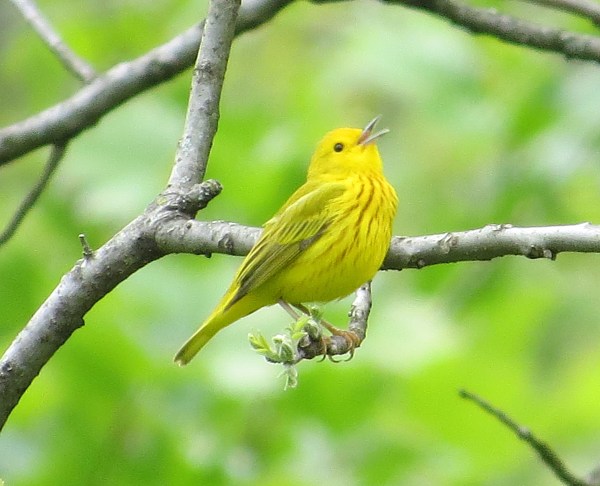
Male Yellow Warbler singing at Cromwell Valley Park, Baltimore County, Maryland. © 2017 S. D. Stewart


American Red Fox stalking prey at Cromwell Valley Park, Baltimore County, Maryland. © 2017 S. D. Stewart

I had a very close encounter with this fox. We were walking toward each other and I’m not sure it even noticed me at first. It was paying close attention to the overgrown field to its immediate right. At a certain point, it turned and started to enter the tall grass. It stood there for a moment with the front of its body obscured before pouncing high up in the air and then disappearing into the grass. I kept walking until I got to the point where it had left the grassy path. I couldn’t see the fox anymore at that point, so I waited and eventually I saw its head pop up amidst the tall grass. We eyed each other for a few seconds before it suddenly stood up and walked out directly in front of me, only about six feet away, and casually turned to the right to continue walking in the direction it had originally been headed. It did not look particularly concerned about my presence, exhibiting only a barely visible wariness. I watched it for a while and then I kept walking in the opposite direction.

new arrivals and a mysterious departure

At some point last night under the cloak of darkness the neighborhood’s catbirds arrived to spend the summer muttering to themselves in the dense foliage. I came downstairs this morning to the welcome sound of their strange twittering cacophony. I looked out the window of the sunporch and saw at least three or four of them skulking in the yard, chasing each other through the ground cover. On the front walk, another of their tribe held in its narrow bill a fruit of the nearby Japanese laurel, aka Gold Dust Plant, or to be more formal about it: Aucuba japonica. Decidedly unimpressed with its breakfast bounty, the bird quickly discarded the bright red drupe (looks can be deceiving!) and flew off.

Oddly enough, our other local representative of the Mimid family, the stalwart mockingbird, has been conspicuously absent from the immediate environs of the house since last fall. A usual year-round resident, this bird (if it has indeed been the same individual) was always nearby in its obvious way, singing and scolding, even visiting the feeder out of desperation during particularly hard winters, and providing an amusing foil to the more retiring catbirds throughout the summer months. Sadly, no mockingbird has yet shown up to take this one’s place. I had often wondered if ‘our bird’ had been a grizzled old bachelor, for on many a spring night I would hear him singing late into the evening hours, yet I witnessed neither courting nor nesting activity. Perhaps his mellifluous songs never attracted a mate and he met with some unknown fate having never propagated his species. I am still hoping, though, that someday soon one of his brethren will appear and take up residence nearby.

leonora and gabriel – an instant

old sam peabody

old sam peabody
song of white-throated sparrow
northbound bird visits

a siren sounding

a siren sounding
enters afternoon stillness
i bow my head low

it’s never just about the weather

I do not want to bore you but I need to mention the weather. How it changes so often. Grey one day, yellow the next. Warm then cold then warm again. The brightness, the whiteness, the way the light shifts inside a room. And the way to compensate with the artificial. Our lamps. Our electric manipulation of the shadows.

I am reading this book wherein the main character feels inauthentic. He keeps trying to capture the feeling of being real. He goes to elaborate lengths using methods only possible due to the generous settlement he received following a traumatic accident. He wants to relive his body’s response to the trauma. The natural opioids flowing through his body. That tingling serenity. But he doesn’t know this. So he keeps trying. He exerts control in an effort to manifest a desired outcome. He too is concerned with how the light moves across a room. Yet he cannot control it for the Earth is always changing its position relative to the Sun. He cannot count on it always being the same. I want him to know that it’s all real. That it’s not a matter of recapturing a feeling of being real. That he must awaken to it.

In March the weather changed so often. Now it is almost April and I am learning to walk again. It has been a long and strange winter in more ways than the most obvious one.

I wonder if the world is really different. Is it really changing. Or do we just perceive it to be doing so. A person can pretend that it is not. Quite easy to do that. Everything is happening all at once and one can only choose to pay attention to so much of it. What will catch your attention. A call to action, perhaps. But there are no more manifestos. They cannot breathe in this information-choked environment. So maybe the world is different. Maybe it is different in how words have become both so much less and so much more important. Words spew out around us at light speed. Our eyes and ears are bombarded by them. Words are cheap and they pile up around our feet by day’s end. But there are a few diamonds in that pile. Which of these will we choose to hear? Which ones will we allow to penetrate the filters now affixed to our eyes. And how will we respond.

I continue to ruminate on the act of writing and what purpose it serves, if any. The consensus among writers I admire is that the point of writing is not to say something. As the writer of the book I refer to above quotes Kafka:

I write in order to affirm and reaffirm that I have absolutely nothing to say.

To take it to the furthest extreme, I’m reminded of Enrique Vila-Matas and his novel Bartleby & Co., which chronicles an array of “artists of refusal,” those who chose not to write. Now Vila-Matas clearly wrote his book with tongue firmly planted in cheek, and yet there are indeed writers who have chosen not to write. One can certainly see the appeal, especially when confronted with the dread of the empty page.

In his short story “The Library of Babel”, Jorge Luis Borges wrote:

The certitude that everything has been written negates us or turns us into phantoms.

Even taken out of context from a piece of fiction that sounds harsh. And I don’t agree (nor do I think Borges did). While this certitude can get me down, I refuse to be negated and I am certain of my realness. I am not a phantom. At one time I may have believed I was, but no longer. Writing for me now is an attempt to perpetuate this realness. Of figuring out a way to convey actuality in prose. Of removing the filters and exposing the words in all of their stark, fragile beauty. It is likely an impossible task, but it is the striving that fills the pages.

parts not clear

Our Nervous Friends [erasure]

Erased from Our Nervous Friends: Illustrating the Mastery of Nervousness by Robert S. Carroll. New York, 1919. Courtesy of Project Gutenberg.

her earliest recollection, parts not clear
there were her father, her mother
face so strange, so strange
white cloths, his head, strange faces
not seen before, strange stillness
strange new fear

her father did not move
so quiet, memories blurred
not sure which memories
grown from what she heard
the funeral, never forget
silvered handles, shining coffin
women in black, her touch
the prettiest things ever seen

run away, frightened, empty
her father thrown against a tree
fractured skull
unconscious and buried
shiny coffin, silver handles

instincts of the herd

Instincts of the Herd erasure

Erased from “Imperfections in the Social Habit of Man.” In: Instincts of the Herd in Peace and War by W. Trotter. London: T. Fisher Unwin Ltd., 1916. Courtesy of Project Gutenberg.

first feeling of the ordinary citizen
fear—immense, vague aching anxiety
the individual fears for future
food supply, family, trade

with fear, a heightening of intolerance of isolation
loneliness urgently unpleasant
the individual experienced desire for company
and even physical contact.
in such company aware of
confidence, courage, and moral power

isolation tended to depress confidence,
company fortified it.
the change in frigid atmosphere
of railway train, omnibus, and all such meeting-places
was most interesting

most striking of all was
the strength and vitality of rumour,
startling evidence that a stronger force than reason
was at work in formation of opinion

non-rational opinion so widespread,
such opinion spread so rapidly, established so firmly.
the successful rumours invaded all classes.
the observer found self irresistibly drawn to
acceptance of popular belief

allied with accessibility to rumour was readiness
with which suspicions of treachery and hostility
grew and flourished
about anyone of foreign appearance or origin

attempt to discuss origin and meaning of
various types of fable epidemic in opinion—
we are concerned with their
immense vitality and power of growth

strange sea creatures

Strange Sea Creatures

Erased from “Strange Sea Creatures,” in Pleasant Ways in Science, by Richard A. Proctor. New York: Longmans, Green, & Co., 1905. Courtesy of Project Gutenberg. [click to enlarge]

so-called fabulous animals
the merman, zoologically possible, of course,
the unicorn, the dragon, the centaur,
the minotaur, the winged horse,
recognized as known forms.

the sea has been misunderstood,
land cannot long escape.
the most powerful and ferocious beasts struggle.
savage man must be killed
and the true appearance of the animal determined.

powerful winged animals remain mysterious,
a mighty bird might swoop down and disappear.
from time to time the strange winged monster
would be seen hovering.

savage races of man, animals now extinct.
power of the winged enemy,
sea creatures monstrous.
we remain ignorant.

hidden beneath the waves
creatures of the deep sea expose themselves,
men counter-attack.
great sea creatures, monsters of the deep
seen only for a few moments,
sinking back into the depths, a mystery.

repetition of the story
the creature, its true nature recognized.
understand then the fabulous creatures,
remarkable, the monsters of the deep sea,
understand the truth.

‘the source we have forgotten’

The road. When I could drive no more for weariness I huddled in the back of the car and uneasily dreamed for a few hours but I did not do that often, I was in a frenzy that precluded rest. I felt that I was in a great hurry but I did not know I was speeding toward the very enigma I had left behind–the dark room, the mirror, the woman. I did not know this destination exercised a magnetic attraction on me. I did not know I could not stop.

In the mornings, the ground was white with hoar frost for it was now late October and a crimson sun rose over plains that rolled as far as the pale hem of the sky. There were no trees. The radio in the car fed me an aural pabulum of cheapjack heartbreak; this nasal country music was interspersed with voices that sang the praises of innumerable articles of consumption and sputtered out frequent news bulletins. The Harlem Wall grew longer, taller, thicker; the National Guard was on permanent call. Riots, incendiarism. I could not have picked a worse time for my trip. Only fatality could have possessed me to go high-tailing off in such troubled times, fatality and the unknowable impulsion of the destination ahead of me, a destination of which I was entirely ignorant although it had chosen me long ago for our destinations choose us, choose us before we are born.

And exercise a magnetic attraction upon us, drawing us inexorably toward the source we have forgotten. Descend lower, descend the diminishing spirals of being that restore us to our source. Descend lower; while the world, in time, goes forward and so presents us with the illusion of motion, though all our lives we move through curvilinear galleries of the brain towards the core of the labyrinth within us.

—Angela Carter, The Passion of New Eve

  • Recent Posts

  • Navigation Station

    The links along the top of the page are rudimentary attempts at trail markers. Otherwise, see below for more search and browse options.

  • In Search of Lost Time

  • Personal Taxonomy

  • Common Ground

  • Resources

  • BOOKS BOOKS BOOKS