
Beneath the crust lies a kernel. A kernel formed of decisions made and those deferred. Crack it open and free the seed inside to float away. Follow it. Down a deer trail. Under a rock. Into the reeds. Up in the air, over the ridge. Pay attention. Ignore the ghostly hands pulling at your collar, suggestive in manner, dragging you, enticing you toward a warm spot to curl up and stop. It’s always the decisions. Counseling for or against. Talking, hashing it out, pacing in deranged circles. Stop the pacing. Wrangle your thoughts and subdue them. Step back. Breathe. There is a lightness in us that we can reach. Tap it like a sugar maple and let it flow, sweet and pure. Drink it in and never stop. What will matter in the end is how we spent our days; these moments won’t return.
All posts in category nature
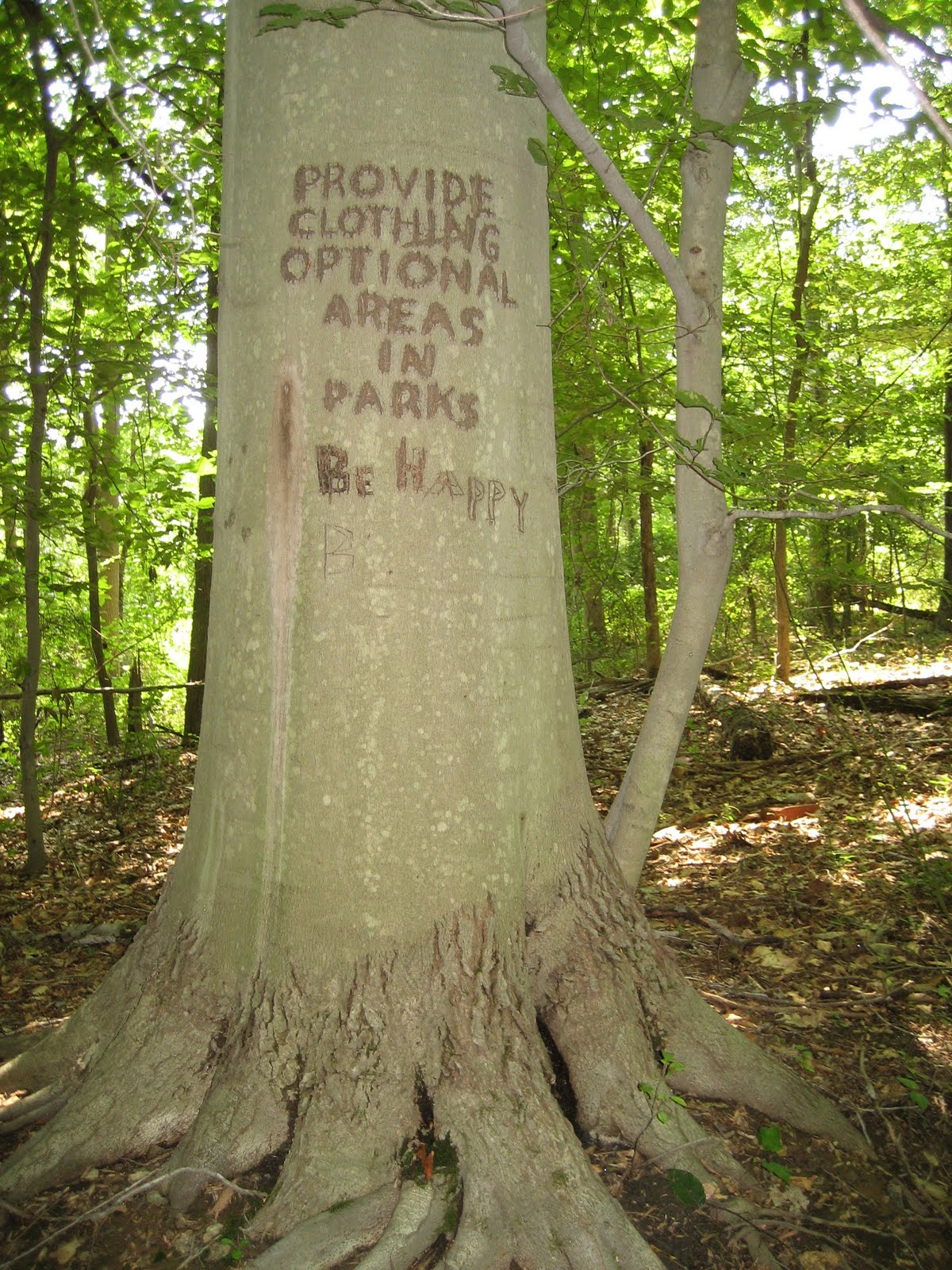
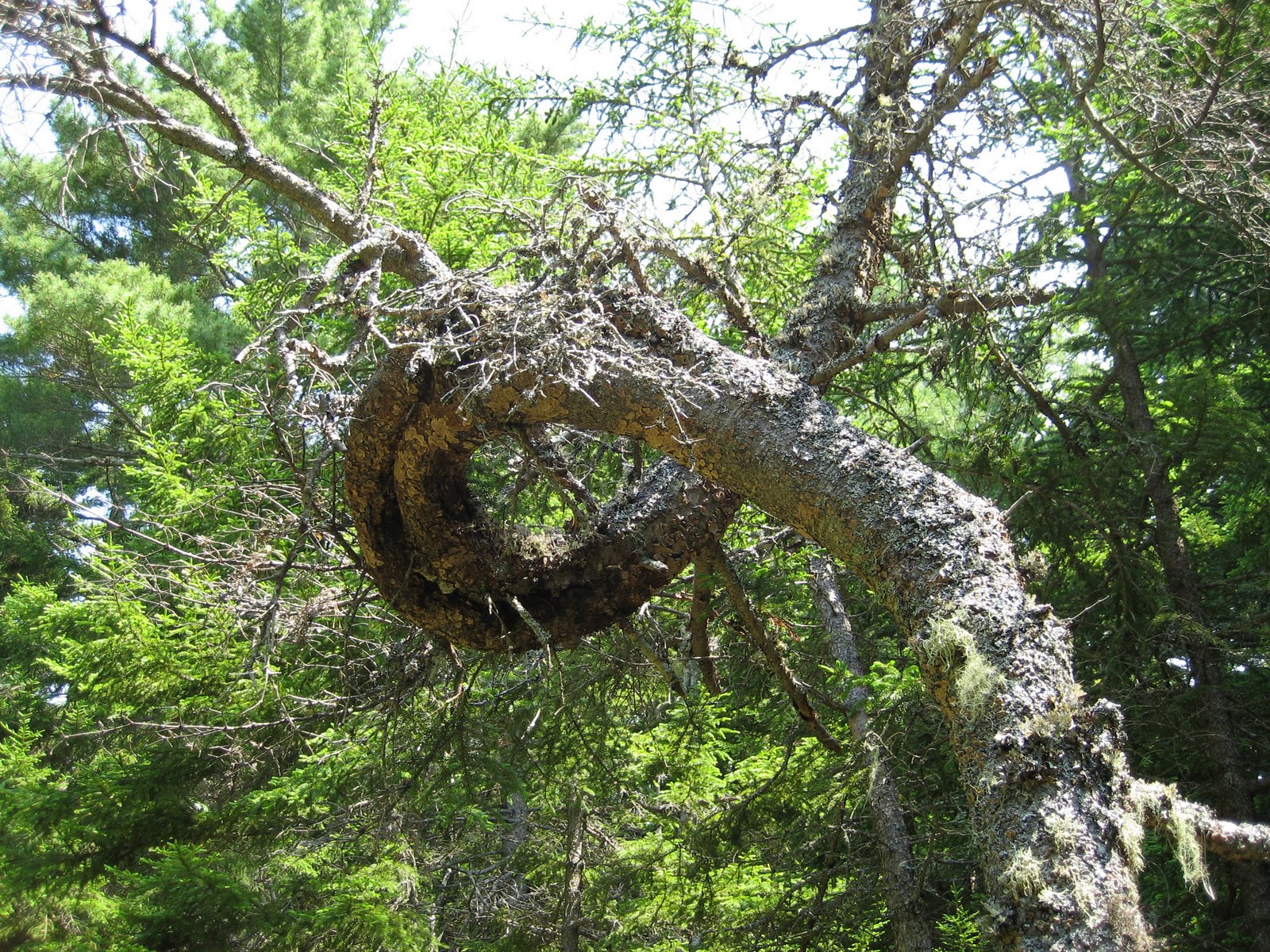
i realize everyone’s got an agenda…
…but this is just a waste of a good beech tree.
Posted by sean on September 2, 2010
https://sd-stewart.com/2010/09/02/i-realize-everyones-got-an-agenda/
maine
On the outskirts of town, we stop at a used bookstore & antique shop. I pick up a reissue of Black Sun and Em Ell finds me an old Western shirt with snaps down the front. Twenty minutes later as we pull into our place for the week, I hear the first hermit thrushes. That night I crack open the book and read Abbey’s words in the first paragraph: “He hears the flutelike song, cool as silver, of a hermit thrush.” Fiction mirrors life, every single time. If it’s good and true, that is.
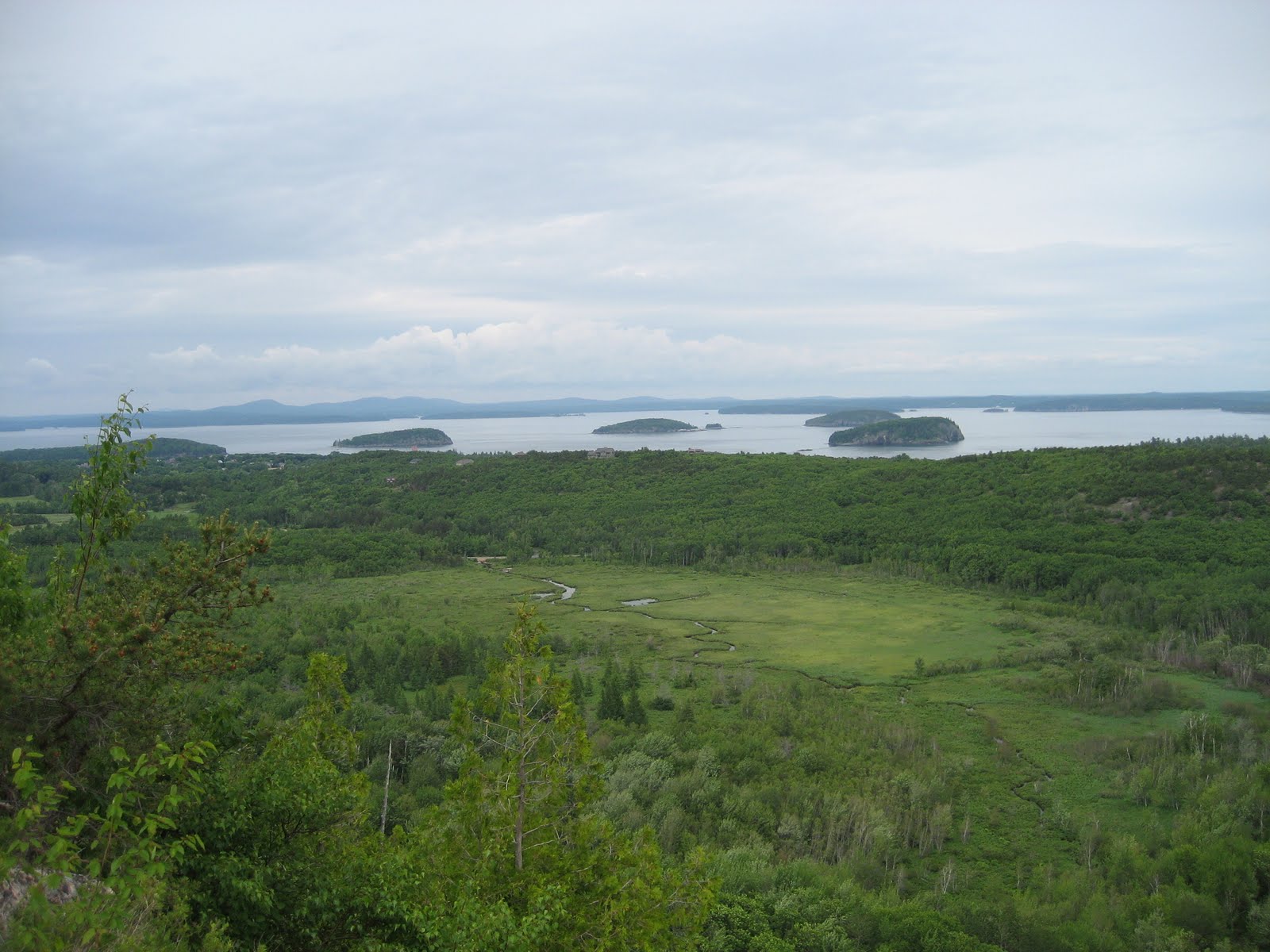
Maine’s natural beauty, both rugged and fine, bowled me over. I came as a pilgrim, seeking solace from the noisy, angry city streets, and I left a zealot, prepared to spread the gospel. Maybe better to keep it to myself, I thought later, though, don’t want to spoil a good thing anymore than it’s already been spoiled, which is surprisingly very little, as evidenced by views such as this:
We explored by boat, by foot, by bike, by kayak, and again by foot. I saw and/or heard 62 species of birds (several of them were lifers), a little lower than my expectations, but considering I did very little dedicated birding, not bad by a long shot. We climbed in the mountains, topping out somewhere around 1160 feet. We kayaked with the loons and listened to their haunting song. This particular loon seemed unimpressed with us:

The one day I went out by myself specifically to go birding was cool and rainy. I woke at 6 AM to the sound of steady rain and almost decided not to go. I lay back down in bed, but I just kept thinking about how I am only in this place for one more day. So I went. At my first stop, deep in the park on the western side of the island, I found myself surrounded by ravens scronking their unearthly calls in the trees. I’d hear sounds like churning helicopter blades, and look up to see another raven flapping its wings, off to unknown places. I then found myself slightly off-track due to a confusing turn in the trail. So I returned to the car and drove on twisting gravel roads to the place I was looking for. I’d planned out this excursion using a birding guide to Mount Desert Island. This first place ended up a bust, though. There I was deep in the forest, and all I could find was a robin and some mourning doves. I can find those birds in my backyard any day of the week! But they don’t get to see this:

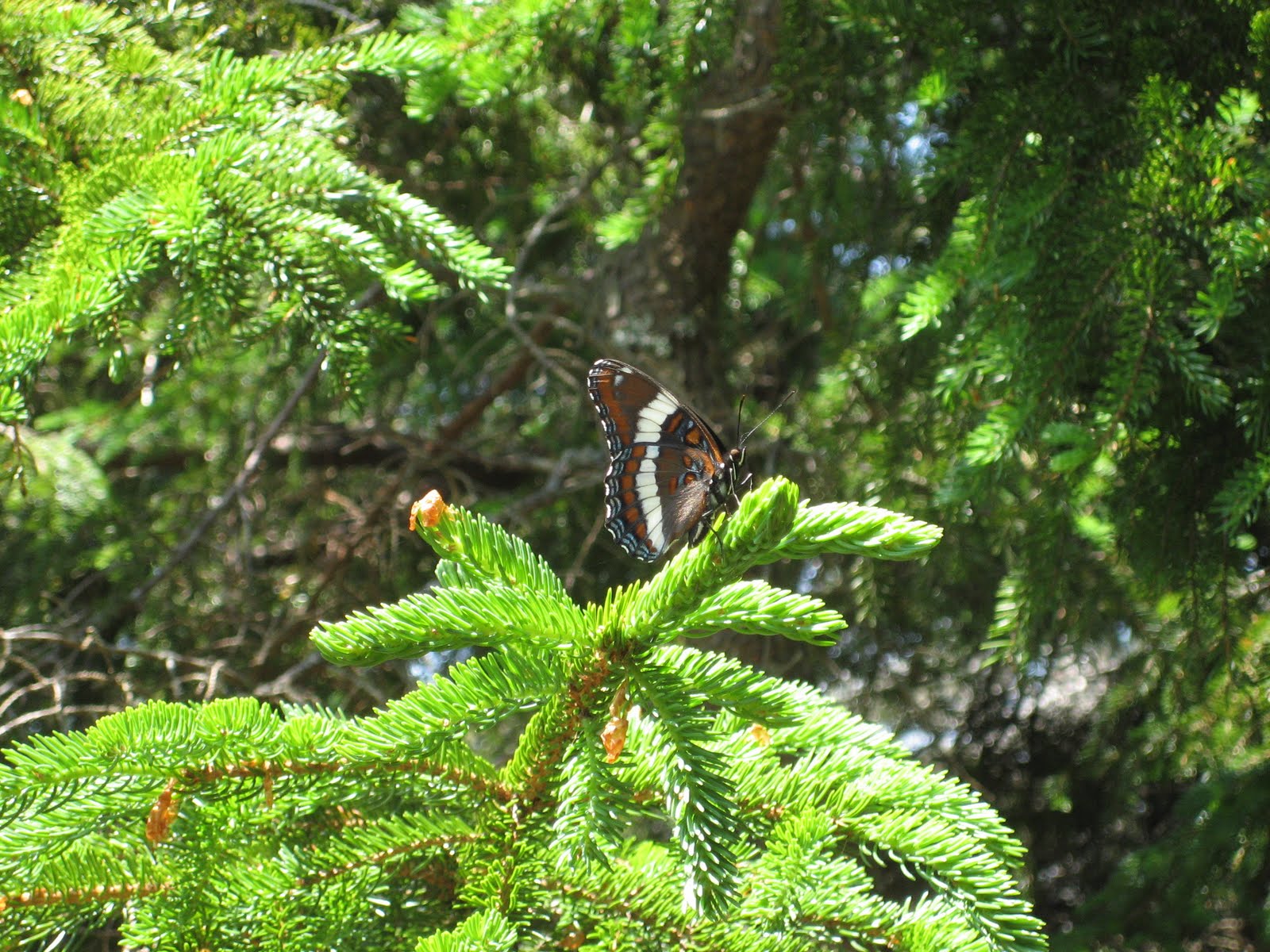
A curious thing about birding that you learn early on is that the most beautiful isolated places in the world are not necessarily the birdiest places. In fact, they are often not very birdy at all. Birders often find themselves hanging around water treatment plants, landfills, parking lots, and disgusting ponds behind shopping centers. Birds don’t care what a place looks like, per se, as song as their needs are met. On this particular day in Maine, I was experiencing this phenomenon. It’s hard to be upset at a lack of birds, though, when there is so much else to look at, such as this White Admiral butterfly.
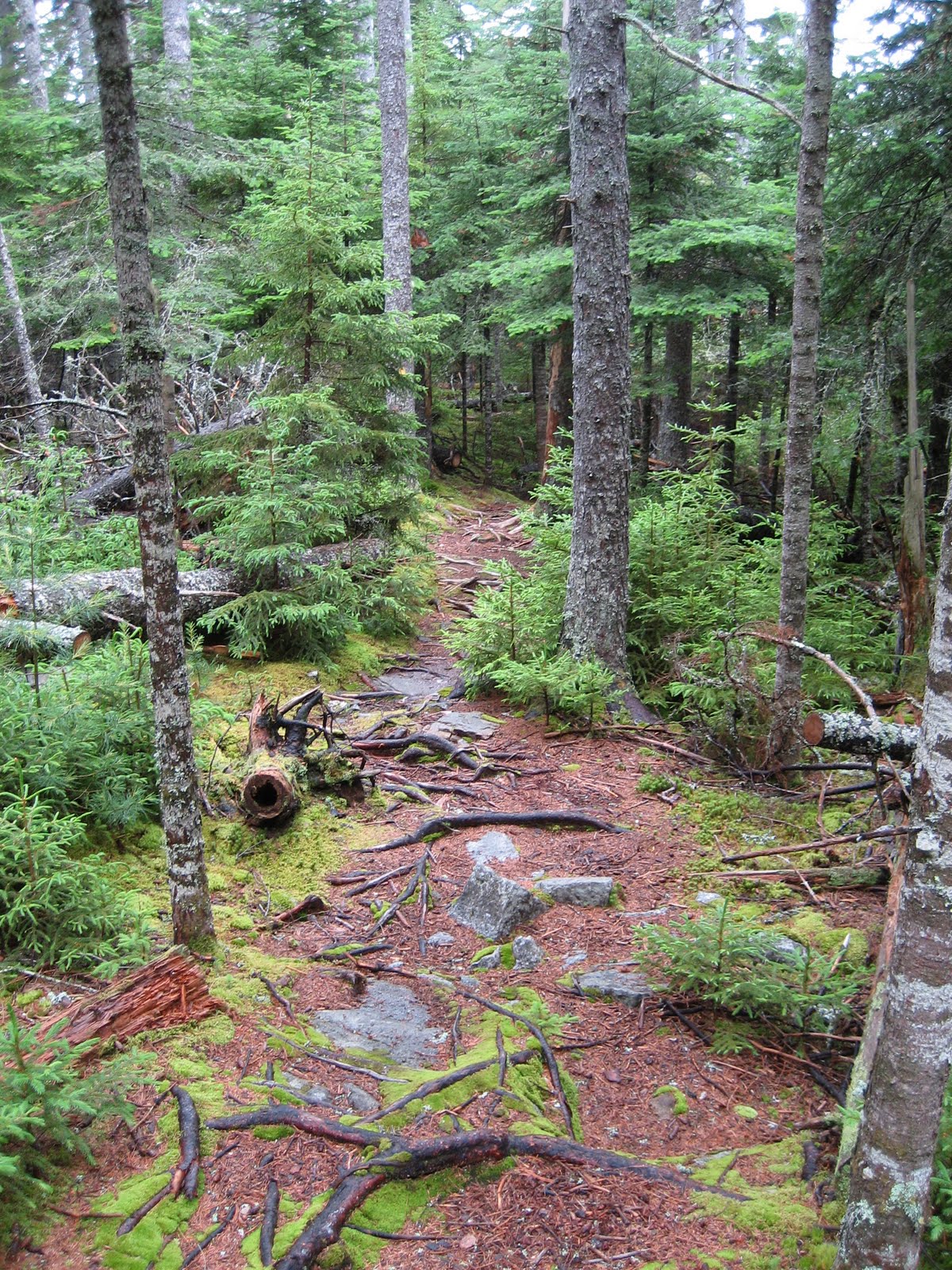
I left the forest and headed to the western coast, where I hiked in to some land preserved by the Nature Conservancy. This was a tract of towering white cedars, red spruce, and balsam firs that were untouched by the great fire of 1947. The trail, gnarled with massive tree roots, wound a circuitous route to the beach. When it opened up out of the forest, I found singing warblers, most very high in the trees. Busy woodpeckers worked the lower trunks. A winter wren trilled its bubbling song. I only lingered for a little while, though, as I’d already been out for several hours.
Later that day we explored the Wonderland and Ship Harbor trails in the southwestern section of the park. It was quite birdy there, and we saw a bald eagle land off-shore on some exposed rocks where a group of gulls was roosting. The gulls were none too pleased with the eagle and started dive-bombing it. I forgot the camera in the car during these hikes so I don’t have any visuals. But here is where we hiked to the very next morning:

After climbing mountains that last day, we returned to home base. I needed to reflect and absorb, as I felt the end of this time nearing and my state of mind already shifting. Near our place, at the bottom of a long cascading series of wooden steps lies a rocky beach. I go there, close my eyes and hear the tide wash in and recede. I open my eyes and see that large smooth stone on the beach as my soul, washed as it has been by the saltwater tonic of this place. I want to distill the salt-laced air, the fragrant pine boughs, the views of aching beauty, the hermit thrush’s song–take it all and fill a tiny bottle to carry with me and open to breathe in as needed. But the grains of my recollections will instead likely drift away over time in the stale winds of the day-to-day. Perhaps, though, if I concentrate hard enough, I can keep some of the uniqueness of what I saw cloistered deep within my mind, where nothing from the outside can ever destroy it.
Posted by sean on July 3, 2010
https://sd-stewart.com/2010/07/03/maine/
gargling truth serum
Never swallow, never swallow, but keep that golden truth serum swirling around in your mouth. That way it can become anything you want. A brilliant answer to a dusty question, a missing piece to a bruised and broken puzzle, a misplaced passion found again. Passed by the stairs at the top of this page again a day or so ago. Stairs to the future…stairs to wildness…stairs out of this purgatory. Traveling through the woods with my avian friends…walking the Mason-Dixon trail…coulda kept walking and walking and never stopped. There was no real reason to stop. The birds just kept singing and they just kept moving, and I just kept moving with them, ticking them off as I went. The water was there, too. And the sky. And the trees. The ground below my feet felt good. Everything felt good and right and I felt alive. I felt so good, high on the experience of being where I was and nowhere else at that moment. Something extraordinary seeking to burst out from inside…seeds laid to rest on bare soil and rising toward the warm sun. Rich feeling pervades for mere moments, gulp enough to sustain another few days, few weeks, few months. Don’t wanna be the second-guesser anymore…don’t want to renege, reinterpret, revisit, re- anything. Just clearing the path, one heavy stone at a time….all we can do, all we know to do.
Posted by sean on May 17, 2010
https://sd-stewart.com/2010/05/17/gargling-truth-serum/
woodcock-blocked
Yesterday, the dulcet tones of the resident mockingbird guided me through my morning rituals. Once the eyes and ears have awakened to nature’s wonder, they just keep opening wider each day. Even in this broken and struggling city, there are many dazzling natural phenomena to discover. Often they are subtle and may take time to become attuned to, but with a little searching a reward will come. And it will keep paying out over a lifetime.
In that spirit, we set out one night last week to look for American Woodcocks at a local park. I’d yet to lay eyes or ears on this elusive and fascinating bird. A report on a birding discussion list tipped me off to their presence at this particular park, and so it seemed like a good opportunity. During spring months, the male woodcocks come out at dusk in open fields to perform their “sky dance” (as described by Aldo Leopold) in hopes of attracting a mate. We arrived at the park around 7:30 PM and walked down the trail in the fading light. About a quarter mile in, we heard several woodocks making their “peent” calls. Soon we arrived at the power line cut, a broad open area, and found two other birders staked out below the trail at what sounded like the epicenter of the “peenting” activity. We hung around for about ten minutes, until my companion began showing heightened signs of anxiety concerning the rapidly increasing darkness. No flight displays had been observed, but I reluctantly headed back down the trail. As we neared the parking area, we saw a truck with its lights on and a ranger walking around. Two other cars besides ours were present. We reached our car just as the ranger was copying down the license plate number onto a ticket. I approached him and explained that we were looking for woodcocks, thinking that a park ranger would share the enthusiasm of people using the park to observe nature. Instead I was met with a blank stare, followed by a typical verbose string of law enforcement pedantry, whereby arbitrary rules are repeated ad nauseum in the tone and manner with which one usually addresses a disobedient toddler. Yes, officer, I heard you the first of the now six times (and counting!) that you have told me the park closes at sunset. Thank you for pointing out in an incredulous tone that it’s now well past that point in time. It’s a pity that the woodcock is unwilling to accommodate the draconian time constraints you impose upon well-meaning folks who endeavor to quietly observe this marvel of the natural world. Thankfully, our new friend was kind enough to let us off with a carefully enunciated and frequently repeated warning. Not so lucky were the owners of that Toyota Prius parked next to our car, who were undoubtedly still ravaging naked through the woods when we left, setting random fires and hurling empty whiskey bottles at the local deer.
I know that park rangers are just following orders, and there are perhaps (although in this location doubtfully so) people who shouldn’t be allowed in parks after dark. And maybe that’s the problem: it would be considered “discriminatory” to ban certain people but allow others, so as a result we all suffer. But if there were no limits on public land, would it all just end up trashed? It’s a tough question to answer, because by answering yes we acknowledge that people are essentially programmed to self-destruct, or at least to destroy the planet that sustains their existence. And certainly history has more than hinted at this predisposition. By answering no, on the other hand, we are branded as naive by those who set the rules. It’s a conversation that could proceed in a perpetual circle.
All philosophical musings aside, I just want to see the woodcock spiral toward the sky. A simple and innocent enough desire, or so I thought. But I don’t want to be harassed by some park cop in the process. Why is that so much to ask?
Posted by sean on March 26, 2010
https://sd-stewart.com/2010/03/26/woodcock-blocked/
something was missing
At the end of the day on Friday, I felt irritable. Typically, a Friday spent engrossed in the woods restores sharpness to eyes dulled by a week in front of a computer in the office. However, this Friday was slightly different in that more time was spent in the car, driving around from place to place, than was spent actually walking in the woods. I know myself pretty well at this point in my life, and every time I get behind the wheel of a car my soul takes a beating. To mix the joy of watching birds in the field with battling moronic drivers on the road, therefore, is a bastardization of everything I hold sacred. This was actually the first time I tried this method of visiting various places across a sprawling geographic area in order to maximize the number and diversity of birds seen. Many people on this birding discussion list I follow use this method at least every weekend, and sometimes most of the entire week. They are not necessarily all twitchers (birders who travel great distances to view rare birds in order to build their lists), but I think many of them are and certainly they exhibit the tendency. I think it’s fair to say that people who travel all over the state to fill out their “county lists” may as well be called twitchers, even if the birds they are chasing are not rare, per se.
I always suspected I couldn’t be one of these people, but after Friday I now know for sure. I can’t stand driving; everything about it is abhorrent to me. Impatient drivers who crawl up your car’s ass particularly drive me insane. Just being on a road in a box made of steel kills me. I much prefer to bike to my birding locales. What this means in practical terms is that my list(s) will grow at a much slower rate than if I were a gas-guzzling twitcher. I’ll also end up birding most of the time in the same place (my local patch, as it’s known in birding parlance). And that’s fine with me. Sometimes I get impatient with seeing the same birds over and over, particularly in the winter, but when that happens I need to just stop and remind myself of why I like birding and, more importantly, why I love birds. It’s not a competition for me; I just want to observe. It’s fun to keep track of what I see, but it’s not the ultimate goal. The ultimate goal is to reach that plane of existence, however tenuous and short-lived it must be, where I can untether my soul and let it roam free, as I immerse myself in the natural world around me.
Occasionally I will continue to travel farther, by car, to go birding, but I think I will restrict myself to going to just one place and staying there, instead of driving around to multiple places in one day. And I found on Friday that birding from a car just feels wrong to me, sort of unnatural. Walking down a country road looking for birds is one thing, but driving down it is different. The birds are more easily frightened, for one thing, and so I see less of them (not to mention more significantly disturb their activities), but it’s also the principle behind it. I don’t use a car to commute to work, so why should I use one for my recreational activities? I felt like a big hypocrite on Friday driving all over creation, when I could’ve just stayed in one place. Sure, I would’ve seen less birds, but at least my soul would’ve remained intact, and I would’ve ended the day with a more peaceful inner state. I also don’t like myself behind the wheel of a car, because I get too easily worked up by other people’s asinine behavior on the roads. I’d rather completely remove myself from that equation whenever possible, but especially when I am engaged in an activity that is as free and pure to me as observing nature has become.
Posted by sean on February 22, 2010
https://sd-stewart.com/2010/02/22/something-was-missing/
signs of spring?
One day this past week I heard a male cardinal singing from the top of a tree in the alley. That same day, Em El reported seeing a male cardinal feeding seeds from the feeder to a female. Later on, she also saw the female fluttering her wings, as the male retrieved more seed from the feeder. This is a courtship ritual where the female mimics the behavior of a helpless nestling, and the male then feeds her. Northern Cardinals typically begin to breed in March, so these birds have begun courting right on time. Soon they will be looking for a nest site, if they haven’t found one already.
I went out Friday and spent the whole day driving around up in northern parts of the county. I spent some time at Prettyboy, where there were tracks in the snow to follow, but the snow depth still prevented easy walking. I had to keep watching where I was stepping, so couldn’t accomplish much in the way of intensive birding. This was fine, though, as it wasn’t particularly birdy out there. I walked down to the edge of the reservoir, which was partially frozen over. The open water was much too far away for me to tell if any waterfowl were present. I saw and heard mostly titmice and chickadees, although I did find one Brown Creeper working a snag along the trail, which made the trek worthwhile. As I headed back I found a solitary Blue Jay loitering around not far off the trail. Another singing male cardinal rounded out the walk. No one else was present on the trails, and the snowy silence did my soul good. I only wish I’d remembered the camera!
After Prettyboy, I drove around on some back roads, hoping to find a flock of Horned Larks, and possibly a Lapland Longspur or two mixed in with them, but I had no luck. I did see some sparrows along the roadsides, but nothing very exciting. The best bird was a single sprightly Savannah Sparrow, hopping around on top of a snow bank. On the same road, I found an impressive flock of at least 300-400 blackbirds feeding on some exposed patches in an otherwise snow-covered field. I didn’t have a scope and couldn’t pick out many individual birds, but it looked to be mostly Common Grackles, with a few Red-winged Blackbirds mixed in. I could see there were a few smaller birds, too, but they were too far away for me to identify. The flock also kept rising up and shifting back and forth, which while presenting an arresting visual image, further hampered my attempts to pick through the flock for any interesting individuals. When I reached the end of this road, I spotted a chipmunk poking its head out of a tunnel it had dug through the center of a three-foot high snowbank. It quickly reversed direction once it saw me approaching.
I ended the day at Irvine Nature Center, which was significantly birdier than Prettyboy, in part because of the feeders the staff maintains throughout the woods. Many White-breasted Nuthatches, chickadees, and titmice crowded the feeders. A titmouse even treated me to a cheery song, which made the otherwise very wintry landscape feel less cold for a few moments. Downy and Red-bellied Woodpeckers were present in healthy numbers, as well, but not the Red-headed Woodpecker I had hoped to find. I did not find many sparrows, either, only a few juncos and a single Song Sparrow. After another hour of tromping through snow up past my shins, my boots were soaked through and my feet had grown quite cold, so I called it a day.
I returned home to find water finally surging freely through the rear downspout, and most of the ice melted off of the rain barrel. This warm spell arrived just in the nick of time, as those icicles were looking more menacing with each passing day.
Posted by sean on February 21, 2010
https://sd-stewart.com/2010/02/21/signs-of-spring/
redemption
Yesterday, I decided to salvage what I could of the day and left the house, observing curiously as the late afternoon blossomed unexpectedly before me. As fate would have it, during its period of disuse, the chain on my other bike (meaning not my commuter bike) had achieved a patina of rust and gunk that prevented it from making a successful circuit around the drive-train. So I crouched next to the back door, generously oiling the links and massaging them back into working order, until one of my neighbors arrived home next door. I hailed her, and we spoke pleasantly at length. When she went inside, my neighbor from the port side hailed me and we engaged in a discussion of a less sprawling, though just as neighborly, nature than the previous one. It is good to be friendly with the neighbors, I thought to myself, and I am lucky to have such affable and considerate ones! With that, I was off on my bike across town to my old birding and exploring haunt where I spent a couple of happy hours tromping through the woods, restoring the waning energy levels of my soul and communing with the natural world. As the sky darkened, then, and I wound my way reluctantly forth from the woods, the sweet ethereal song of the Hermit Thrushes rose surprisingly from the forest floor and carried through the trees, as if to ease me ever so gently back toward the main road, and harsh traffic, to that which I always must return.
Posted by sean on January 16, 2010
https://sd-stewart.com/2010/01/16/redemption/
random
Nicest day we’ve had in weeks and I’m stuck inside waiting for a tardy contractor. As I wait, someone intermittently uses a loud drill next door. Sometimes homeownership sucks. Muggings and robberies are up, in both the neighborhood and the city at large. This depresses me on an epic scale. Drilling next door probably indicates installation of new deadbolts. Bars on windows, steel doors, quadruple locks, where does it end? How safe can you be? Muggers lie in wait looking for opportunities. We really have no control over it. The problem is systemic: the haves and the have nots forever divided. No reconciliation possible. Only solution is to take to the woods. The cities are doomed.
In 1960, John Steinbeck traveled the United States with his dog and wrote a book about his trip. At one point he notes, “I wonder why progress looks so much like destruction.” Since then, we have happily continued to destroy all the natural places, with the exception of a select few that are so overrun they project a carnivalesque atmosphere. We have built a society so spread apart that most people see the automobile as the only way to traverse the uncomfortable distances between point A and point B. To not own a car is anathema. You are branded a freak and possibly un-American; at the very least, you are suspect. Similarly, to eschew the consumerist lifestyle that is so red-bloodedly American is also viewed with suspicion. Why wouldn’t you want to buy all the latest greatest stuff? You saw it on TV, after all, and it looked totally awesome. And everyone who had that stuff looked really happy. So why wouldn’t you want to be happy? Get out there and shop, sucker.
Often I think I was born in the wrong century, perhaps in the wrong country, possibly of the wrong race, and maybe even on the wrong planet altogether.
I just got back from a work retreat that I had been dreading for quite some time. During said retreat, I spent some late night hours carousing with a few coworkers who I hadn’t really gotten to know beforehand. I found them to be decent and fun to hang out with, at least in my inebriated state. I’m sure they were surprised by my sudden bout of gregariousness. I’m not a mean drunk, but I can be a saucy one. During the work sessions, I was surprised to sense a tiny flame of enthusiasm ignite somewhere deep below the layers of cynicism within me. But I know better. We can talk grand and eloquent away from the office, but reality is grim. Knowing how long it’s taken to get this far (still a sad state of affairs) makes it impossible to expect that even a quarter of our lofty ideas will ever come to fruition within the next three and a half years. And that is not cynicism talking; that’s just pragmatism.
The place where we stayed was a Bavarian-styled inn that was the type of place where the Griswold family would’ve roomed during one of their epically disastrous vacations. My bathroom had a disused-looking bidet in it and a space heater mounted in the wall that smelled like burning dust when turned on. Still, the king-sized four-poster bed was comfortable and the vaguely shabby past-its-heyday look to the entire place was preferable to the sterility of modern hotels. Not a good place to be a vegan, but I got by (barely). I wish I had photos to share, but the camera was left behind.
Posted by sean on January 15, 2010
https://sd-stewart.com/2010/01/15/random/
Get Posts by RSS

 s. d. stewart