a philalethe and a panmnesiac walk into a bar

Scripturient fugues scrape at this summer torment, as I sit saccadic in my seat, genuflecting to twin telescreens, the slim dark overlords of these waking hours. Glistering dreams spawn from stem and cortex under cloak of darkness; if not coaxed out quick, consciousness crucifies them upon the day’s brutal y-axis.

Late at night I hail the sidewalk slugs, grown fat on summer’s bounty, no longer convening, but navigating solo in their slow deliberate way, yearning perhaps for a more saltigrade life. I try to lead Farley’s falling paws away from their soft yielding bodies, but theirs is forever a doomed existence in this urban setting. I can only do so much.

Revulsion spawns in less innocent corners, as I perceive the proboscis of humanity probing at inappropriate places. Get thee away, proboscis! See how your callous actions rub salt in your own wounds, spinning on until one day you’ll all lie screaming, salted strips of dried-out flesh stretched on a burning hot bed of asphalt. Or something…ahem.

Never mind, it’s time to molt this dacrygelotic husk. It’s time to cram these junked-out hours in a dirty suitcase and hurl it in the harbor. The air is like bathwater and I will yet swim in it, for I have no choice. And yet the psithurism of the autumnal approach beckons. I still hear it, muted and steam-wrapped as it is.

ignotum per ignotius

Old Tractor, Queen Anne's County, Maryland

This has nothing to do with the following post.

Good evening, this is your onomatomaniacal captain speaking. While I ruminate over a possible second section of the previously published story, I’m returning this blog to its regularly scheduled program of automatic writing, arcane ramblings, and sudden bursts of intentional confusion. I feel excited and relieved about that, although I realize others might not. To those folks I will relate the following anecdote. I have always been curious about the wasp they call the cicada killer. Now, I like cicadas, so much so that I even have a tattoo of one on my arm (people usually think it’s a butterfly or a bee, but to hell with them). So I was shocked when I first learned that there was a wasp feeding on cicadas. To me, they seemed untouchable. I just figured they showed up, made a lot of noise, and then fell dead on the ground. I had no idea about this cicada killer and I wanted to know more. Well, today I finally saw a cicada killer. IT WAS FLYING WITH A CICADA THAT IT HAD JUST CAUGHT. This was at the country estate of my sister and her boyfriend. The cicada killer flew past me with its cargo and descended from the sky to the edge of the garden, where it promptly disappeared into a hole in the ground! I was flabbergasted. So if you’re feeling disappointed about the story not continuing right now, just be thankful you’re not a half-dead cicada being dragged underground by a wasp. And if you’re not disappointed, that’s good, too, because you must be reading this blog for the aforementioned rambling confusion and such, which is what we now have plenty of here.

More about cicada killers here. Side note: my favorite part of that link is the droll observation made in the photo’s caption that “Tall grass does not seem to keep them from locating the entrance.” Indeed it does not, as I saw with my very own peepers earlier today!

P.S. I may post a few more photos later from “Weekend at the Country Estate,” starring cicada killers, muddy dogs, giant gardens, and ancient abandoned vehicles.

escape to hot springs

Some friends purchased a cabin and 15 wooded acres in the North Carolina mountains so a visit was in order. On Saturday we hiked up Max Patch Mountain, a bald mountain in Pisgah National Forest that was cleared for pasture in the 1800s. The Appalachian Trail crosses the top, where lucky hikers are afforded dreamy views of the Great Smoky Mountains to the southwest. Off to the distant west rise the dark ridges of the Black Mountains.

© 2012 S. D. Stewart, Max Patch Trail, Pisgah National Forest, North Carolina

The trail to paradise.

And then there is the reward…

© 2012 S. D. Stewart, Max Patch Trail, Hot Springs, North Carolina

The Great Smoky Mountains seen from the top of Max Patch Mountain in Pisgah National Forest, North Carolina.

Such beauty is all the more poignant when shared with old friends.

© 2012 S. D. Stewart, a/t on the a/t

A/T on the A.T.

Farley was beside himself with joy for the entire trip.

© 2012 S. D. Stewart, Max Patch Trail, Pisgah National Forest, North Carolina

Farley in his element, bounding through the tall grass on top of Max Patch Mountain.

There were also non-mammals enjoying the outdoors.

© 2012 S. D. Stewart, Max Patch Trail, Hot Springs, North Carolina

A Common Buckeye butterfly alights on one of the plentiful blackberry bushes growing along Max Patch Trail, Pisgah National Forest, Hot Springs, NC.

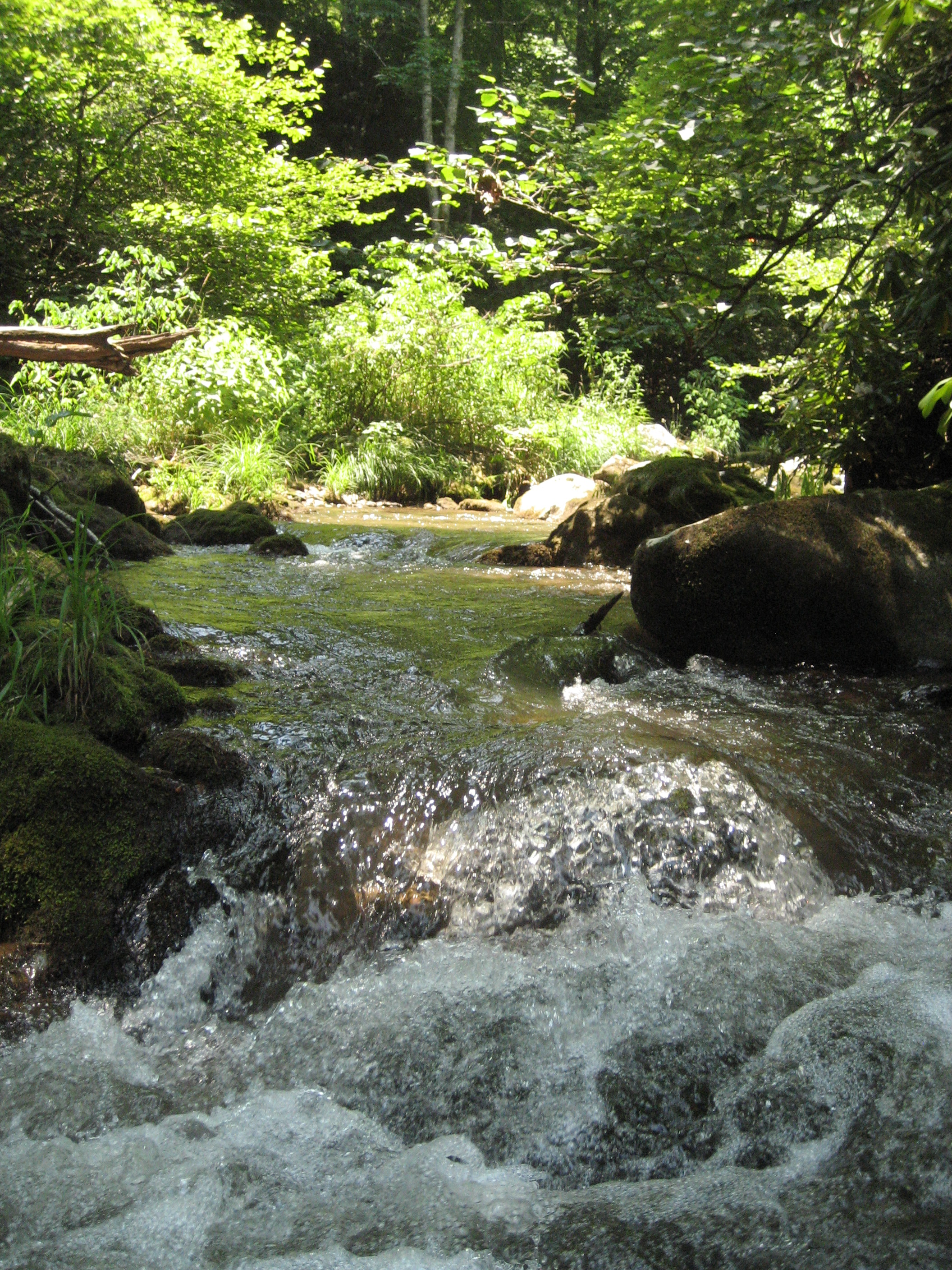
Back at the cabin, we cooled off in the creek.

© 2012 S. D. Stewart, Creek at Dave & Betty's cabin, Hot Springs, North Carolina

I walked up the middle of the creek and found damselflies consorting with each other.

© 2012 S. D. Stewart, Creek at the cabin, Hot Springs, North Carolina

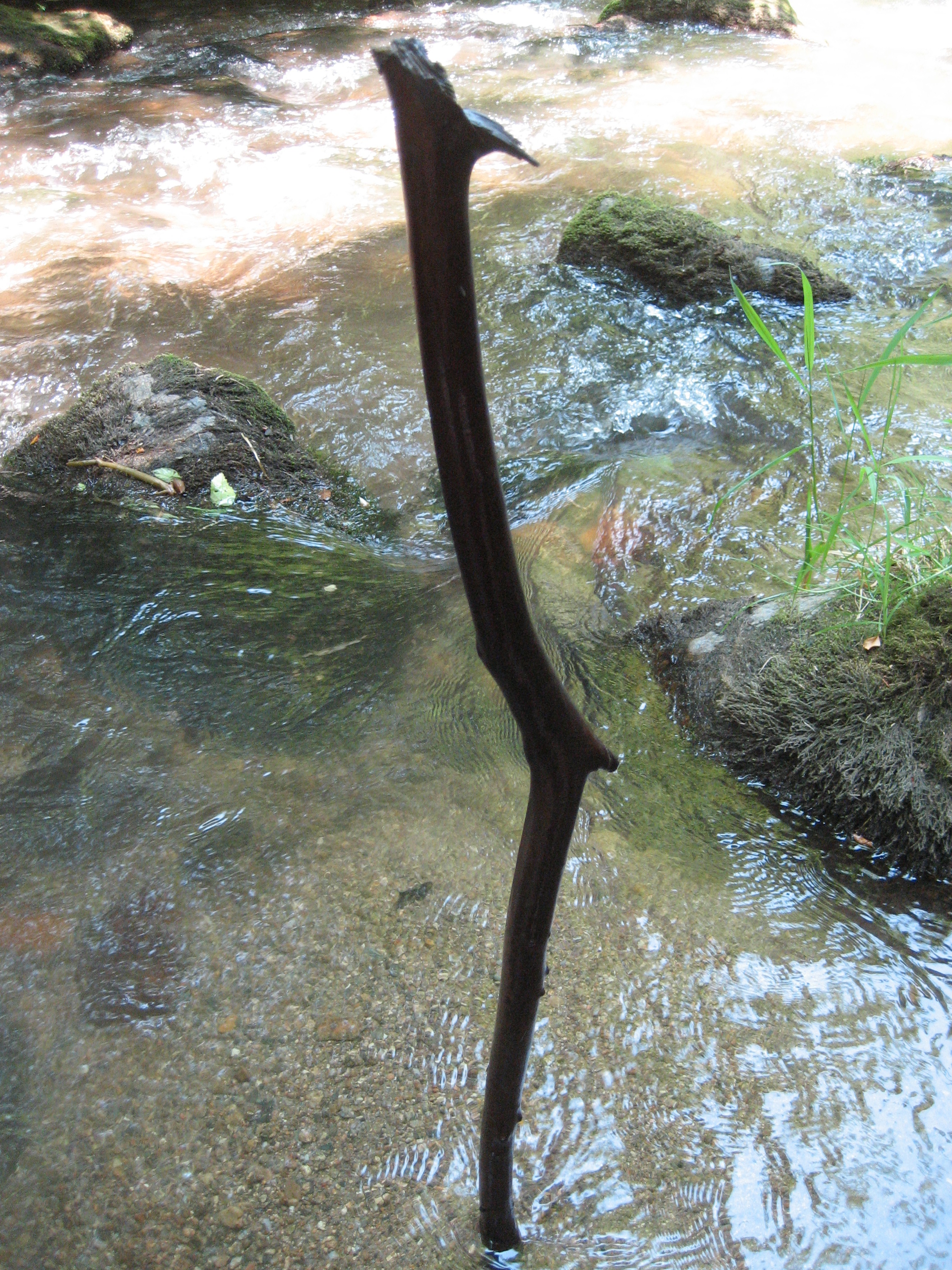
My walking stick used for navigating the creek.

© 2012 S. D. Stewart, Scene from creek at Dave & Betty's cabin, Hot Springs, North Carolina

For some reason this little sun-dappled tableau struck me. I don’t think it comes across in the photo, but it was the sort of scene into which you wish you could miniaturize yourself for the purpose of better enjoying it.

And here is where we retired for eating, sleeping (although some of us camped outside), and reading during the heat of the day.

© 2012 S. D. Stewart, Dave & Betty's cabin, Hot Springs, North Carolina

Farley exhibits signs of extreme boredom outside the cabin.

destroyers despoil, dessicate…desecrate

Destroyers come and go, leave splinters stuck in flesh. The invisible ones so hard to tweeze. Bathe in alcohol, seek where it burns. Trust rusts, cowers in your heart’s dark corners.

The well-dressed destroyer is hard to spot, but look for the smile. It’s crooked and false. Talk seeps like oil, slick to the ears, popping with heat. We drink it up, let it drip down, leaving holes in its wake.

Enter the fixer with boom and detergent. Too late to scrub. Too late to contain. Casualties cauterize the causeway. Volunteers move in with murkier motives. High tide beckons, we retreat to the hill.

Those despoiled blend in with the rest. Open their arms like mechanical dolls. Destroyers long gone, wreckage wake trailing, hidden from view but for a few.

I want to retrace the lines—help consecrate, recreate, rehydrate the husks.

I know that smile.

d = rt

Rain-washed city at night I welcome you. Empty streets and silent skies fall into step. Green grow the shadow trees. Beneath your leaves, I untether my fears, not even knowing if it’s safe. It might not matter.

Morning yawns open, its breath dry and breezy, this heat island cooled for now. Scudded clouds on blue, white shreds of a humid shroud shrugged off. Suspend seeking sustenance to gaze on bareness before you. I always see(k) it.

Distance equals rate times time plagues time travelers and distance runners. How far outside the circle I stand. Is it distance or time that matters. I can never get that straight. Distance being relative, for some meaning time. I hate math.

Twist the word wrapper at the ends of meaning like hard candy in cellophane. Suck it down to syrup, feel the rush. Spit back at the spitting sky, for its taunts fall on us with no reason. Stretch your hand out, fail to pass it through the clouds. These best things remain out of reach. What we have are objects on the ground. What we have feels arbitrary. I don’t want it.

Thoughts control, alter our actions. I sung that once. In youth we state the obvious. Of course they control; of course they alter actions. What did I know. I was a crippled distance runner. I was a failed time traveler. I was standing in the rain, spitting, waiting for the morning, candy melting on my tongue. One day dawn broke.

And now there is this. An equation to tinker with, variables to solder: a space behind me to fashion into organs of my own truth.

yellow light beckoning

These brushes with low-level fame grow dimmer as the years tear the flesh from our bones. In my mind’s eye I still see it all before me. How this was done. How it could’ve gone. Sneaking out of bed at the wrong time. Not primed in our prime. The time it takes to falter. The dreams you’ve lost to waking. Sleep-walking through daytime hours, thrashing through evening dreamtime.

These thrushes with flute-like voices grow stronger as my time on this earth strips youth off this sapling. Near-sighted I stumble but still know how it ends. How it must follow. Staying up late when it feels right. Fueled for the long haul. Steady walking to the light, the fields, the tall pines. The dreams I fall into every night. Breathing in, breathing out. Waiting for my reward.

in the pines

© 2012 S. D. Stewart, Oregon Ridge

Monday afternoon, along the creek, I found a copse of pines and entered there. It was a day of reckoning, I reckoned, facing forward, rooted in time’s peat. I crushed the needles in my hands and breathed. A white-throated sparrow flitted at my feet. It was a moment, in the pines, and I lived it.

view from the 39th step

© 2012 S. D. Stewart, Oregon Ridge

of scents and sounds: when kindling fails to ignite

In a recent post, a fellow blogger whose writing I enjoy surveyed the sometimes tenuous ability of words to capture thoughts and feelings, to provide us with the solace and understanding we as humans (and perhaps aliens) seek. As someone who has spent his entire life relying on the written word both to interact with and decode the world around me, I read the post with interest, and it set off a chain reaction of thought. Sometimes it feels like we introverts have limited tools at our disposal, but of these tools, for many of us written language is often the sharpest and most accurate. But what about when it dulls or falls short? Unable to write ourselves out of the cages we’re trapped in, what other implements exist to sever our bonds, assuage our pain, aid us in puzzling out our conception of the world and our place within it?

Humans arrive on planet earth armed with an arsenal of senses. From the point of our harsh entry into this world we explore our surroundings using our rapidly developing senses of taste, smell, touch, sight, and hearing. As adults, these senses, though apt to weaken over time, continue to serve as an interface between us and our environment. And so I’ve come to rely on them when words are not enough to dig me out of whatever rabbit hole I’ve fallen down. For brevity’s sake, in this post I will only focus on the two I’ve found to be most effective in mitigating mental or emotional collapse: scent and hearing.

The human sense of smell, while not as developed as in other species, is still a formidable system. We smell food cooking and find it makes us hungry. We know that certain scents can also stimulate memories, as Marcel Proust famously described. Scent (and its companion taste) can therefore help us revisit our past and perhaps plumb its depths for answers to our present questions.

As an example, I will deconstruct the roots of my strong nostalgic attachment to the scent of pine trees. About a decade ago, I moved to a strange and foreign land. It was like no place I’d ever lived before. I lacked the familiar and suffered as a result. One day I discovered a small grove of pine trees behind my workplace. When feeling low at my desk in the windowless bowels of the library, I’d creep out the back door and stroll down the sidewalk, breathing in the familiar pine scent. It inevitably flooded my “emotional brain,” the limbic system, with pleasurable sensations. When I probed at this reaction, I unearthed a store of early memories of summer vacations spent on the northeastern and southeastern coasts of the U.S., where the rich scent of pitch pines (northeast) and loblolly pines (southeast) hangs in the warm summer air. After this realization, I explored what it was about these times that seeded such a deep-rooted nostalgia in my brain. A number of possibilities came to me. For one, these vacations brought me close to nature, and a different kind of nature than what was available to me at home. At an early age, these trips helped form the foundation of my lifelong passion for the natural world. These vacations were idyllic, full of fun and leisure time, all experienced within a framework of the outdoors. Thus, important associations grew within me. I am also a Pisces, the water sign, and have always felt an affinity for water (though we’ve not been without our occasional disagreements over the years). Observing and listening to water soothes me. As a child I spent a lot of time near or in water. And so our family vacations at the ocean reinforced this. Now when I crush a few pine needles between my fingers, the scent rushes to my hypothalamus, triggering the resultant emotional reaction, i.e. all of the above. How does this help me? What I took from this was the knowledge of some actions I can take to improve my mood. I can travel to the beach (not always feasible, but good for longer term relief) or I can sniff some pine trees (easy enough to find and provides a quick fix). This is good information to know and I use it often.

Now let’s set scent aside and move to hearing. Hearing permits a range of constructive activities, but here I’d like to discuss it only in the context of music. In a 2001 Scientific American article, Kristin Leutwyler reports that no human culture on earth has lived without music, that music existed before agriculture, and possibly even language. Think about that for a moment. People may have been making music before they even began speaking and writing! This makes so much sense. Even though I don’t formally play music as much as I used to, I have always felt that it is the purest form of creative expression. As much as I love tinkering with words, sitting down and playing guitar or bass never fails to unspool rich threads of satisfaction inside me. While I have experienced similar transcendent moments while writing, I have to admit that they are rare and fleeting. Music feels like a more natural release; it comes from some deep unconscious stream, where it steeps in primal rhythmic tannins. There were many times in the past, playing in various bands or just casually with like-minded folks, that the music took over, and it was as if we were mere vessels, that the music was playing us, rather than us playing it. It was so much greater and larger than the sum of our collective instruments. The feelings such experiences provoked are difficult to describe. And perhaps this is because music is older than language.

Listening to music can be often nearly and sometimes equally as transcendent as playing it. I can recall certain shows, listening in the shadows as chills traveled through me, the hairs on my arms and neck standing up. Music has so much power, and it is so tied to emotion. In my head lies a map of my life with all the music I know plotted out upon it. Songs conjure people and places, melodies represent events, and in an instant I am transported somewhere else, to the epicenter of the song’s significance to me. Once there I can study its connections to my present life.

Leutwyler notes in her article that music, like scent, also travels to the limbic system, the part of our brain that is, evolutionarily speaking, one of the most ancient. It’s a part that we share with many other creatures, including whales and birds. Leutwyler cites Patricia Gray, head of the Biomusic program at the National Academy of the Sciences, who states in a paper written with colleagues, “When birds compose songs they often use the same rhythmic variations, pitch relationships, permutations and combinations of notes as human composers.” This is one likely reason why we find bird songs to be so appealing. It’s as if all of us creatures on earth, not just humans, are connected through music, making it truly more universal than words. As Dan Higgs sings in “Creation Story”:

but the music pervades
it was music that gave the shove
and resolved in music
we shall breathe

We can use music in many ways. On the simplest level it can elevate mood (or foster wallowing in it, depending on your inclination). My taste in music, like my taste in beer, changes with the seasons. In winter, it’s heavy and dark on both accounts. The transitional seasons, spring and fall, engender tunes and ales teetering on the cusp of light and dark, cool and warm. Take The Smiths, for example. While I consider them a band for all seasons, certain songs and even certain albums fit better on bleak winter days, while others suit the sweet breezes of an early June morning. And this is where it gets more technical. The mental map unfurls and soon I am poring over it, pinpointing exactly why that Ride song makes me think of my old college roommate. Or why that Pixies song wakens memories of a girl in church I burned for in that torturous way shy teenage boys have of burning.  If you want, you can plunge deeper, to the charred terrain on the map, and really begin to excavate. You may get lost, and feel real pain, but there is much to learn in that territory.

At any given moment in our lives, the health of our mental state depends so much on whether we are happy or not. Happiness can be elusive (as can its definition) and doesn’t often linger long, but discovering our individual keys to unlock this state of mind (whatever you want to call it) is crucial to our survival. We need to learn what is good for us and we need to remember it in times of crisis, be it minor or major. In my own experience, I’ve found that writing through trauma can hasten the healing process. But sometimes the words dry up, or their bandages only cover so much of the wound. At those times, I seek out the scents and sounds I know will bring relief. And if I’m really lucky, they will irrigate the mental fields enough for words to grow again.

good night, friday

As Friday winnows to a close I address the day in retrospect. This morning I set out with the sole purpose to watch birds for the first time in many weeks. I traveled to the rare and alien Southwest Area Park, aka SWAP. There I found two pairs of Northern Shovelers. I did not find an Orange-crowned Warbler, as had been previously spotted at SWAP. However, I redeemed this loss by flushing an American Woodcock, one of my all-time favorite birds. With my trusty bins clamped to my face, I followed that oddly aerodynamic buffy bullet as it shot full-speed up and over the reeds, far away from the deer track where I stood. Elation! Later, hundreds of migrating blackbirds flew overhead, filling the air with the ethereal music of their contact calls. Spring is on its way! Ah, if only every day were filled with such moments!

  • Recent Posts

  • Navigation Station

    The links along the top of the page are rudimentary attempts at trail markers. Otherwise, see below for more search and browse options.

  • In Search of Lost Time

  • Personal Taxonomy

  • Common Ground

  • Resources

  • BOOKS BOOKS BOOKS