
My noble co-pilot:


New arbor for the front yard below. Trumpet vine (Campsis radicans) is creeping up the left side, although it’s hard to see in the sunlight. The hummingbirds should be pleased this summer.

My noble co-pilot:
New arbor for the front yard below. Trumpet vine (Campsis radicans) is creeping up the left side, although it’s hard to see in the sunlight. The hummingbirds should be pleased this summer.
Posted by sean on April 24, 2012
https://sd-stewart.com/2012/04/24/visuals/
Life is full of contrast, yin and yang, often subtle, sometimes blatant. Saturday was a beautiful day, warm and sunny, while Sunday brought cold and rain. It was like living in two opposite climates in a single weekend. On Saturday we spent the day outside, hiking and visiting old friends. On Sunday we went to a soggy native plant sale and picked up a few more plants for the front yard. The cool wet weather continues today, ushering in the always jarring Monday Troll, having freshly clawed itself up the muddy embankment from its weekend under-bridge haunts. It sits on my keyboard now, all red gleaming eyes and slavering fangs.
The weekend yielded a few new first-of-year birds, including Northern Parula, Ovenbird, Louisiana Waterthrush, Yellow-throated Warbler, Black-and-white Warbler, Common Yellowthroat, and one of my all-time favorites, WOOD THRUSH! How happy was I to hear their dulcet notes while walking the arboretum trails on Friday evening.
This morning as I rode past the parole and probation office, a young man crossing the street in front of me yelled “Gimme that damn bike,” not even pausing in his stride and with no more than a cursory glance in my general direction. I am always mystified by interactions like this (a more aggressive spin on the classic “Hey, lemme borrow your bike” scheme). Did this guy expect me to immediately dismount and hand my bike over to him? He made no threatening gestures nor did he display any inclination to take my bike by force. His instruction was delivered in a manner more akin to a casual aside than a strict command, although I found his tone reflected a savagery inappropriate for such an early hour. Likely on his way to meet with his probation agent, perhaps he was not in the best of moods and needed to make some desperate attempt to assert control over his situation. I was almost tempted to stop and give him the bike just to see what he would do. I’m sure it would not have been what he was expecting. Maybe he would’ve asked me to hold it for him while he went inside and spoke with his agent. I can imagine him in the office, highly agitated, imploring his agent to hasten the meeting along: “C’mon, man, can we just finish this up? There’s a guy outside who’s gonna gimme his bike and I dunno how much longer he’s gonna wait for me.”
When you live in a crime-riddled city like this one, you need to have a sense of humor about stuff like this. Otherwise you’d stay in your house all the time with the blinds pulled shut.
Posted by sean on April 23, 2012
https://sd-stewart.com/2012/04/23/observations-and-updates/
Unfortunately, Em El and I were sick with colds during part of our time in Texas, she for longer than me. They were not debilitating colds, but they were an inconvenience (and still are, as we continue to slog along through their end times). We still soaked up plenty of family time, and I even picked up three (!) new life birds, all within the Dallas city limits. Important lesson: never underestimate the value of urban birding! At White Rock Lake, I found an American White Pelican snoozing on a log and a flock of Franklin’s Gulls gathering overhead. These birds were just passing through during migration. The next day I observed a couple of Harris’s Sparrows feeding on seed outside the fantastic Trinity River Audubon Center. This bird is a winter resident in north Texas. None of these birds are easy to find in Maryland, as they are nonresidents and only rarely vagrant in the northeast U.S. during migration.
Other than occasional birding and lots of chilling with the family, Texas involved a lot of eating. Of course we had to sample the best of what the Dallas area has in the way of vegan fare! These included the always delicious Spiral Diner; the newly spruced-up under new ownership 100% vegan Asian buffet, Veggie Garden; a new one for me, Kalachandjis (Dallas’ longest serving vegetarian restaurant, which begs the question of why they never brought me here before!); and a new one for everyone, D’Vegan (specializing in vegan Vietnamese cuisine- soooo good). We also ate plenty of Mexican food naturally, including vegan migas from a new place in Dallas.
Here are a few photos. I took less than I thought. I blame the sickness. Or maybe I was just trying to live these moments, not document them.
The first few are from Trinity River Audubon Center. The wildflowers are Texas Paintbrush (Castilleja indivisa).


Sign on the wall at Veggie Garden Restaurant in Richardson, TX:

Maneki Neko (“Beckoning Cat”) statue at D’Vegan Restaurant in Dallas, TX:

Posted by sean on April 13, 2012
https://sd-stewart.com/2012/04/13/texas-trip/
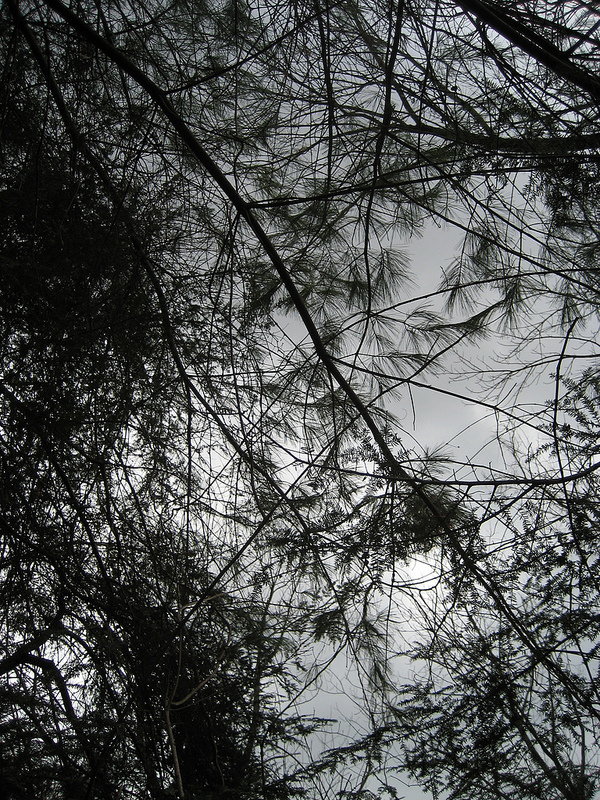
Monday afternoon, along the creek, I found a copse of pines and entered there. It was a day of reckoning, I reckoned, facing forward, rooted in time’s peat. I crushed the needles in my hands and breathed. A white-throated sparrow flitted at my feet. It was a moment, in the pines, and I lived it.
Posted by sean on March 22, 2012
https://sd-stewart.com/2012/03/22/in-the-pines/
In a recent post, a fellow blogger whose writing I enjoy surveyed the sometimes tenuous ability of words to capture thoughts and feelings, to provide us with the solace and understanding we as humans (and perhaps aliens) seek. As someone who has spent his entire life relying on the written word both to interact with and decode the world around me, I read the post with interest, and it set off a chain reaction of thought. Sometimes it feels like we introverts have limited tools at our disposal, but of these tools, for many of us written language is often the sharpest and most accurate. But what about when it dulls or falls short? Unable to write ourselves out of the cages we’re trapped in, what other implements exist to sever our bonds, assuage our pain, aid us in puzzling out our conception of the world and our place within it?
Humans arrive on planet earth armed with an arsenal of senses. From the point of our harsh entry into this world we explore our surroundings using our rapidly developing senses of taste, smell, touch, sight, and hearing. As adults, these senses, though apt to weaken over time, continue to serve as an interface between us and our environment. And so I’ve come to rely on them when words are not enough to dig me out of whatever rabbit hole I’ve fallen down. For brevity’s sake, in this post I will only focus on the two I’ve found to be most effective in mitigating mental or emotional collapse: scent and hearing.
The human sense of smell, while not as developed as in other species, is still a formidable system. We smell food cooking and find it makes us hungry. We know that certain scents can also stimulate memories, as Marcel Proust famously described. Scent (and its companion taste) can therefore help us revisit our past and perhaps plumb its depths for answers to our present questions.
As an example, I will deconstruct the roots of my strong nostalgic attachment to the scent of pine trees. About a decade ago, I moved to a strange and foreign land. It was like no place I’d ever lived before. I lacked the familiar and suffered as a result. One day I discovered a small grove of pine trees behind my workplace. When feeling low at my desk in the windowless bowels of the library, I’d creep out the back door and stroll down the sidewalk, breathing in the familiar pine scent. It inevitably flooded my “emotional brain,” the limbic system, with pleasurable sensations. When I probed at this reaction, I unearthed a store of early memories of summer vacations spent on the northeastern and southeastern coasts of the U.S., where the rich scent of pitch pines (northeast) and loblolly pines (southeast) hangs in the warm summer air. After this realization, I explored what it was about these times that seeded such a deep-rooted nostalgia in my brain. A number of possibilities came to me. For one, these vacations brought me close to nature, and a different kind of nature than what was available to me at home. At an early age, these trips helped form the foundation of my lifelong passion for the natural world. These vacations were idyllic, full of fun and leisure time, all experienced within a framework of the outdoors. Thus, important associations grew within me. I am also a Pisces, the water sign, and have always felt an affinity for water (though we’ve not been without our occasional disagreements over the years). Observing and listening to water soothes me. As a child I spent a lot of time near or in water. And so our family vacations at the ocean reinforced this. Now when I crush a few pine needles between my fingers, the scent rushes to my hypothalamus, triggering the resultant emotional reaction, i.e. all of the above. How does this help me? What I took from this was the knowledge of some actions I can take to improve my mood. I can travel to the beach (not always feasible, but good for longer term relief) or I can sniff some pine trees (easy enough to find and provides a quick fix). This is good information to know and I use it often.
Now let’s set scent aside and move to hearing. Hearing permits a range of constructive activities, but here I’d like to discuss it only in the context of music. In a 2001 Scientific American article, Kristin Leutwyler reports that no human culture on earth has lived without music, that music existed before agriculture, and possibly even language. Think about that for a moment. People may have been making music before they even began speaking and writing! This makes so much sense. Even though I don’t formally play music as much as I used to, I have always felt that it is the purest form of creative expression. As much as I love tinkering with words, sitting down and playing guitar or bass never fails to unspool rich threads of satisfaction inside me. While I have experienced similar transcendent moments while writing, I have to admit that they are rare and fleeting. Music feels like a more natural release; it comes from some deep unconscious stream, where it steeps in primal rhythmic tannins. There were many times in the past, playing in various bands or just casually with like-minded folks, that the music took over, and it was as if we were mere vessels, that the music was playing us, rather than us playing it. It was so much greater and larger than the sum of our collective instruments. The feelings such experiences provoked are difficult to describe. And perhaps this is because music is older than language.
Listening to music can be often nearly and sometimes equally as transcendent as playing it. I can recall certain shows, listening in the shadows as chills traveled through me, the hairs on my arms and neck standing up. Music has so much power, and it is so tied to emotion. In my head lies a map of my life with all the music I know plotted out upon it. Songs conjure people and places, melodies represent events, and in an instant I am transported somewhere else, to the epicenter of the song’s significance to me. Once there I can study its connections to my present life.
Leutwyler notes in her article that music, like scent, also travels to the limbic system, the part of our brain that is, evolutionarily speaking, one of the most ancient. It’s a part that we share with many other creatures, including whales and birds. Leutwyler cites Patricia Gray, head of the Biomusic program at the National Academy of the Sciences, who states in a paper written with colleagues, “When birds compose songs they often use the same rhythmic variations, pitch relationships, permutations and combinations of notes as human composers.” This is one likely reason why we find bird songs to be so appealing. It’s as if all of us creatures on earth, not just humans, are connected through music, making it truly more universal than words. As Dan Higgs sings in “Creation Story”:
but the music pervades
it was music that gave the shove
and resolved in music
we shall breathe
We can use music in many ways. On the simplest level it can elevate mood (or foster wallowing in it, depending on your inclination). My taste in music, like my taste in beer, changes with the seasons. In winter, it’s heavy and dark on both accounts. The transitional seasons, spring and fall, engender tunes and ales teetering on the cusp of light and dark, cool and warm. Take The Smiths, for example. While I consider them a band for all seasons, certain songs and even certain albums fit better on bleak winter days, while others suit the sweet breezes of an early June morning. And this is where it gets more technical. The mental map unfurls and soon I am poring over it, pinpointing exactly why that Ride song makes me think of my old college roommate. Or why that Pixies song wakens memories of a girl in church I burned for in that torturous way shy teenage boys have of burning. If you want, you can plunge deeper, to the charred terrain on the map, and really begin to excavate. You may get lost, and feel real pain, but there is much to learn in that territory.
At any given moment in our lives, the health of our mental state depends so much on whether we are happy or not. Happiness can be elusive (as can its definition) and doesn’t often linger long, but discovering our individual keys to unlock this state of mind (whatever you want to call it) is crucial to our survival. We need to learn what is good for us and we need to remember it in times of crisis, be it minor or major. In my own experience, I’ve found that writing through trauma can hasten the healing process. But sometimes the words dry up, or their bandages only cover so much of the wound. At those times, I seek out the scents and sounds I know will bring relief. And if I’m really lucky, they will irrigate the mental fields enough for words to grow again.
Posted by sean on March 7, 2012
https://sd-stewart.com/2012/03/07/of-scents-and-sounds-when-kindling-fails-to-ignite/
Woke with a heavy heart and the universe responded. Two morning omens visited to provide a lift:
1. Downy Woodpecker on the deck.
2. Ben on his bike.
That is all.
Posted by sean on February 29, 2012
https://sd-stewart.com/2012/02/29/good-omens-for-a-rainy-day/
As Friday winnows to a close I address the day in retrospect. This morning I set out with the sole purpose to watch birds for the first time in many weeks. I traveled to the rare and alien Southwest Area Park, aka SWAP. There I found two pairs of Northern Shovelers. I did not find an Orange-crowned Warbler, as had been previously spotted at SWAP. However, I redeemed this loss by flushing an American Woodcock, one of my all-time favorite birds. With my trusty bins clamped to my face, I followed that oddly aerodynamic buffy bullet as it shot full-speed up and over the reeds, far away from the deer track where I stood. Elation! Later, hundreds of migrating blackbirds flew overhead, filling the air with the ethereal music of their contact calls. Spring is on its way! Ah, if only every day were filled with such moments!
Posted by sean on February 25, 2012
https://sd-stewart.com/2012/02/25/good-night-friday/
*nod to Samhain
The daffodils are rising as the robins trickle back into the city. Last week I heard a male cardinal testing out his pipes, gearing up for courtship rites. And today, as I rolled my bike out the basement door, a Song Sparrow belted out his bright song from an undisclosed location secreted within the old cottonwood tree.
These signs of spring feel unwarranted. We have not endured enough of winter’s harshness to deserve such rich pleasures so soon. It makes me want to move farther north, where the extreme cold and steady snow sweeten the coming warmth of spring’s new life.
As the temperature wavers, still my mind wanders, far from here, never where it’s paid to be. This dreamer role, this aqueous nature, it is equal parts curse and blessing. It becomes harder every day to reel myself back in to accomplish the tasks at hand. Perhaps one day I will unravel all the way, cut loose to float wherever the wind will take me. But for now routines strangle me, each of them a single lead weight in my pocket, rooting me to this unfamiliar patch of land I struggle to call home.
Posted by sean on February 7, 2012
https://sd-stewart.com/2012/02/07/february-coming-spring/
A chickadee calls
outside my window
from the bare winter branches
of the crape myrtle.
Inside, your poems speak
to what already
I suspect.
Words sown through a lifetime,
telling us not to leave,
once what is needed
has been found.
The answers in each poem:
the wind, the seasons,
a hard and simple life.
Posted by sean on February 6, 2012
https://sd-stewart.com/2012/02/06/to-john-haines/
As if I needed another reason to hate Wal-Mart.
Posted by sean on December 19, 2011
https://sd-stewart.com/2011/12/19/this-is-how-we-fail/

 s. d. stewart