
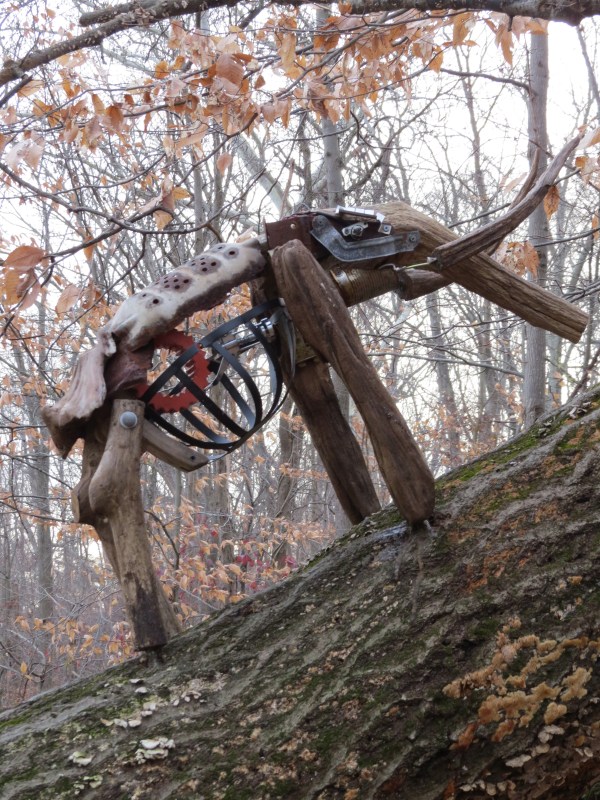
They’re making a comeback.
They’re making a comeback.
Posted by sean on December 7, 2015
https://sd-stewart.com/2015/12/07/baby-mastodon/

No one was home.
Posted by sean on December 6, 2015
https://sd-stewart.com/2015/12/06/fairy-house/
Recent intelligence gathering indicated the presence of a group of likely overwintering red-headed woodpeckers, including two adults, at another park in the area so I went to investigate. Again I found them immediately, as they were actively foraging and calling frequently. Their ‘rattle’ call is quite distinctive and often precedes a visual ID. Lighting was more favorable today, so here are a few photos accompanying a report on my findings.

Adult Red-headed Woodpecker strikes the classic woodpecker pose at Black Marsh, North Point State Park.

Adult Red-headed Woodpecker at Black Marsh, North Point State Park.
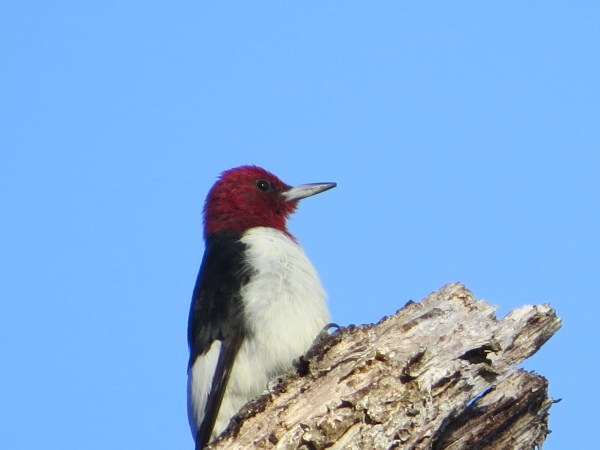
Adult Red-headed Woodpecker at Black Marsh, North Point State Park.

An immature Red-headed Woodpecker glares at the photographer, North Point State Park.
After spending way too much time attempting to photograph the woodpeckers I continued on from the Black Marsh Wildlands into the rest of the park. First I took the Powerhouse Trail.

Powerhouse Trail at North Point State Park.
Rising up out of the woods before me came the trail’s namesake…

Powerhouse at North Point State Park.

Powerhouse at North Point State Park.
The property that is now North Point State Park was formerly a local attraction known as the Bay Shore Amusement Park during the first half of the 20th Century, and there was streetcar service extending to the park from the city (extremely hard to imagine today in this rabidly car-centric region). This concrete monolith provided power to the streetcars. Now it serves as an informal art gallery for graffiti artists:
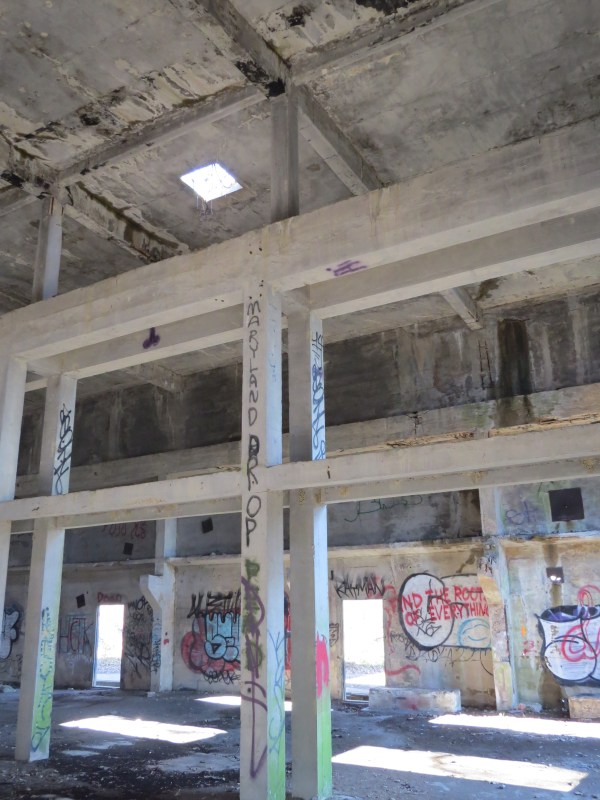
Inside the powerhouse at North Point State Park: ‘Find the roots of everything.’
After leaving the powerhouse I took a spur trail to gaze upon the Chesapeake Bay.

Chesapeake Bay from overlook at North Point State Park.
Friendly people had left sand art on the beach.

Friendly people were here…
After scanning the Bay for waterfowl and only finding a few bufflehead and a single double-crested cormorant, I left the park and drove farther down the peninsula to where it dead ends at Fort Howard, the former coastal artillery headquarters for Baltimore. Fort Howard has a rich military history, which I will not go into here but you can certainly read about it to your heart’s content elsewhere on the internet. The park is rather bedraggled and largely unused, likely due to its remote location. But there are some nice spots. Of course I only photographed the horrible ones because that’s just how I am.

The Brandon Shores Generating Station, viewed from Fort Howard. A 2011 NRDC report based on EPA data described it as releasing the second highest amount of toxic air pollutants annually in the U.S.
Despite the glaring lack of visitors, there are more picnic tables and trash cans at Fort Howard than I’ve seen at any other park. I was curious about the trailer in the photo below but simultaneously afraid so I chose not to get any closer. I thought if I called the number someone might be willing to divulge the contents but then this person would have my phone number. So I didn’t call. I find that life is an ongoing process of weighing the pros and cons of situations like this.
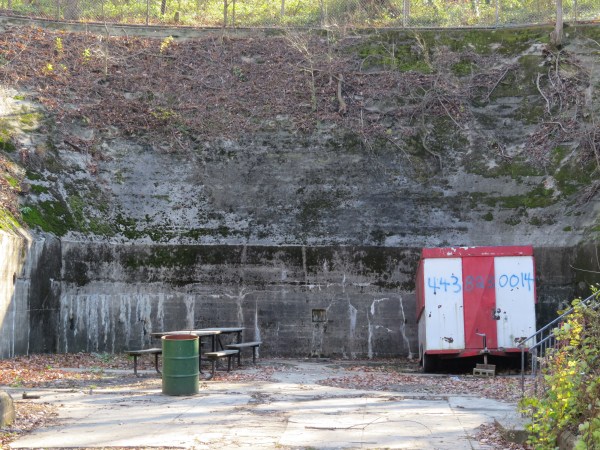
Scenic picnic area where I chose not to consume my lunch. (Note: if you call the number please leave a comment below.)
After passing the scenic picnic area I came upon this:

Menacing…
Again, I wasn’t sure what to do here. Were they keeping women locked inside or barring them from entry. I couldn’t tell, but I didn’t hear any cries for help and without bolt cutters there was not much I could have done. So I left. No doubt this decision will haunt me for quite some time…
Posted by sean on December 5, 2015
https://sd-stewart.com/2015/12/05/field-report-woodpecker-redux/

Illustration remix by Anna Vignet from Alice’s Adventures in Wonderland, an online annotated edition featuring twelve Lewis Carroll scholars taking one chapter each, plus new artwork and remixes from classic 1865 and 1905 illustrations. A joint project from The Public Domain Review and Medium, on the occasion of the story’s 150th anniversary.
Posted by sean on September 2, 2015
https://sd-stewart.com/2015/09/02/150-years-of-alices-adventures/
 Some books demand to be read based on their covers alone. Such is the case with The Calm Ocean by Gerhard Roth, which I was surprised to find sans ugly hardcover binding on the university library’s shelves. The bright red background initially draws the eye, which may then focus on the fox, specifically the head, also depicted in primary color. Illuminated by the rising sun (or moon) behind it, the highly stylized fox is looking back across the face of the book, into the unknown. The eye might now wander up to the title of the novel, which seems to contradict the rural scene represented on the cover. One begins to wonder about this contrast, and whether the fox is significant in any way, as well as what the title says about the book.
The Austrian writer Roth is a relatively new discovery for me, thanks to a recommendation last year from a friend over at Goodreads. Roth’s early work falls into the broad soup of ‘experimental’ fiction, lacking the more traditional trappings found in realist fiction. But he grew closer to realism over the years, though I find his take on it to be palatable. It’s as if he took the experimental skeleton he crafted as a younger writer and hung some strange costumes on those angular bones. Murky and sometimes even hallucinatory, Roth’s post-experimental fiction is not to be overlooked simply because it began to dress in new and bizarre realist outfits. Of course I say this while now reading only my second of these later works (the first Roth book I read, The Will to Sickness, was much more experimental; the second one, The Lake is a later work). But I have a feeling (partly based on other descriptions/reviews I’ve read), that I am right about Roth in this regard.
In his writing, Roth is concerned with sifting through the social and political culture of his home country of Austria, both past and present. Most of his books resemble mystery novels, at least superficially. They are not traditional mysteries at all, though, and readers who simply must find out all the details of what happened should probably stay away. At this point in my reading of the book, The Calm Ocean already recalls the The Lake in that it also concerns a man away from home, in an unfamiliar provincial place, feeling disoriented and alienated. Since my reading thrives on characters like this, I was drawn in immediately. I’m still early on, but I already know that it will live up to the promise of the cover.
Roth has completed two ambitious cycles of works, each of which consists of novels, essays, and documentary volumes: Die Archive des Schweigens (The Archives of Silence) and Orkus (Hades), the former consisting of seven works, and the latter of eight. Unfortunately, many of these works are still unavailable in English, though Ariadne Press has been doing an admirable job in bringing some of them into English translation, with their focus centered on ‘Studies in Austrian Literature, Culture & Thought’. Hopefully these current offerings from Ariadne, as well as Atlas Press and Burning Deck (each of which has published one of Roth’s earlier books in English), will grow in popularity among English readers and thus attract more translation efforts in the future. Roth certainly ranks with Thomas Bernhard as a contemporary Austrian writer very much worth reading (Elfriede Jelinek and Peter Handke being two others on my list of to-reads).
Posted by sean on June 17, 2014
https://sd-stewart.com/2014/06/17/allure-of-the-cover/
(via public domain review)

Posted by sean on January 23, 2014
https://sd-stewart.com/2014/01/23/thank-you-wellcome-library/

Click image to see more ‘monsters’.
Found lurking in my RSS reader, courtesy of the always fantastic Public Domain Review.
Full-text of De Monstris available at Internet Archive.
Posted by sean on November 20, 2013
https://sd-stewart.com/2013/11/20/fortunio-licetis-de-monstris-1665/

 s. d. stewart