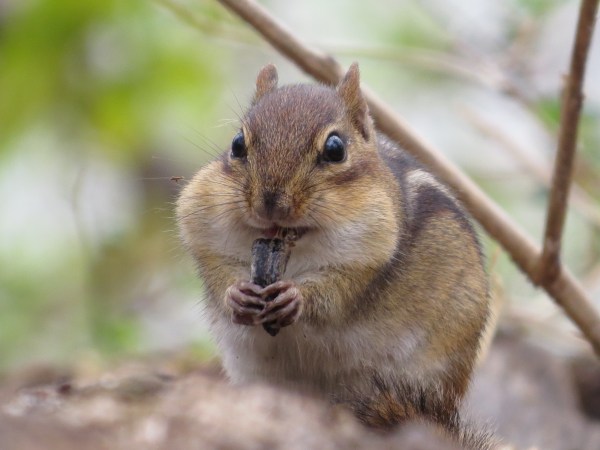
Eastern Chipmunk
Eastern Chipmunk
Posted by sean on April 1, 2016
https://sd-stewart.com/2016/04/01/eastern-chipmunk/
I never knew if the prairie dogs could leave. They lived in a town inside a park inside a town. There was a fence around their town. It was not a high fence but prairie dogs are not tall. They do burrow, though. That’s one thing they’re known for—building tunnels. So the question for me remained: why didn’t the prairie dogs leave? How far underground did that fence go? Had any of them tried to burrow out, only to encounter the fence? To the untrained eye (mine) they looked content. But I didn’t trust my untrained eye. There were young ones and old ones, so clearly they were procreating. But was there a carrying capacity to this confined town within a park within a town? If no prairie dogs left, would the population not eventually reach this capacity, leading to a crash or other dire consequences? Did the Parks & Recreation Department even have a strategic plan?
Meanwhile, in a nearby state there was another prairie dog town inside a park inside a town. But these prairie dogs were free-range, and their town spread out across acres of parkland. It was a decentralized town, difficult at first glance to even conclude that it existed. The prairie dogs themselves were also less obvious to the naked eye, though apparently no less active according to one news source that named them as likely suspects in an electrical cord chewing scheme plaguing this year’s Christmas display. In fairness to the prairie dogs, though, human vandals were accused of playing an even more significant part in this tragedy. The implication in the article was that the humans knew better.
The other town, the one in my town, was quite elaborate, much more concentrated, presumably as a consequence of the prairie dogs’ confinement. They built up instead of out. It was an odd thing, really, with the fence around it being only a few feet high. The lower part of the fence was made of chain link so the prairie dogs could look out and visualize their freedom. I wonder how the jailers knew what height to build the fence. If three prairie dogs stood on each others’ shoulders the top one could easily leap over.
This Just In: Cursory online searching yielded an article from earlier this year that says some of the prairie dogs have begun to escape from the confined town! The Parks & Recreation director said the fencing is original and is believed to extend to a depth of five feet. But the fence is deteriorating and the city doesn’t have the money to replace it. Note: due to the horrid quality of this article I refuse to link to it. In fact, if anything, my recent superficial review of online regional news outlets from this part of the United States has made me thankful for having put such a great distance between it and me. Apparently, in that part of the country one doesn’t need to be literate to find work as a journalist.
What I wonder is how one town in a region decides to confine their park-dwelling prairie dogs while another town does not. To me this indicates a fundamental difference in world view, and yet having visited both places (and lived in one of them), I would never have guessed that the authorities would be at such polar opposites when it comes to dealing with potentially destructive ‘critters,’ as one diligent reporter so endearingly referred to them. In the free-range town, the Parks & Recreation representative displayed a surprisingly blasé, perhaps even a live and let live, attitude toward the prairie dogs. In the other town, however, the parks director made it clear that the animals were there for public display and the popularity of this display would drive the town to secure funds necessary to fix the fence. This, in my opinion, would be the expected point-of-view in that region, a place where most people consider animals to be: (a) something to eat; (b) something to shoot; and/or (c) something to be confined for the amusement of humans. However, I was apparently not thorough enough in my highly amateur and flagrantly qualitative anthropological research. Although I regret the oversight, I still expect this shoddily constructed case study to ensure my continued membership in the esteemed Society for Purveyors of the Unscientific Method.
Posted by sean on December 12, 2012
https://sd-stewart.com/2012/12/12/prairie-dog-towns-a-case-study/

Posted by sean on July 7, 2012
https://sd-stewart.com/2012/07/07/intentionally-blank/
I had to slam on the brakes to avoid hitting a rabbit tonight. I’m so sick of automobiles. Death traps they are. I’m not well-suited to them.
Today I read through sections of my dream journal for the first time in perhaps forever. Here’s an entry from May 2010:
“I could understand what squirrels were saying. Apparently they have jobs like us and were discussing a colleague. It was actually quite boring.”
My process for dream journaling involves retrieving the notebook from my bedside table as soon as I awake. I try to approximate automatic writing as near as possible. The result is extraordinary; when I look back at entries I often have no recollection of writing them. Frequently there are editorial comments on the dream that I’ve entered during the recording process. A lot of these are simply question marks indicating my confusion about the presence of a particular person, theme, or action in a dream.
I often have horrific dreams, many of them set in post-apocalyptic settings (usually due to some form of environmental collapse). In an entry from April 2010 I complained about not remembering my dreams lately. The next morning yielded this entry:
“Well, I got what I asked for. Gruesome dream during part of which I was standing at the bottom of this chute. People at the top were throwing down these plastic bags, some of which contained blood and other fluid, and others that contained chopped up body parts. Sometimes the bags would break open. Disgusting.”
Dreams such as these leave me shaken. But dreams also bring welcome visitors from my past, such as my dearly departed cats. Waking from these dreams leaves me warm inside.
Lately many of my dreams have been set in my hometown, a place I haven’t seen in almost 20 years. It’s made me curious to visit.
A common thread in my dream journal is the periodic desperate comment that I haven’t been remembering my dreams. Dream-life is so important to me, and when I lose that connection to it waking life appears dimmer than usual. I also feel that dream-life and waking life interact. Sometimes the two are so bizarrely different, but as I keep track I see a seamless passing of themes, of characters, of settings between the two worlds. There is a path between them that I know is worth traversing.
Posted by sean on June 10, 2012
https://sd-stewart.com/2012/06/10/our-small-furry-friends-in-dreams-and-waking-life/
As I stare out the window, fluffy puffs of snow drift purposefully down from the sky. They signal a lazy day, or at least they provide rationalization for such. As the first of the season, they also hammer the final nail in the coffin lid of autumn, and prod me into a grudging admittance that winter is definitely here now. Yesterday morning, I searched in vain again for the Red-headed Woodpeckers at Irvine. It was cold, gray, and quite birdy, with loads of other woodpeckers, sparrows (including several Fox Sparrows), many jays, and the other usual suspects. I also surprised an interesting looking squirrel. It was smaller than an Eastern Gray Squirrel, with a reddish tail and mostly blonde body. Blonde phases of gray squirrels are not uncommon, but I’m not too sure about a red/blonde mix.
Feeling a bit restless now so I think I better venture out of the house. Maybe more later?
Posted by sean on December 5, 2009
https://sd-stewart.com/2009/12/05/snowy-day/